Four factors of production make all output
Definition
Land: all the natural resources used in production, such as farmland, forests, minerals, rivers and the sea.
Labour: the physical and mental human effort people put into producing goods and services.
Capital: the man-made goods used to produce other goods and services, such as machinery, tools, vehicles and buildings.
Enterprise: the willingness of an entrepreneur to take risks and organise the other three factors into production.
- The factors of production are the scarce inputs a producer uses, and every business uses all four at once.
- Nobody produced land, and its supply is close to fixed, which is why a shop unit on a busy high street costs far more than one in a small market town.
- What a producer gets from labour depends on the education, training and experience of its workers, not only on the hours they work.
- A producer builds up its capital by investing, giving up output today to buy equipment that raises output in later years.
- The entrepreneur who supplies enterprise carries the risk, because a business can fail and leave its owner with nothing.
Example
- In 2021 Mondelez put £15 million into a new Cadbury Dairy Milk production line at the Bournville factory in Birmingham.
- The Bournville site itself is land.
- The workers who run and maintain the line are labour.
- The new line, the mixing equipment and the factory buildings are capital.
- The decision to risk £15 million on the new line, not knowing whether the extra chocolate will sell, is enterprise.
Each factor earns its own kind of income
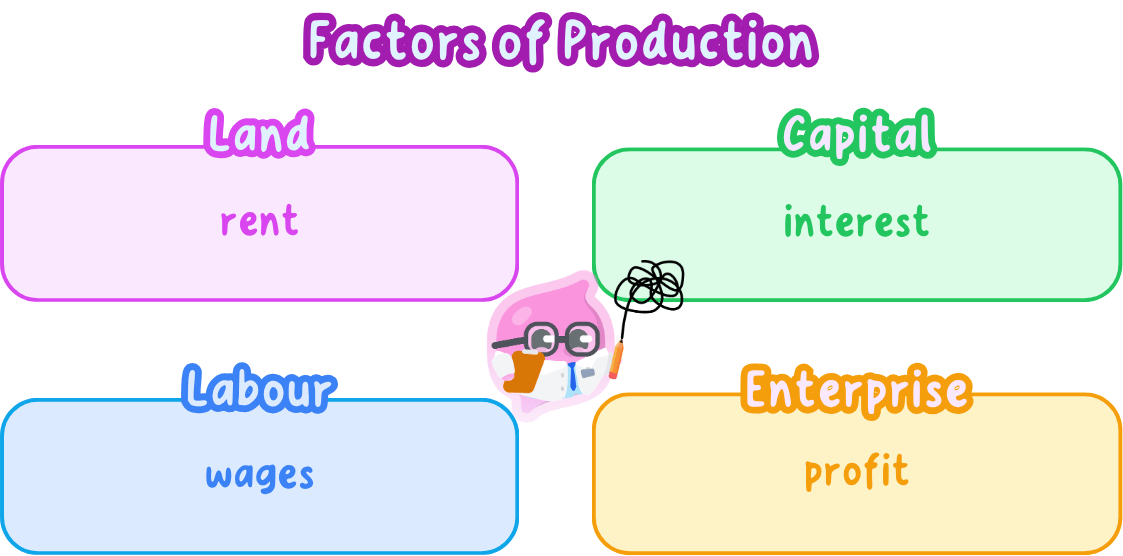
- Land earns rent, labour earns wages, capital earns interest and enterprise earns profit.
- Profit is the only one of the four not agreed in advance, which is exactly why it is the reward for taking the risk.
Common Mistake
- Capital means machinery, equipment, vehicles and buildings, never money.
- The £30,000 a bakery borrows is finance, and only the oven it buys is capital.
- Money by itself produces nothing, so it is a medium of exchange rather than a factor of production.
The same output can be made from different mixes
- Producers do not use the four factors in fixed proportions, because most goods can be made in more than one way.
- Labour-intensive production uses proportionally more labour than capital, such as a small chocolatier tempering and wrapping every bar by hand.
- Capital-intensive production uses proportionally more capital than labour, such as the automated Bournville line that moulds and wraps thousands of bars an hour.
- Both methods make chocolate, so the producer chooses between them rather than being forced into one.
Example
- A farm can harvest a field in two ways.
- It can hire a large team of pickers, which is labour-intensive.
- It can buy a harvester and run it with one driver, which is capital-intensive.
- The same field and the same crop, the land, still produce the harvest either way.
Producers choose the mix that suits their costs
- A producer picks the mix by comparing what each factor costs against what it adds to output.
- When wages rise, capital becomes relatively cheaper, so producers tend to substitute machinery for workers.
- No amount of one factor makes up for having none of another, because output stops if any one of the four is missing.
Whether adding more of a factor keeps raising output efficiently is taken further in 2.6.2.
Self review
- Name the four factors of production.
- Is the money a producer borrows to buy a machine capital?
- Which factor earns profit, and why is that income not agreed in advance?
- What is the difference between labour-intensive and capital-intensive production?
- Why might a rise in wages change the mix of factors a producer uses?
