Three sectors split production into stages
Definition
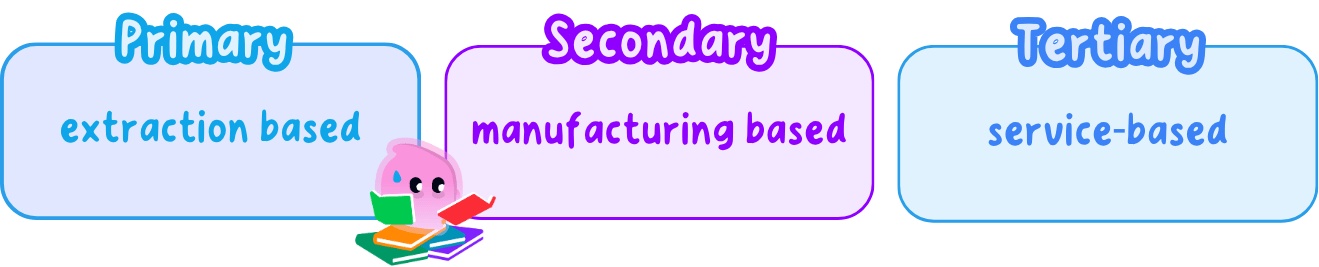
Primary sector: the stage of production that extracts raw materials from nature, such as farming, fishing, forestry, mining, and oil and gas drilling.
Secondary sector: the stage that processes, manufactures or constructs those raw materials into finished goods, such as steel making, car assembly and housebuilding.
Tertiary sector: the stage that provides services rather than physical goods, such as retailing, healthcare, banking, transport and education.
- Primary output depends heavily on nature: weather, geology and fish stocks limit how much can be produced in a given year, whatever a firm would like to sell.
- Named UK primary work includes oil and gas extraction off Aberdeen, arable farming in East Anglia and the Scottish fishing fleet.
- Secondary output adds value by changing the material: a secondary firm buys what the primary sector produced and turns it into something people will pay more for.
- Named UK secondary work includes the Nissan car plant in Sunderland, JCB digger production in Staffordshire and housebuilding across the country.
- Tertiary output is an action rather than an object: nothing physical changes hands, and the work cannot be made in advance and stored on a shelf.
- Named UK tertiary employers include the NHS, Tesco, Barclays and the train operating companies.
Example
- A rig in the North Sea extracts crude oil from beneath the seabed, which is primary work.
- A refinery such as Fawley near Southampton turns that crude oil into petrol, diesel and plastics, which is secondary work.
- A tanker driver delivers the fuel and a petrol station sells it to drivers, which is tertiary work.
- One product has therefore passed through all three sectors before anyone fills a tank.
The sectors form one chain of production
- The three sectors are stages in a single chain rather than separate economies, because each stage buys from the stage before it.
- A rise in demand at the tertiary end pulls output through the whole chain, since more petrol sold means more crude refined and more crude extracted.
- A break at the primary end runs the other way, because a poor harvest leaves food manufacturers short and shop shelves emptier.
- One firm can work in more than one sector, since Greggs bakes its own products, which is secondary work, and sells them over the counter, which is tertiary work.
Goods are tangible and services are not
Definition
Good: a tangible, physical item that can be touched, owned and stored, such as a loaf of bread or a pair of trainers.
Service: an intangible action carried out for a customer, such as a haircut or a bus journey, which cannot be touched, owned or stored.
- A service also cannot be passed on, because a bus journey you have already taken cannot be sold to someone else.
- The test is whether the output is physical, not what it costs or how much it matters, so a pencil and a new car are both goods while a car wash and a heart operation are both services.
- Many purchases bundle the two, since a new car comes with the servicing and warranty work that follow, and a phone contract bundles a handset with network access.
Common Mistake
- Do not classify by price or by importance, because the only test is whether what the customer receives is a physical item.
- Do not assume anything free at the point of use is a service, since an NHS prescription medicine is a physical item you take away and own.
- Do not label a whole firm as a service provider, because a car dealership sells cars, which are goods, and repairs them, which is a service.
Services dominate UK output and employment
- The tertiary sector is by far the largest of the three, producing 80% of UK gross value added in 2023 and accounting for 84.8% of UK jobs in March 2024 (Source: House of Commons Library).
- The secondary sector is much smaller: manufacturing produced 9.1% of UK output in 2023, with construction adding roughly another 6%.
- The primary sector is the smallest of all: farming, fishing, forestry and mining together account for only a few pounds in every hundred of UK output.
- The balance has shifted over decades, because services grew from about 70% of UK output in 1990 to 80% in 2023 while manufacturing fell from about 17% to 9% over the same period.
Exam technique
- Classify the activity described in the question rather than the whole firm, because a large company usually operates in more than one sector at once.
- Keep a sector of production separate from the public and private sectors, which is about who owns a firm rather than which stage it works at.
Self review
- What does the primary sector produce, and give one UK example.
- Why can a service not be stored?
- Which sector does a refinery belong to, and why?
- Roughly what share of UK output came from services in 2023?
- Why can one firm belong to more than one sector?
