Factor and product markets trade different things
Definition
Factor market: a market in which the factors of production, land, labour, capital and enterprise, are bought and sold.
Product market: a market in which the finished goods and services made using those factors are bought and sold.
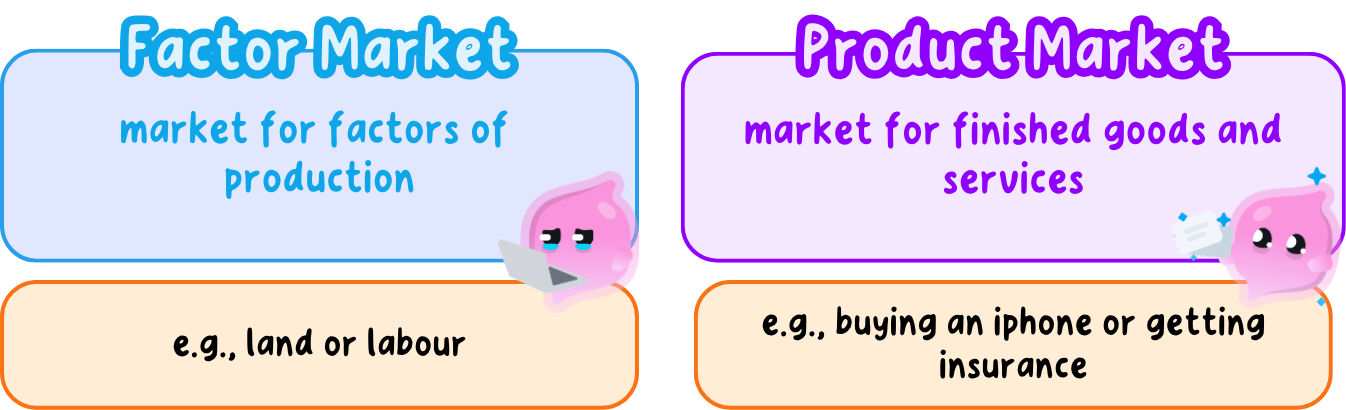
- The two are told apart by what is being traded, not by which firm happens to be involved.
- In a factor market the price of the resource has its own name, so the price of labour is the wage and the price of land or premises is the rent.
- In a product market the price is simply the price of the finished good or service, such as what a customer pays for a coffee.
- Firms are buyers in factor markets, because a firm cannot produce anything until it has hired the land, labour, capital and enterprise it needs.
- Households are sellers in factor markets, since a worker sells time and effort and a landlord sells the use of a building.
Common Mistake
- Do not classify a market by the firm in it, because the same firm buys in factor markets and sells in product markets on the same day.
- Do not treat a wage as the price of a good, since a wage is the price paid for labour and so belongs in a factor market.
Firms and households swap sides between markets
- A firm is a buyer in the factor market and a seller in the product market, so it appears on opposite sides of the two.
- Money therefore travels in a loop, because the wages firms pay out in the factor market come back to them as spending in the product market.
- The loop closes quickly in practice, since a worker paid on Friday can be a paying customer on Saturday.
Case study
- Greggs traded from 2,773 shops as at 27 June 2026, and every one of them sits at both ends of this loop (Source: Greggs).
- In the factor market Greggs hires bakers and shop assistants, rents its high street units and buys ovens and delivery vans.
- In the product market it sells sausage rolls, bakes and coffee to customers over the counter.
- The wages it pays in the first market become part of the spending that turns up in the second.
- A Greggs baker paid on Friday can be buying a coffee on Saturday, so one person is on both sides within a day.
A change in one market moves the other
- Demand in a factor market comes from demand in the product market, because a firm hires resources only in order to produce something it can sell.
- A rise in product demand therefore raises factor demand, so a bakery chain selling more takes on more staff and buys more ovens, vice versa.
- That is what interdependence means here: neither market can be understood on its own, since each one sets the conditions the other trades in.
- When sales of vegan products rose, Greggs added production capacity and took on more staff, which is a product market change pulling a factor market with it.
How wages in the market for labour are actually settled by supply and demand is covered in 2.7.2.
Self review
- What is traded in a factor market?
- What is traded in a product market?
- Is a wage a factor market price or a product market price?
- Why does a rise in demand for coffee raise demand for baristas?
- Give one way a change in a factor market affects a product market.
