A market is where buyers meet sellers
Definition
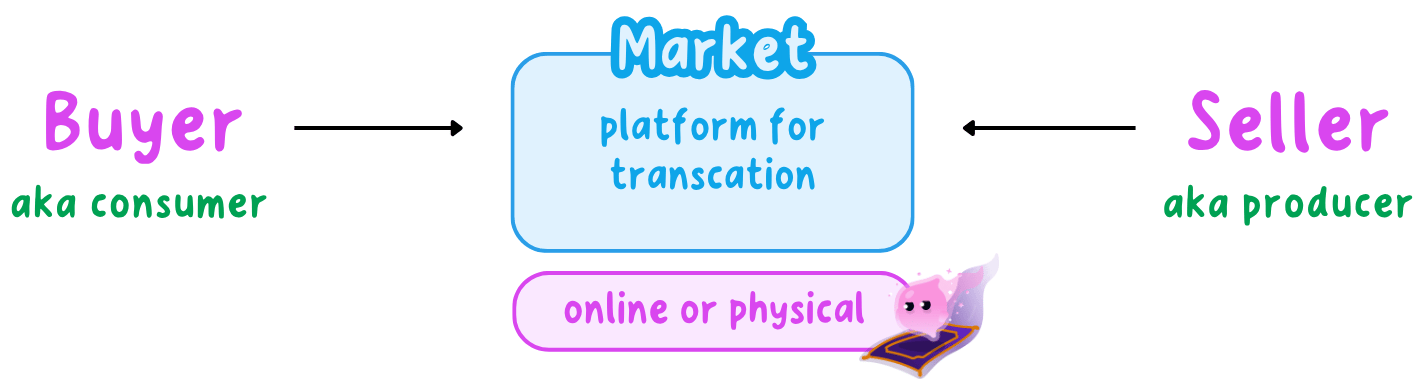
Market: any arrangement that brings buyers and sellers together so that a good or a service can be traded at an agreed price.
- A buyer is willing and able to pay for a product, and a seller offers that product in return for money.
- Willing and able matters, because someone who would like a car but cannot afford one is not part of that market.
- The product is the good or service being traded, such as a punnet of strawberries or a train journey.
- A transaction is one completed exchange of a product for money at a price both sides accept.
- Both sides have to be there for a market to exist, because a seller with no buyers and a buyer with no sellers have nothing to trade.
Example
- At Borough Market in Southwark a shopper hands money to a stallholder and walks away with a punnet of strawberries.
- That single swap of money for goods at a price both sides accepted is one transaction, and the stall is a small market.
- The hall as a whole is really dozens of markets side by side, because each type of product is traded separately.
Markets can be physical or entirely online
- A physical market has a real location where the two sides meet in person, such as a farmers' market or a high street car showroom.
- An online market links them through a website or an app instead, such as eBay or a supermarket's delivery service.
- A market can be local, national or global, since its boundary is set by who can actually trade with whom rather than by distance.
- A seller does not have to be a shop, because a household selling a used bike on eBay is a seller in that market.
Common Mistake
- Do not assume a market has to be a building with stalls, because anywhere the two sides can reach each other counts as one.
- Do not assume the two sides must meet in person, since traders who never see one another are in the same market as long as each can trade with the other.
Markets exist for products and for resources
- There is a market wherever something is traded, so alongside markets for finished goods there are markets for workers, for materials and for money.
- Workers and employers trade in a market too, and the price they agree on is the wage.
- Savers, borrowers and banks trade in financial markets, where the price of borrowing is the interest rate.
- The idea is the same in every case: two sides, something to trade, and a price that comes out of their interaction.
The split between markets for finished products and markets for resources is covered in 2.1.3.
Self review
- What is a market?
- What is the difference between a buyer and a seller?
- What is a transaction?
- Give one example of a physical market and one example of an online market.
- Why can a market have no single location?
