Producers differ in how fast they can react
Definition
Price elasticity of supply (PES): a measure of how responsive the quantity supplied of a good is to a change in that good's own price.
- The law of supply in 2.3.3 says output rises when price rises, but not by how much.
- A factory with idle machines can double output in a week, while an orchard cannot grow more apples this season at any price.
- Price elasticity of supply puts a number on that difference, and the price involved is always the good's own price.
Elastic and inelastic supply sit on one scale
Definition
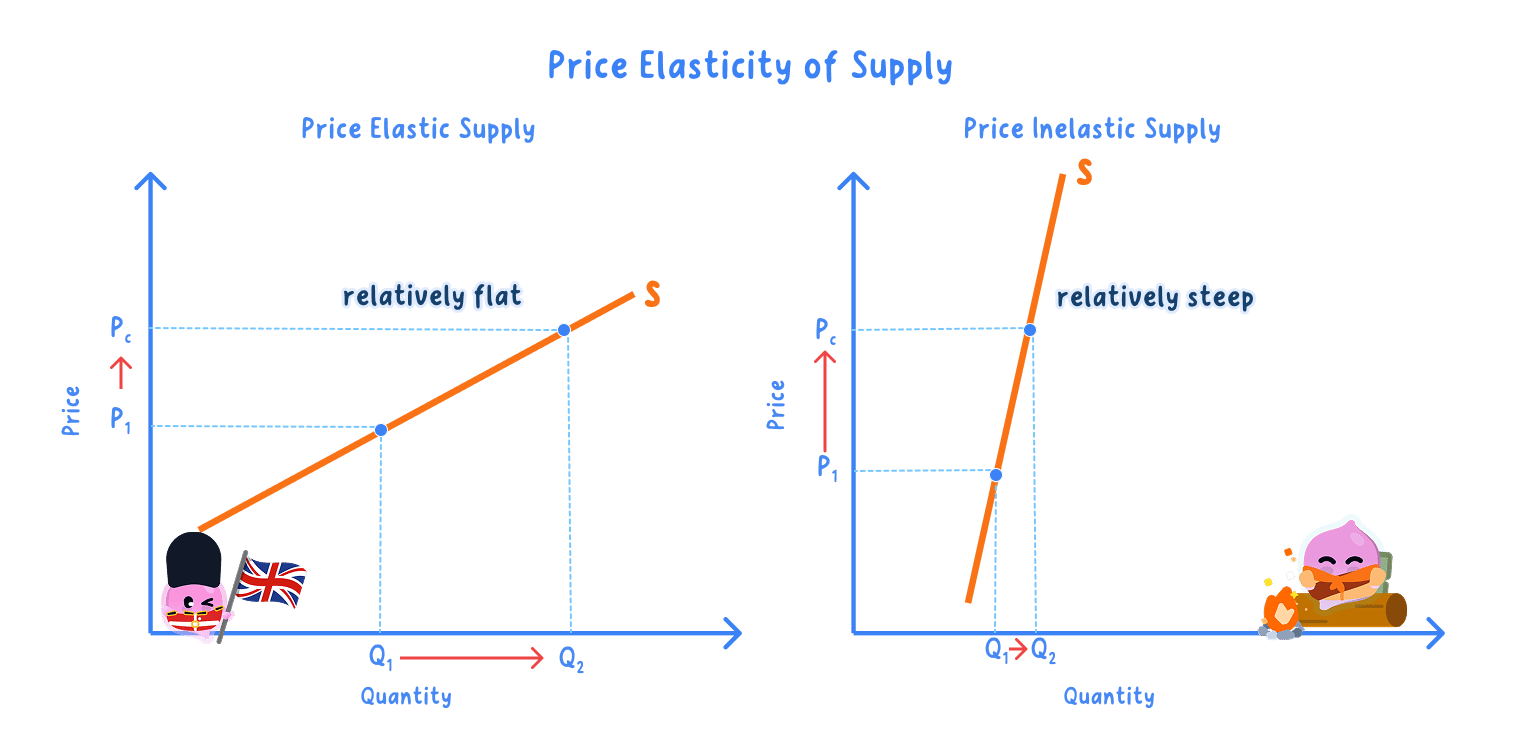
Price elastic supply: supply where the quantity supplied changes by proportionally more than the price that caused the change.
Price inelastic supply: supply where the quantity supplied changes by proportionally less than the price that caused the change.
- The test compares two percentage changes, so it is never a judgement about how many units moved.
- On a diagram the difference shows up as steepness, since a steep supply curve is inelastic and a shallow one is elastic.
- Both curves still rise, because elasticity changes how steep the line is and never which way it slopes.
The formula divides one change by the other
- PES is the percentage change in quantity supplied divided by the percentage change in price, and because both halves are percentages the answer has no units.
- Work each percentage change out against the original figure, so a rise from 500 to 600 chairs is measured against the 500 it started from.
The coefficient is read against one
- A value between 0 and 1 means supply is inelastic, a value above 1 means it is elastic, and exactly 1 means the two percentage changes are equal.
- PES is normally positive, because price and quantity supplied move in the same direction, which is the opposite of PED.
Example
- The price of a chair rises from £40 to £42 and weekly output rises from 500 to 600 chairs.
Step 1: find the percentage change in quantity supplied:
100500×100=20% \frac{100}{500} \times 100 = 20\% 500100×100=20%Step 2: find the percentage change in price:
£2£40×100=5% \frac{\pounds2}{\pounds40} \times 100 = 5\% £40£2×100=5%Step 3: divide the first by the second:
PES=205=4 \text{PES} = \frac{20}{5} = 4 PES=520=4- A PES of 4 is well above 1, so supply is price elastic over this range and the maker can raise output easily.
Time is the factor that settles most cases
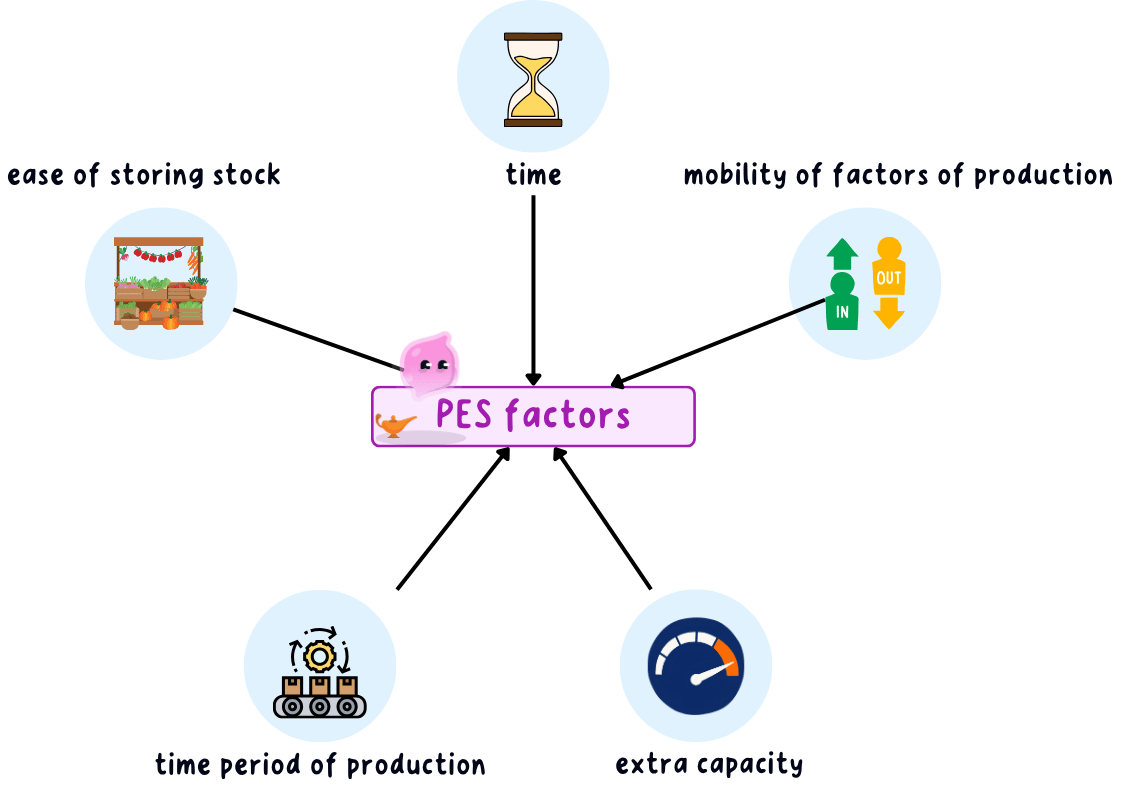
- Time: supply is almost fixed within days, more responsive over months as firms use overtime and materials, and most responsive over years once new capacity is built.
- Stock levels: a firm holding finished goods in a warehouse can meet a price rise straight away, which makes its supply elastic.
- Spare capacity: idle machines and workers let a firm expand without investing, while a factory already running flat out cannot.
- Factor mobility: supply is elastic where land, labour and capital can be switched to this good quickly, and inelastic where the skills or equipment are specialised.
- How long the good takes to make: crops, timber and buildings are inelastic in supply simply because production cannot be hurried.
The same good changes elasticity over time
- An apple grower facing a price rise in September can sell only what is already on the trees, so supply is close to perfectly inelastic.
- Over the following year the grower can prune, fertilise and buy in fruit, so supply becomes more responsive.
- Over several years new orchards can be planted, and by then supply is elastic.
Exam technique
- State the time period when you judge PES, because the same good is inelastic in a week and elastic over a decade.
- Judge the coefficient against 1 rather than against 0, since any positive number below 1 still means inelastic supply.
Self review
- What does price elasticity of supply measure?
- A price rises by 20% and quantity supplied rises by 4%. Is supply elastic or inelastic?
- Why is PES normally positive?
- Name three factors that make supply more elastic.
- Why is the supply of apples inelastic in September but elastic over several years?
