Non-price factors shift the whole supply curve
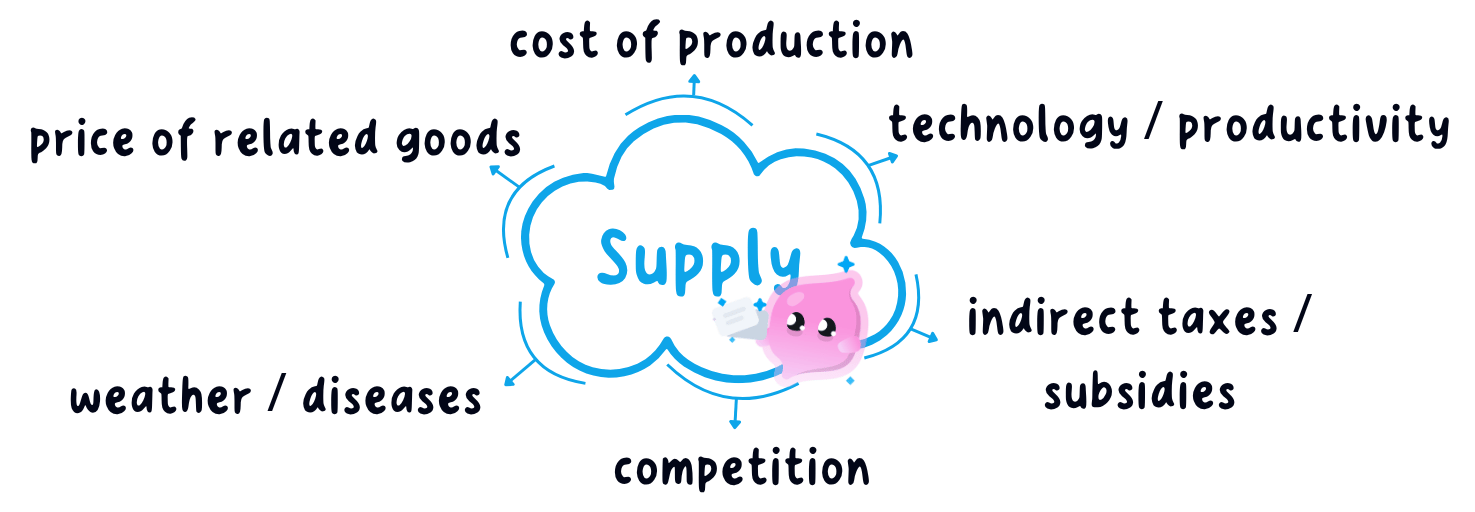
- Costs of production: wages, raw materials, energy, rent and interest all change the cost of a unit, so higher costs shift supply left and lower costs shift it right.
- Technology and productivity: more output from the same inputs lowers the cost of each unit and increases supply, as covered in 2.6.2.
- Indirect taxes: a tax on the good adds to the cost of supplying it and shifts supply left, using the tax defined in 3.5.1.
- Subsidies: a government payment to producers does the opposite and shifts supply right, using the subsidy defined in 3.8.2.
- The number of firms: more producers in the market increases supply, because market supply is every firm's plans added together.
- The weather and other shocks: a poor growing season cuts the harvest whatever price the crop is fetching.
- The price of a related good: a farm that can switch its fields to a crop whose price has risen supplies less of the original one.
Real UK markets show these causes at work
- A cause is worth naming only if you can say which way the curve moved and why.
Case study
- UK barley production fell 10% to 6.4 million tonnes in 2025 after wet September weather held up the harvest (Source: Defra).
- Nothing about the price of barley caused that, so it is a decrease in supply and a shift left rather than a contraction.
Producers feel a supply change through costs
- A decrease in supply usually arrives as higher costs, so the profit on each unit falls before output does.
- Firms respond by cutting output, raising prices where they can, or leaving the market altogether if the loss persists.
- An increase in supply from better technology raises profit per unit, which is why firms invest in it even though it costs money up front.
- How far price actually moves is settled by demand as well as supply, which is covered in 2.4.6.
Consumers feel it through price and choice
- A fall in supply means less is available, so consumers face higher prices and sometimes nothing on the shelf at all.
- A rise in supply works the other way, giving consumers lower prices and more producers to choose between.
- The households hit hardest by a supply fall are those spending the largest share of their income on the good, which is why energy and food shocks matter more than most.
Common Mistake
- Do not describe a cost rise as a movement along the supply curve, because the good's own price has not changed.
- Do not assume a supply fall always raises price sharply, since that depends on how demand responds as well.
How far the consequences reach depends on conditions
- It depends on how large the shift is, because a 10% harvest failure and a small tax change are not the same shock.
- It depends on how responsive demand is, since consumers of a good with close substitutes escape a supply fall by switching, as covered in 2.2.6.
- It depends on how long it lasts, because one poor harvest is absorbed from stocks while several in a row change what farmers plant.
Exam technique
- Name the specific factor rather than writing that supply changed, because the cause is what is being analysed.
- Take producers and consumers in turn when a question names both, since the same shift affects them differently.
Self review
- Name four non-price factors that shift the supply curve.
- Which way does the supply curve shift when a subsidy is introduced?
- Wet weather cuts the barley harvest. Is that a shift or a movement, and which way?
- Give one consequence of a fall in supply for consumers.
- Why does a rise in production costs not always raise the price by the same amount?
