The same price rise, two different reactions
Definition
Price elasticity of demand (PED): a measure of how responsive the quantity demanded of a good is to a change in that good's own price.
- The law of demand in 2.2.3 gives only the direction of the reaction, never its size.
- Two goods can meet the same percentage price rise and lose completely different shares of their sales.
- Price elasticity of demand puts a number on that difference, which is what a firm setting a price actually needs to know.
- The price involved is always the good's own price, so a change in income or in another good's price is a separate idea.
Elastic and inelastic sit on one scale
Definition
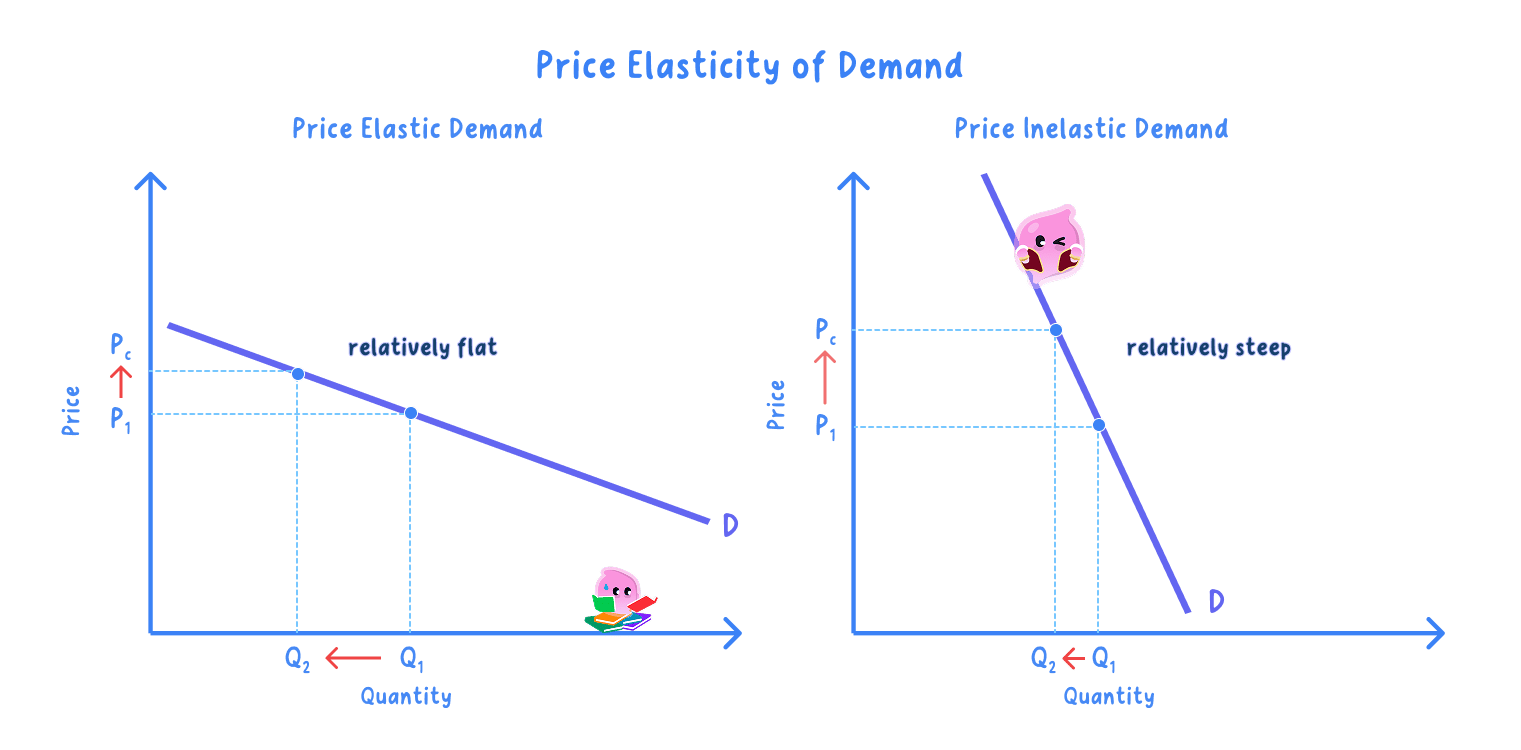
Price elastic demand: demand where the quantity demanded changes by proportionally more than the price that caused the change.
Price inelastic demand: demand where the quantity demanded changes by proportionally less than the price that caused the change.
- The test compares two percentage changes, so it is never a judgement about how many units moved.
- On a diagram the difference shows up as steepness, since a steep demand curve is inelastic and a shallow one is elastic.
- Inelastic never means no reaction at all, only a reaction proportionally smaller than the price change behind it.
- The words describe a reaction and not the size of a market, so petrol has inelastic demand even though it sells in enormous quantities.
The formula divides one change by the other
- PED is the percentage change in quantity demanded divided by the percentage change in price, and because both halves are percentages the answer has no units.
- Work each percentage change out against the original figure, so a fall from 4,000 to 3,840 is measured against the 4,000 it started from.
The coefficient is read against one
- A size between 0 and 1 means demand is inelastic, a size above 1 means it is elastic, and a size of exactly 1 means the two percentage changes are equal.
- PED is normally negative, because price and quantity demanded move in opposite directions, so judge it by its size and ignore the minus sign.
Example
- A loaf rises from £1.20 to £1.32 and weekly sales fall from 4,000 to 3,840.
Step 1: find the percentage change in quantity demanded:
−1604,000×100=−4% \frac{-160}{4{,}000} \times 100 = -4\% 4,000−160×100=−4%Step 2: find the percentage change in price:
£0.12£1.20×100=+10% \frac{\pounds0.12}{\pounds1.20} \times 100 = +10\% £1.20£0.12×100=+10%Step 3: divide the first by the second:
PED=−410=−0.4 \text{PED} = \frac{-4}{10} = -0.4 PED=10−4=−0.4- The size is 0.4, which is below 1, so demand for this loaf is price inelastic over this range.
Close substitutes settle most elasticity cases
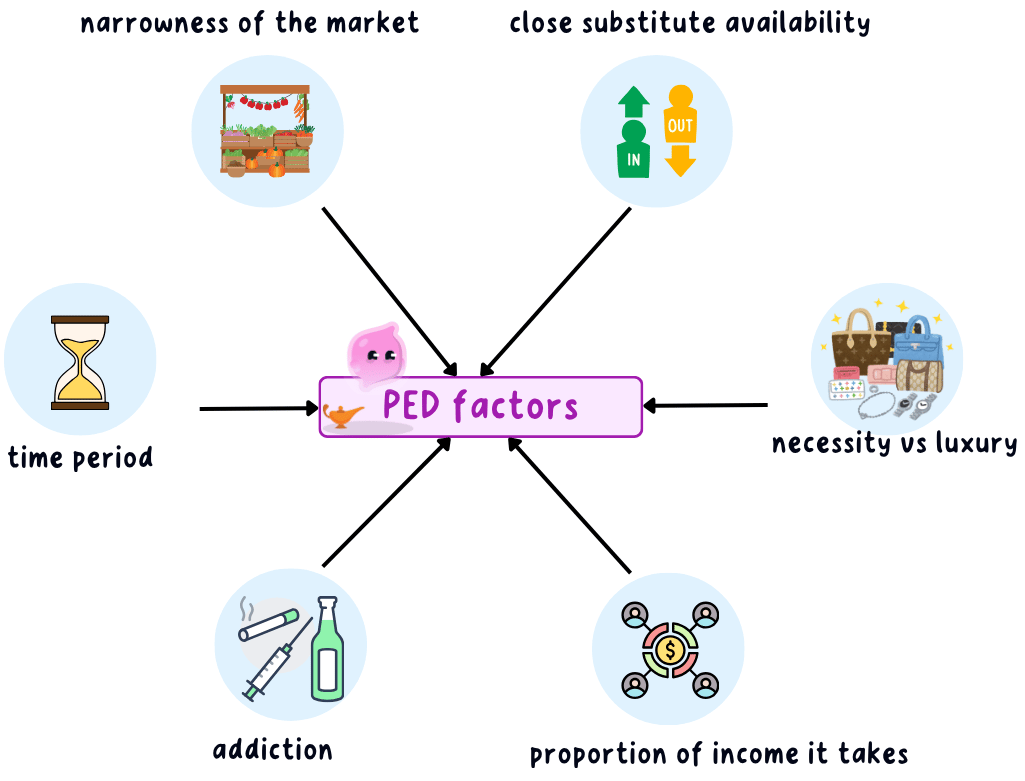
- Substitutes: the closer and more available the alternatives, the more elastic demand is, because a price rise sends the buyer to a rival instead of costing them the purchase.
- Necessity or luxury: a necessity such as bread or a prescription medicine has inelastic demand, while a luxury such as a holiday can be abandoned altogether.
- Share of income: a good taking a large share of income has more elastic demand, because a price rise on it costs real money.
- Habit and addiction: these remove the buyer's willingness to react, which is why cigarettes stay inelastic despite taking a large share of a smoker's income.
- Time: demand becomes more elastic the longer the period allowed, because buyers find more escape routes.
Example
- One supermarket's own-label baked beans, price up 5%: sales of that label fall by far more than 5%, because the shopper reaches for the tin next to it, so demand is elastic.
- Baked beans across every brand, the same 5% price rise: total tins sold fall by much less than 5%, because a household that wants beans still wants beans, so demand is inelastic.
- Identical goods, opposite answers, which is why naming the market is part of naming the elasticity.
How the market is defined can flip the answer
- The same physical purchase can be elastic or inelastic depending on how narrowly the market is drawn.
- A single brand almost always has elastic demand, because its closest substitute is sitting on the same shelf.
- The whole product category is usually inelastic, because leaving it means going without the thing altogether.
Exam technique
- Judge a coefficient by its size against 1 and say so, rather than treating a negative sign as making demand inelastic.
- Name which factor is dominating when factors point opposite ways, because that is what turns a list into an explanation.
Self review
- What does price elasticity of demand measure?
- Which price does it respond to?
- A price rises by 10% and quantity demanded falls by 4%. Is demand elastic or inelastic?
- Why is PED normally negative?
- Why can demand for one brand of beans be elastic while demand for beans as a whole is inelastic?
