Non-price factors shift the whole demand curve
Definition
Substitute goods: goods a buyer can use in place of one another to meet the same want, so buying one normally means not buying the other.
Complementary goods: goods a buyer uses together, so buying one makes buying the other more likely.
Normal good: a good people buy more of as real income rises.
Inferior good: a good people buy less of as real income rises, such as a supermarket value range.
- Real income: a rise in what pay will actually buy increases demand for normal goods and reduces it for inferior ones.
- The price of a related good: a fall in a substitute's price pulls buyers away and lowers demand, while a fall in a complement's price raises it.
- Tastes, fashion and advertising: these change how much the good is wanted with no price change involved.
- Population: more buyers in the market raises demand for most goods.
- Expectations: households expecting a price rise buy sooner, which brings demand forward.
- Government action: a subsidy, a tax, change in interest rate or a ban changes what buyers face without touching the good's own price.
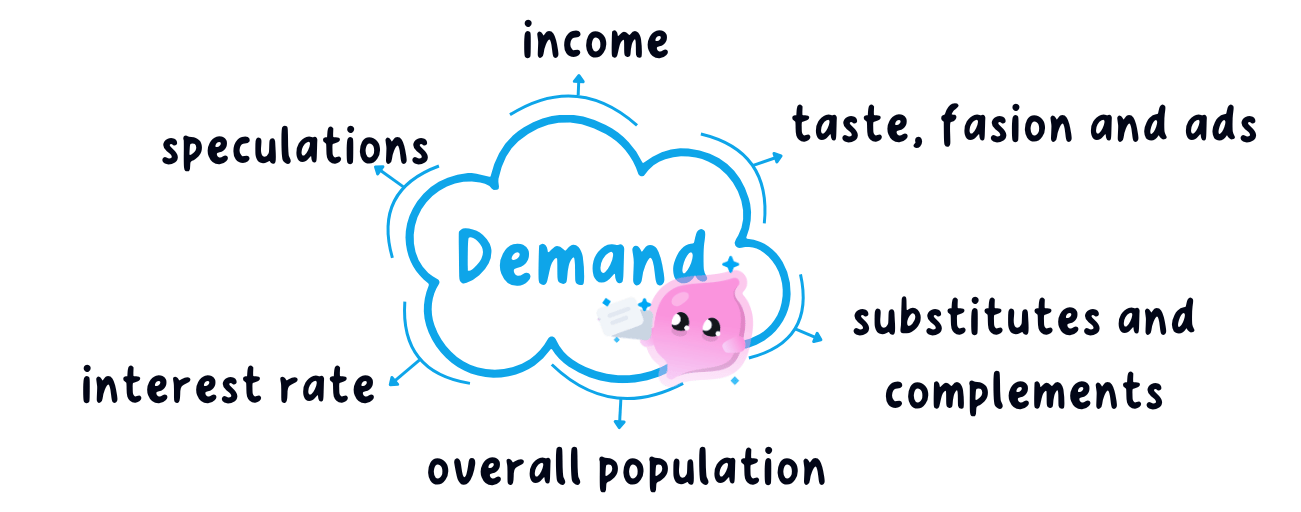
Real UK markets show these causes at work
- A cause is only worth naming if you can say which way the curve moved and why.
- The clearest cases are policy changes, because the date and the size of the change are both known.
Case study
Banning single-use vapes from June 2025 worked the other way, and the share of adult vapers mainly using disposables fell from 24% in 2025 to 8% in 2026 as buyers moved to refillable devices (Source: ASH).
Producers feel a demand change through sales
- An increase in demand means more is bought at the price the firm is already charging, so revenue rises before anything else changes.
- Firms respond by ordering more stock, running longer hours and taking on staff, which is why a demand change reaches the labour market in 2.7.1.
- Sustained higher demand also gives a firm room to raise its price, though how far price actually settles depends on supply as well, as set out in 2.4.6.
- A decrease in demand leaves unsold stock, so firms cut orders, discount and eventually cut jobs.
Consumers feel it through price and availability
- When demand rises, consumers are competing for the same goods, so the price they face tends to rise and bargains disappear.
- Popular goods can sell out, so some consumers who were willing and able to buy still go without.
- A movement along the curve is different, because there the consumer is simply responding to a price that has already changed.
Common Mistake
- Do not say that higher demand causes higher prices as though it were automatic, since the size of the price change depends on supply too.
- Do not treat every consequence as bad news, because a fall in demand lowers prices for the consumers still buying.
How far the consequences reach depends on conditions
- It depends on the size of the shift, because a small change in tastes moves far less than a subsidy worth thousands of pounds a car.
- It depends on how quickly producers can respond, since a firm with spare capacity meets the extra demand without much price change, as covered in 2.3.6.
- It depends on whether the change lasts, because firms will not hire or invest on the back of a demand rise they expect to reverse.
Exam technique
- Name the specific factor rather than writing that demand changed, because the cause is what is being analysed.
- Take consumers and producers in turn when a question names both, since an answer about only one of them is half finished.
Self review
- Name four non-price factors that shift the demand curve.
- What is the difference between a normal good and an inferior good?
- The Electric Car Grant cuts the cost of buying an electric car. Is that a shift or a movement, and why?
- Give one consequence of a fall in demand for a producer.
- Why does a rise in demand not automatically mean a large rise in price?
