Correcting an externality means pricing it in
Internalising an externality: making the producer or the consumer bear the full social cost or benefit of their choice, so the price they face reflects the effect on third parties.
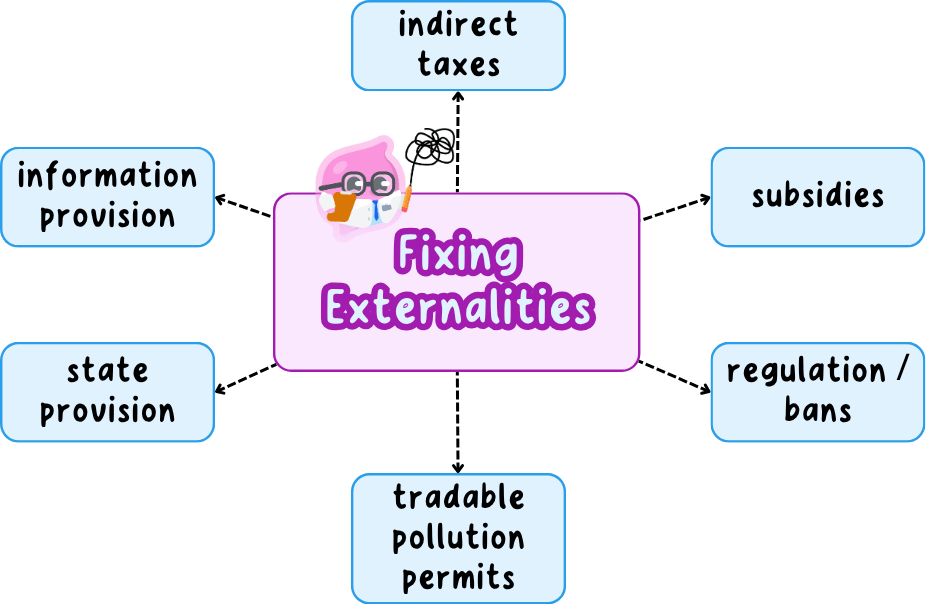
- The problem set out in 3.8.1 is that a cost or benefit falling on third parties never reaches the price, so the government's job is to put it there.
- Four families of policy do this: taxation and subsidies, regulation and legislation, state provision, and information provision.
- Taxation and subsidies work through the price, while regulation, state provision and information provision work around it, which is why a government usually combines them.
Taxing a harmful good raises its price
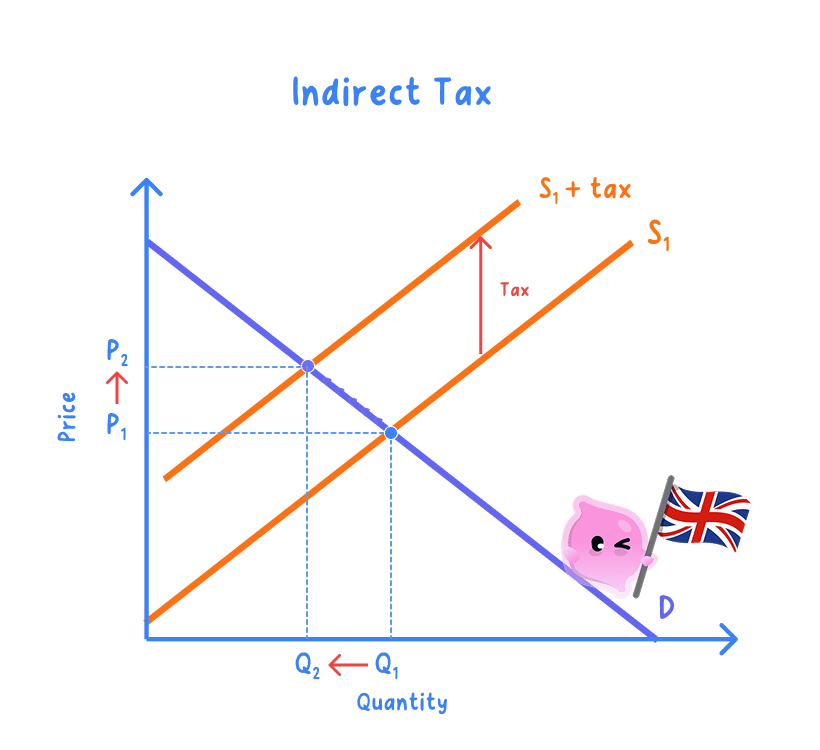
- The tool is an indirect tax, defined in 3.5.1, added to the good rather than charged on income.
- Adding it raises the producer's cost of supplying each unit, so supply falls, the price rises and less is bought.
- In principle the tax should equal the external cost, because that is the amount needed to make the buyer face the full social cost.
- The Soft Drinks Industry Levy charges 20.8p a litre on drinks with 5 to 7.9g of sugar per 100ml and 27.8p a litre at 8g or more, rates that took effect in April 2026 (Source: HMRC).
- The levy was deliberately banded rather than flat, so a producer could escape it entirely by cutting sugar below the lower threshold.
Subsidies make beneficial goods cheaper to buy
Subsidy: a payment from the government to a producer or a consumer that lowers the cost of supplying or buying a good, so more of it is sold at a lower price.
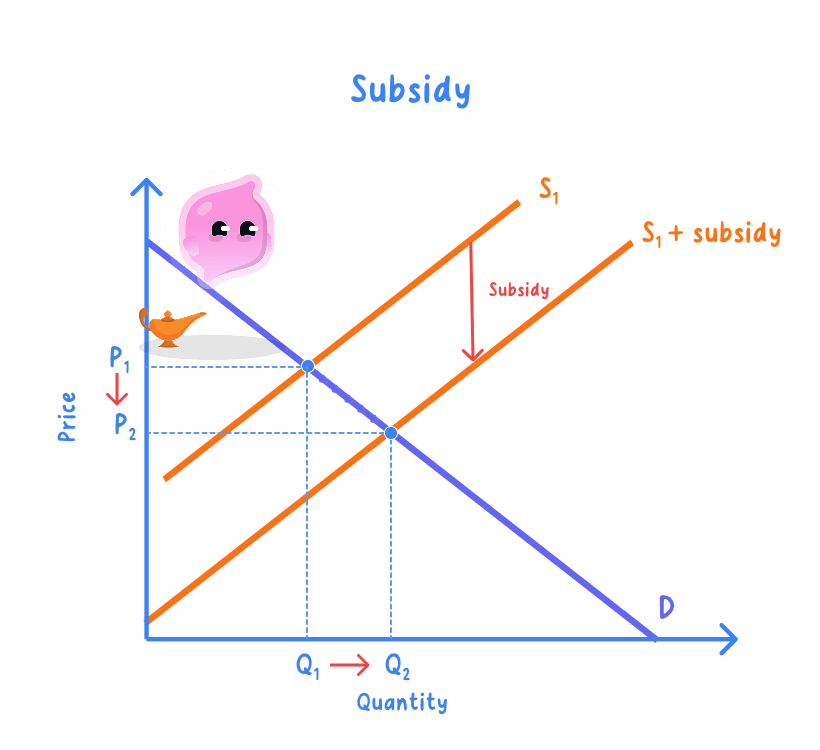
- A subsidy is used where the externality is positive, because the aim is to raise the quantity rather than cut it.
- It lowers the producer's cost, so supply rises, the price falls and more is bought, which is the mirror of what a tax does.
- It works on supply rather than demand, because the payment cuts the producer's cost and does not make buyers want the good any more than before.
The Boiler Upgrade Scheme pays £7,500 towards a heat pump, rising to £9,000 for homes off the gas grid replacing an oil or LPG boiler (Source: GOV.UK).
Regulation and state provision work without price
Regulation: a legal rule that sets a limit, a standard or an outright ban on an activity, backed by enforcement rather than by price.
State provision: the government supplying a good or service directly, so that nobody is priced out of consuming it.
- Regulation suits harm too serious to price, since a limit applies to everyone rather than only to those who cannot afford the tax.
- State provision suits goods with large external benefits, because supplying them free or below cost removes the reason they were under-consumed.
- A tradable permit scheme sits between the two, capping total emissions by law and then letting firms buy and sell the right to emit within the cap.
- Smoking in enclosed public places had been banned everywhere in the UK by July 2007(Source: GOV.UK).
- Single-use vapes have been banned from sale since June 2025 (Source: GOV.UK).
- The UK Emissions Trading Scheme caps emissions from power, heavy industry, aviation and domestic shipping and lets firms trade permits, covering about a quarter of UK emissions (Source: GOV.UK).
- State education and NHS healthcare are both provision rather than pricing, which is why consumption of them is far above what a market alone would deliver.
Information provision changes what people choose
Information provision: government action to give people the facts about a good so that their own choices take the external effect into account.
- Part of the reason a harmful good is over-consumed is that buyers underestimate the harm, and no seller has a reason to tell them.
- Providing the information shifts what people want rather than what they can afford, which is why it can outlast a tax.
- Compulsory health warnings, plain packaging on cigarettes and public health campaigns are all versions of the same tool.
- Say whether the externality is positive or negative before choosing a tool, because a tax and a subsidy are aimed at opposite problems.
- Explain the mechanism rather than naming the policy, so say that the tax raises the price and cuts the quantity rather than that the government taxed it.
- Never call a subsidy a tax, since a subsidy is money paid out to lower a price and a tax is money taken in to raise one.
- Name the four families of policy a government can use to correct externalities.
- Explain how an indirect tax changes the price and the quantity of a good with a negative externality.
- State the difference between a subsidy and a tax.
- Why is state provision used for goods with large external benefits?
- Give one UK example of regulation and one of information provision.
