An externality falls on someone outside the deal
Externality: a cost or a benefit of an economic activity that falls on a third party rather than on the buyer or the seller.
Third party: anyone affected by a transaction who neither bought nor sold and had no say in it.
- A market price only covers what the buyer and the seller charge each other, so anything landing on anybody else is never paid for.
- Because it is never paid for, neither side takes it into account, and the quantity they settle on is not the quantity society would choose.
- That is the limitation of markets this section is about: the market has not stopped working, it is working on incomplete arithmetic.
Negative externalities harm third parties, positive ones help
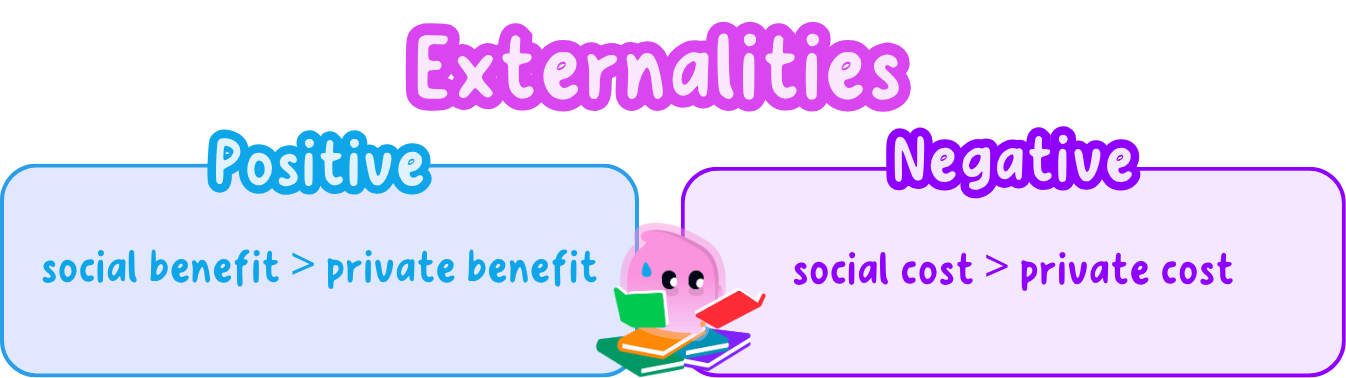
Negative externality: a cost of an economic activity borne by a third party, so the social cost is greater than the private cost.
Positive externality: a benefit of an economic activity enjoyed by a third party, so the social benefit is greater than the private benefit.
- A negative externality means too much of the activity happens, because the person deciding never sees the part of the cost that lands on others.
- A positive externality means too little happens, because the decider counts only their own gain and not the gain to everyone else.
- Traffic fumes in a city are the standard negative case, since the driver pays for fuel but not for the air the pedestrian breathes.
- Vaccination is the standard positive case, since the person vaccinated also lowers the chance of everyone around them catching the disease.
- Take a farm buying pesticide from a chemical supplier and spraying it on a crop.
- The price of the pesticide and the value of the larger harvest are both private, because they fall on the two sides of the deal.
- The beekeeper on the neighbouring land bought nothing and sold nothing, which makes the beekeeper the third party.
- The spray kills bees and cuts the honey harvest, and nobody compensates the beekeeper, so this is a negative externality.
Social cost and social benefit add the externality
Private cost: the cost of an activity paid by the person or firm carrying it out, such as wages, fuel, materials and rent.
Private benefit: the gain from an activity enjoyed by the person or firm carrying it out, such as a firm's revenue or a consumer's satisfaction.
Social cost: the total cost of an activity to society, which is the private cost plus any cost falling on everybody else.
Social benefit: the total benefit of an activity to society, which is the private benefit plus any benefit enjoyed by everybody else.
- The part that falls on third parties is called the external cost when it is a cost and the external benefit when it is a benefit.
- Each side is therefore a simple addition, and the externality is the difference between the two totals rather than a total in its own right.
Applying the identities to real figures
- Decide which side the question is asking about first, then add the external part to the private part on that side alone.
- A haulage firm's private cost of one delivery run is £400 in fuel, wages and wear, and residents along the route value the fumes, noise and road damage at £90.
Step 1: add the private cost and the external cost to find the social cost:
£400+£90=£490 \pounds400 + \pounds90 = \pounds490 £400+£90=£490- The externality is the £90 gap, which the firm never pays and the delivery price never shows.
- On the benefit side, a student values a course at £3,000 in extra lifetime earnings while society gains a further £1,000 from the skills.
Step 2: add the private benefit and the external benefit to find the social benefit:
£3,000+£1,000=£4,000 \pounds3{,}000 + \pounds1{,}000 = \pounds4{,}000 £3,000+£1,000=£4,000- The student decides on the £3,000 alone, which is why less education is bought than society would choose.
Externalities arise in production and in consumption
- Production externalities: created by the act of making the good, so a factory discharging waste into a river harms anglers and everyone downstream whether or not the output is ever used.
- Consumption externalities: created by the act of using the good, so a driver's exhaust and a smoker's second-hand smoke appear at the point of use rather than at the factory.
- One activity can create both types at once, since expanding an airport gives other firms faster trade links while imposing noise and traffic on the villages beneath the flight path.
- Name the third party specifically, such as residents beside the quarry, rather than writing that society is affected.
- Say whether the externality arises in production or in consumption, because an answer that only mentions factory pollution misses half of it.
- Add the private figure to the external one when you use the identity, since giving the harm on its own as the social cost is the most common slip here.
- Check that a cost you are calling external really falls outside the deal, because a wage or a fine is paid by the firm and so is private.
- Define an externality in one sentence.
- Write the identity linking social cost, private cost and external cost.
- A delivery costs a firm £250 and imposes £60 on residents. State the social cost and the externality.
- Give one negative externality of production and one of consumption.
- Why does a positive externality lead to too little of the activity taking place?
