Three groups meet globalisation in different ways
- A developed country such as the UK meets globalisation as producers competing in a world market, as workers whose jobs are exposed to it, and as consumers buying what it delivers.
- The three do not gain or lose together, so the very change that helps one of them can be what harms another.
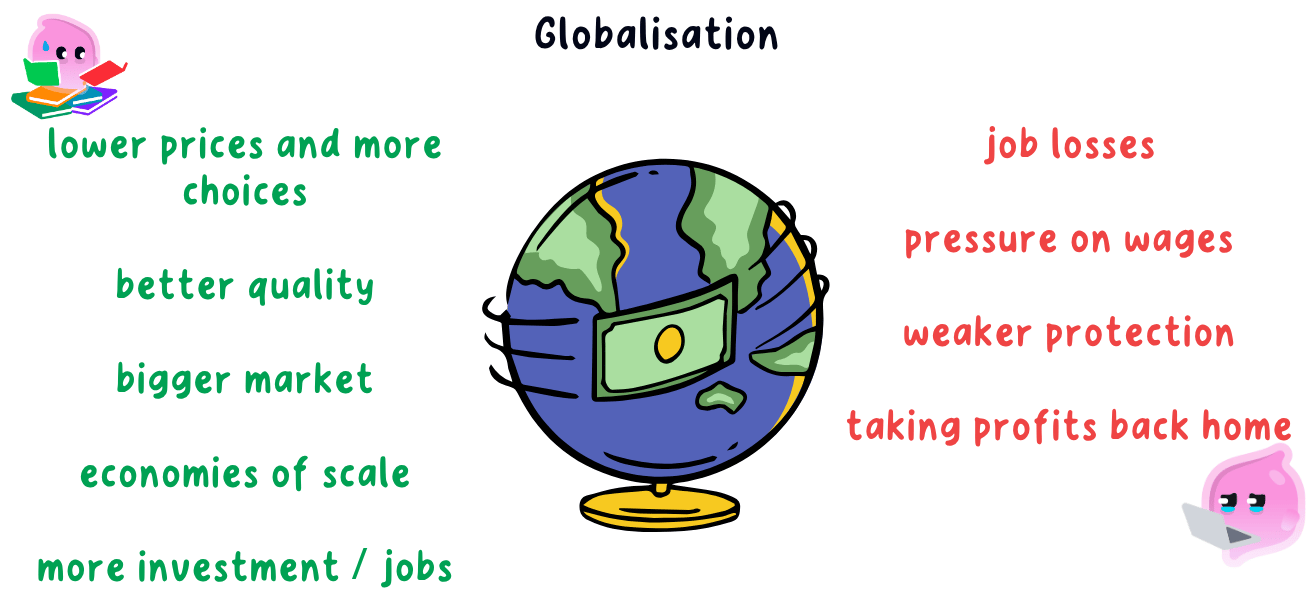
Producers gain a world market but face low-cost rivals
- Firms can sell across the world and produce at higher volume, spreading the cost of factories and machinery across more units.
- They can also buy components, materials and business services from the cheapest supplier anywhere, so costs fall without changing what they make.
- The same openness lets producers from lower-cost countries sell into the home market, so firms making standard goods are the first to lose out, while survivors compete on design, brand, reliability and specialist skill rather than price.
Workers lose some jobs and gain others
- Routine work that can be done anywhere moves to lower-cost countries, so manufacturing employment has fallen across developed economies, with losses often concentrated in single-industry towns rather than spread thinly.
- The same openness creates work in successful export industries and services such as finance, design, higher education, software and logistics, which now sell abroad on a scale they never used to.
- Where a firm could move production abroad, workers have less bargaining power over pay and conditions, even where the firm never actually moves.
Example
- A factory making standard components closes while a nearby firm designing specialist equipment expands by the same number of jobs.
- Nationally the employment count barely moves, so figures suggest almost nothing happened, but for the worker everything has changed because the new jobs need different skills and may be in a different town.
Consumers gain most and notice least
- Goods made wherever they can be produced most cheaply reach shops at lower prices, and competition from imports limits what home producers can charge.
- Households can buy from producers all over the world, including foods outside their home season and products no domestic firm makes at all.
- Households depending on long supply chains are exposed to disruptions thousands of miles away, which can raise prices and empty shelves for reasons nobody here controls, and the consumer gain is real but thinly spread (a few pounds off many purchases) which is why it is felt far less strongly than a factory closing.
The three kinds of sustainability pull apart
- Economic sustainability: growth built on trade can continue for a long time, but an economy that has let whole industries disappear depends on continued access to foreign suppliers and on the earnings of what replaced them.
- Social sustainability: rising real incomes and cheaper essentials improve life for most households, while a community built around one lost industry can face unemployment lasting generations.
- Environmental sustainability: carrying goods and components around the world burns fuel, and cheaper goods encourage households to buy and discard more, but a country's own emissions can fall if production has moved abroad - an improvement that is a transfer rather than a reduction.
The three kinds of sustainability, and how to weigh a choice against all three, are set out in 1.2.4.
How far the gains outweigh the losses
- It depends on which group is being asked about, because consumers and successful exporters gain steadily while the workers of a displaced industry can lose a livelihood, and adding the two together hides both of them.
- It depends on how easily displaced workers can move, because a worker whose skills transfer straight into a growing industry loses a few months of earnings, while one in a town with a single large employer can lose a decade.
- It depends on how widely the gains are spread, because a benefit worth a few pounds a week to millions is larger in total than a concentrated loss, yet far less visible.
- It depends on what the country does with the gains, because retraining, transport links and support for areas that lost industries can turn a national gain into a local one, while doing nothing leaves the loss where it fell.
Self review
- Give one gain and one cost of globalisation for producers in a developed country.
- Name two kinds of work in which globalisation creates jobs in a developed country.
- Why is a lost factory felt more strongly than a price fall of the same total value?
- How can a developed country's own emissions fall without world emissions falling?
- What decides whether a displaced worker loses much or little?
