Why the current account matters to the UK
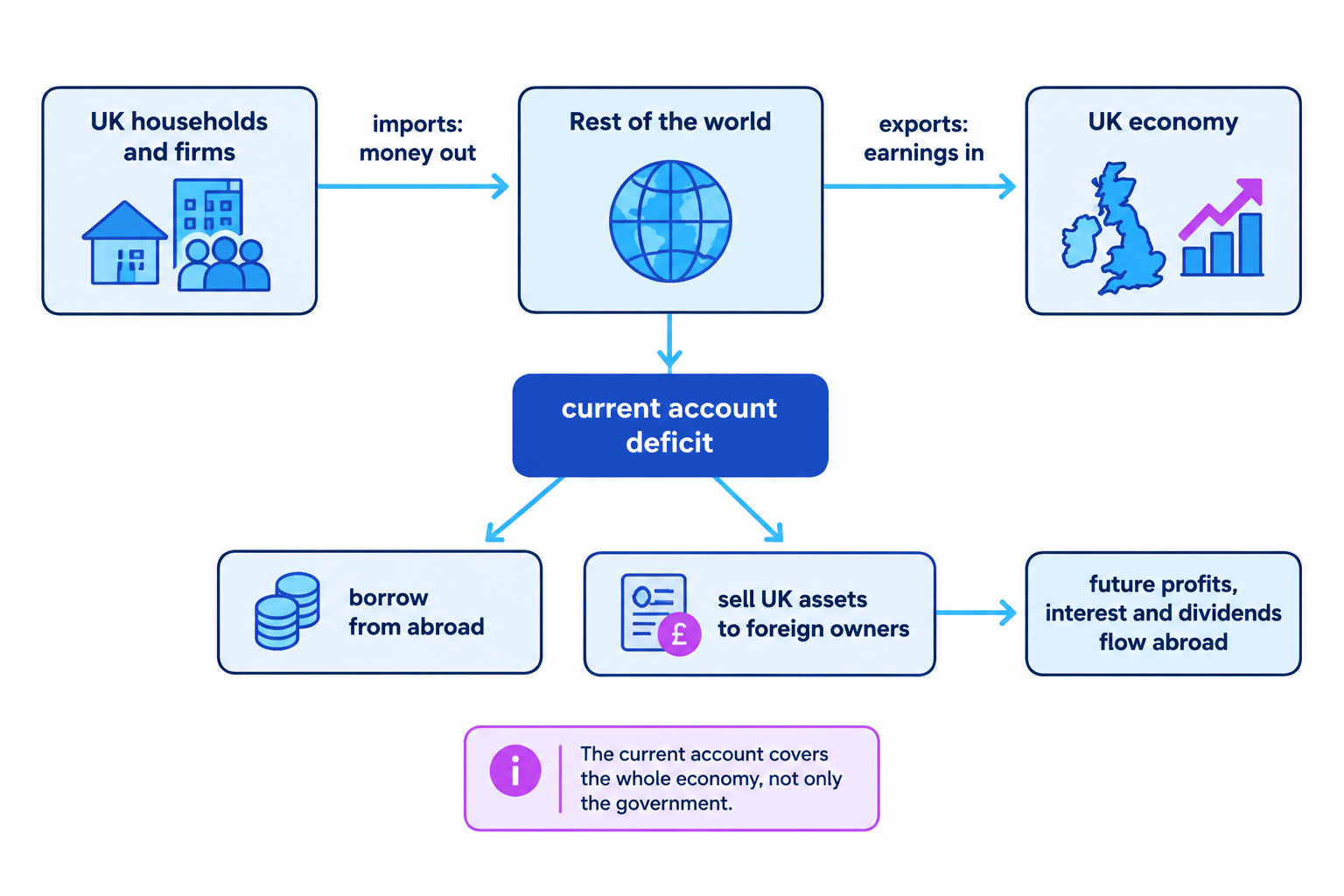
- The current account measures how much the UK earns from the rest of the world against how much it pays out, so it shows whether the country is living within its external means.
- Spending on imports is money leaving the UK circular flow, while export earnings are money entering it, which is why the position feeds through to UK output, jobs and prices.
- A UK deficit has to be financed, either by borrowing from abroad or by selling UK assets such as property, shares and whole companies to foreign owners.
- The UK's deficit is a standing feature rather than a one-off, because its large deficit on trade in goods is only partly offset by its surplus on trade in services.
What a persistent UK deficit can cost
- Financing risk: the UK depends on foreign investors being willing to lend to it and buy its assets every year, and that willingness rests on confidence rather than on any guarantee.
- Future income outflows: assets sold to foreign owners pay them profits, interest and dividends in later years, which appears as an outflow of primary income and widens the deficit further.
- Pressure on the pound: paying for imports means selling pounds to buy foreign currency, so a large deficit adds to downward pressure on the exchange rate.
- Demand and jobs: money spent on imports is not spent on UK output, so a deficit driven by weak UK exports can mean slower growth and fewer jobs in UK export industries.
Exchange rates and how they are determined are explained further in 4.3.1.
A surplus is not automatically a good sign
- A surplus would mean the UK earning more from the rest of the world than it pays out, and those extra earnings can be used to lend abroad or to pay down what the country owes abroad.
- That is the sense in which a surplus most likely leads to a fall in a country's debt, since the excess earnings reduce the need to borrow from abroad.
- A surplus can equally reflect weak demand at home, where UK households and firms are buying too little of everything, imports included.
- A very large surplus can also strain relations with trading partners, because one country's surplus is matched by deficits elsewhere.
Common Mistake
- Never treat the UK current account balance as government borrowing, because it records the whole economy's dealings with abroad, not the state of the public finances.
- Never treat a surplus as proof of a strong economy or a deficit as proof of a weak one, since both can arise for opposite reasons.
How far a deficit matters depends on four things
- It depends on how large it is relative to GDP, because a deficit of around 2 per cent of GDP is comfortably financed by an economy the size of the UK's, whereas a deficit several times that size would need a far larger flow of foreign money every single year.
- It depends on whether it is financed by borrowing or by investment, because foreign money that builds a factory in the UK creates capacity and jobs here and is hard to withdraw, while short-term lending can be pulled out quickly if confidence in the UK falls.
- It depends on whether it is caused by strong demand or weak competitiveness, because a deficit that appears while UK incomes and investment are growing fast tends to shrink again once that growth eases, whereas one caused by UK products being overpriced or poorly made persists until the underlying weakness is fixed.
- It depends on how long it has persisted, because one weak quarter changes very little, while a deficit running year after year steadily transfers the ownership of UK assets, and the income they generate, to owners abroad.
What lies behind a deficit or a surplus in the first place is set out in 4.2.6.
Self review
- How is a UK current account deficit financed?
- Why can selling UK assets abroad make future current account figures worse?
- Why would a current account surplus most likely reduce a country's debt?
- Give one reason a large surplus might not be a good sign.
- State two things that decide how far a UK deficit matters.