Competitiveness decides which way the balance tips
Definition
International competitiveness: how well a country's firms can sell against rival producers abroad and at home, on price and on everything other than price.
- Anything that makes a country's products better value than foreign rivals raises its exports and cuts its imports, pushing the current account towards surplus.
- Anything that makes them worse value does the reverse, and pushes the account towards deficit.
- Every cause below works through one of two routes: the price of a country's products relative to rivals, or the qualities of those products that have nothing to do with price.
The exchange rate changes every export price
- A stronger pound means foreign buyers pay more for each UK export in their own currency, while imports become cheaper measured in pounds.
- So a rising pound tends to cut export sales and raise import spending, moving the current account towards deficit, and a falling pound does the opposite.
- How much the balance actually moves depends on how sensitive buyers are to price, because a small price change shifts sales of near-identical goods far more than sales of goods with no close substitute.
The full chain from an exchange rate change through to exports, imports and the current account is set out in 4.3.5.
Example
- Petrol is sold by many suppliers with nearly identical products, so a 5 pence rise in UK petrol prices when the pound falls sharply switches many buyers to cheaper foreign fuel or to fuel bought across the border, cutting UK petrol exports noticeably.
- By contrast, a 5 pence rise in the price of a unique British luxury product with no close substitute-such as a hand-crafted item from a prestigious maker-shifts far fewer sales, because buyers value the specific product itself rather than shopping on price alone.
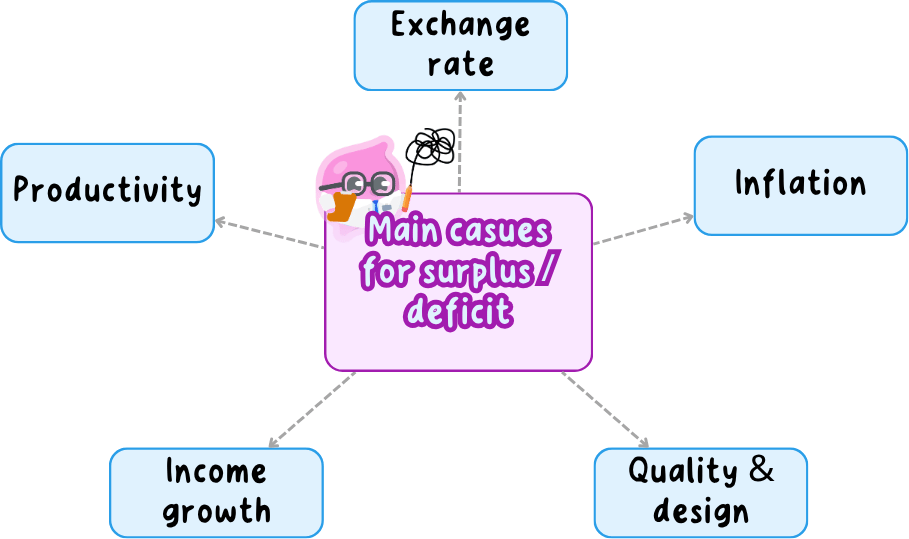
Relative inflation and costs raise export prices
- If a country's prices and wage costs rise faster than those of its competitors, its products become dearer relative to theirs even with no change in the exchange rate at all.
- Buyers abroad then switch towards cheaper rivals and buyers at home switch towards cheaper imports, so the balance moves towards deficit on both sides at once.
- The comparison is always relative, so inflation of 4 per cent matters only against what is happening in the countries a nation trades with, not against zero.
Quality and design matter as much as price
- Non-price competitiveness covers quality, design, reliability, branding, delivery times and after-sales service, and it decides sales wherever buyers are not choosing on price alone.
- Products that are unreliable or badly designed lose sales abroad even when they are cheap, and they lose sales at home to better imports.
- This is the route on which a high-wage economy has to compete, because it cannot win a straight cost contest against much cheaper producers.
Example
- Take a country with structural problems that leave it producing overpriced and poor-quality goods.
- Overpriced goods lose on the price route, so foreign buyers switch to cheaper rivals and exports fall.
- Poor-quality goods lose on the non-price route as well, so buyers at home switch to better imports and import spending rises.
- Exports falling while imports rise moves the balance one way only, which is why that combination points straight to a current account deficit.
Income growth at home pulls in more imports
- When incomes rise, households spend more, and a share of that extra spending always goes on imported goods and foreign holidays.
- If a country grows faster than its trading partners, its demand for imports rises faster than their demand for its exports, so its balance worsens even though nothing about its products has changed.
- The reverse is why a country can slide into surplus during a downturn, as import spending collapses, and that is a symptom of weakness rather than of strength.
Productivity sits behind both routes
- Productivity is output per worker per hour, and higher productivity lets firms make the same output at a lower cost for each unit produced.
- Lower unit costs allow lower prices without lower profits, so productivity feeds the price route directly.
- The investment and training that raise productivity usually raise quality and reliability too, so it feeds the non-price route as well.
- Weak productivity growth therefore damages both routes at once, and it takes years rather than months to put right.
Which causes matter most for the balance
- It depends on the period being judged, because the exchange rate and relative income growth move a balance from one quarter to the next, while productivity and quality decide where it settles over a decade.
- It depends on how easily the cause can reverse, because a currency movement can unwind within a year, whereas a reputation for unreliable products takes far longer to rebuild.
- It depends on whether the cause works on price or on quality, because a price disadvantage can be offset by a cheaper currency, while no exchange rate makes a badly designed product a good one.
- It depends on whether the cause is shared with trading partners, because inflation that is running everywhere leaves relative prices unchanged and moves the balance very little.
- The supported judgement is that short-run swings in a current account are driven mainly by the exchange rate and by relative income growth, but a deficit that persists year after year is almost always a competitiveness problem, so weak productivity and weak non-price competitiveness are the causes that matter most.
Self review
- Define international competitiveness.
- Explain how a stronger pound moves the current account towards deficit.
- Give two examples of non-price competitiveness.
- Why would overpriced and poor-quality goods lead to a current account deficit?
- Why does faster income growth than trading partners tend to worsen the balance?
