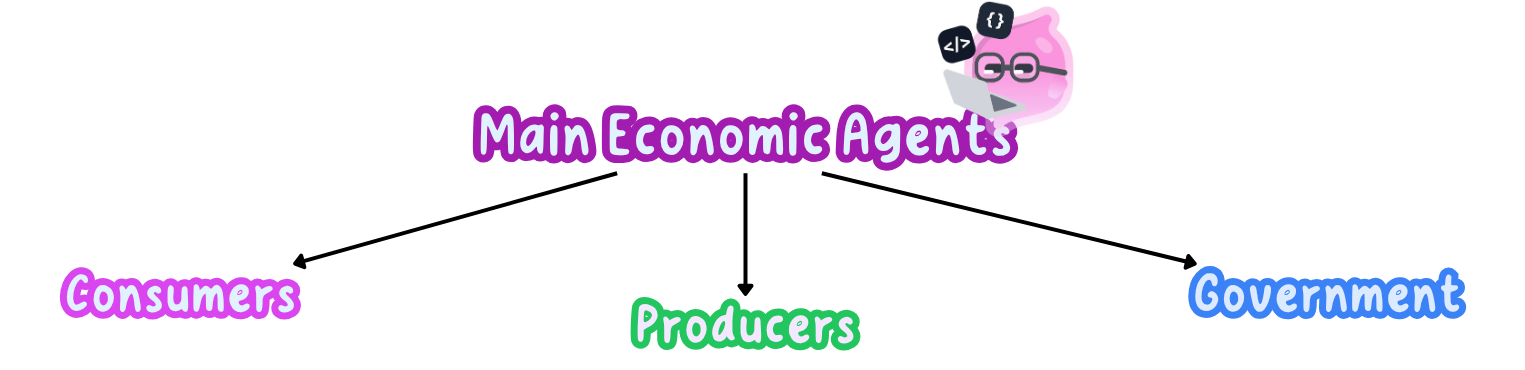
Three groups make every economic decision
Definition
Consumers: the people who buy and use goods and services.
Producers: the firms and individuals who make goods and services.
Government: the body that raises taxes, provides public services and sets the rules consumers and producers follow.
- Every economic decision made in the UK is made by one of these three main economic groups.
- The same person can belong to more than one group, since a plumber is a producer at work and a consumer in the supermarket.
- A producer is not only a large company, because a market stall, a franchise and a self-employed plumber are all producers.
- The government is a producer as well as a rule setter, since it employs NHS staff and teachers to provide services directly.
Example
- One loaf of bread involves all three groups.
- Greggs bakes it and puts it on the shelf, so Greggs is the producer.
- A shopper buys and eats it, so the shopper is the consumer.
- The government sets the food safety rules the bakery must follow and takes tax from what the business earns.
- Each group touches the same loaf for a different reason.
Each group pursues a different aim
- Consumers aim for the most satisfaction they can get from a limited income, which is why they compare prices before buying.
- Producers aim to make a profit, which is why they supply the goods consumers are willing to pay most for.
- The government aims to serve society as a whole, which is why it funds services such as the NHS that a profit-seeking firm would not provide to everyone.
- These aims pull against one another, since the price rise that raises a producer's profit leaves consumers with less satisfaction from the same income.
- Because its aim is not profit, the government provides things no producer would supply to everyone, such as street lighting and pavements that nobody can be charged for using.
Common Mistake
- The government is not just another producer, because its aim is the wellbeing of society rather than profit.
- A producer does not choose its own tax rates either, since the government sets them and the producer has to pay.
The three groups depend on one another
Definition
Interdependence: the way each economic group relies on the others to play its part, so that a decision taken by one affects the other two.
- Consumers rely on producers for the goods and services they buy, and producers rely on consumers to buy what they make.
- The government relies on both groups for tax revenue, such as income tax on wages and VAT charged at 20 per cent on most goods.
- Producers and consumers rely on the government in return, for the rules businesses trade under, for infrastructure such as roads, and for public services such as the NHS and state schools.
- Because the three interact constantly, a decision by one reaches the other two, so a fall in consumer spending cuts producers' output and the government's tax revenue at the same time.
Where these three groups actually meet to buy and sell is the market, taken further in 2.1.1.
Self review
- Name the three main economic groups.
- What does each group mainly aim to achieve?
- What does it mean that the groups are interdependent?
- Give one way the government depends on producers.
- Explain one way a fall in consumer spending affects producers.
