Borrowing costs reach households at different speeds
Definition
Variable-rate mortgage: a home loan whose interest rate moves up and down with Bank Rate, so repayments change soon after a decision.
Fixed-rate deal: a loan whose interest rate is locked for an agreed period, so a change in Bank Rate does not reach the borrower until the deal ends.
- Most UK mortgage borrowers are on fixed deals, so a rise in Bank Rate reaches them in stages as those deals expire rather than all at once.
- Credit cards, overdrafts and new car loans reprice far faster, which is why borrowing for smaller purchases responds first.
- The effect on total borrowing therefore builds over years, and the size of it in any one year depends on how many deals are ending.
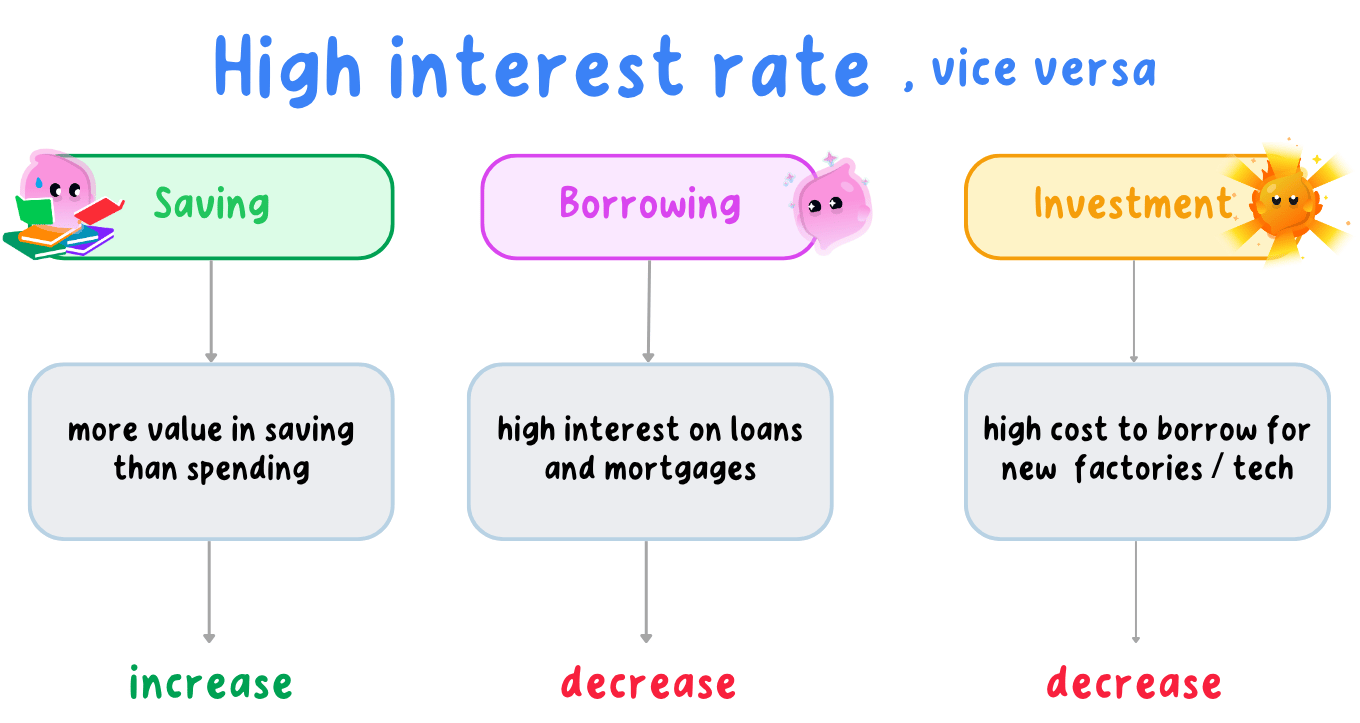
Consumer spending moves with the cost of credit
- A higher repayment takes a bite out of disposable income, covered in 3.3.2, before the household has chosen anything to spend it on.
- Purchases normally bought on credit fall hardest, so cars, furniture and home improvements slow before weekly shopping does.
- The reverse holds when rates fall, and cheaper credit is one reason spending recovers before incomes do.
Example
- A household is considering a £10,000 car loan for one year, and wants to know what a rate change costs it.
Step 1: find the interest at a rate of 4%:
interest=4%×£10,000=£400 \text{interest} = 4\% \times \pounds10{,}000 = \pounds400 interest=4%×£10,000=£400Step 2: find the interest if the rate rises to 6%:
interest=6%×£10,000=£600 \text{interest} = 6\% \times \pounds10{,}000 = \pounds600 interest=6%×£10,000=£600Step 3: subtract to find what the rise costs:
£600−£400=£200 \pounds600 - \pounds400 = \pounds200 £600−£400=£200- The extra £200 is money the household cannot spend on anything else, which is why some borrowers drop the purchase rather than pay it.
Saving becomes more attractive as rates rise
- A higher rate raises the reward for holding money back, so households with savings gain income without doing anything.
- The same change makes spending today more expensive in the sense that the interest given up is larger, which pushes some purchases into the future.
- A rate change therefore moves money between groups rather than simply helping or hurting everyone, since savers gain what borrowers pay.
Common Mistake
- Do not treat a rate rise as good news or bad news for the whole economy, because savers and borrowers are affected in opposite directions.
- Do not assume a better savings rate raises saving much, since a household with nothing spare cannot respond to it at all.
Investment depends on the rate and on confidence
- A firm goes ahead only when the expected return on a project is greater than the cost of borrowing to fund it.
- Raising the rate therefore rules out the projects that were marginal, and cutting it brings them back, as in 3.1.5.
- Expected demand can matter more than the rate, because a firm that doubts it can sell the extra output will not build the capacity at any price.
Reaching a judgement on the effects
- It depends on how indebted households are, because the same rate change hits a household with a large mortgage and a household with none quite differently.
- It depends on how long the change is expected to last, because a move thought temporary changes few long-term plans.
- It depends on what is happening to incomes, because a rate cut does little for spending while real wages are falling.
- Overall: a change in Bank Rate reliably changes the cost of credit, and through it borrowing and investment, but the effect on spending is slow, uneven between households and easily outweighed by confidence, so it steers the economy rather than controlling it.
Exam technique
- Take each of spending, borrowing, saving and investment in turn when a question names them, because an answer about only borrowing leaves most of the question untouched.
- Recalculate the interest at the new rate when figures are given, rather than assuming the change in pounds matches the change in percentage points.
Self review
- Why does a rise in Bank Rate reach mortgage borrowers gradually rather than all at once?
- A household borrows £8,000 for one year. How much more interest does it pay if the rate rises from 5% to 7%?
- Why does a rate rise help savers and hurt borrowers at the same time?
- What rule decides whether a firm goes ahead with an investment project?
- Reach a judgement: how much does a cut in Bank Rate really raise consumer spending?
