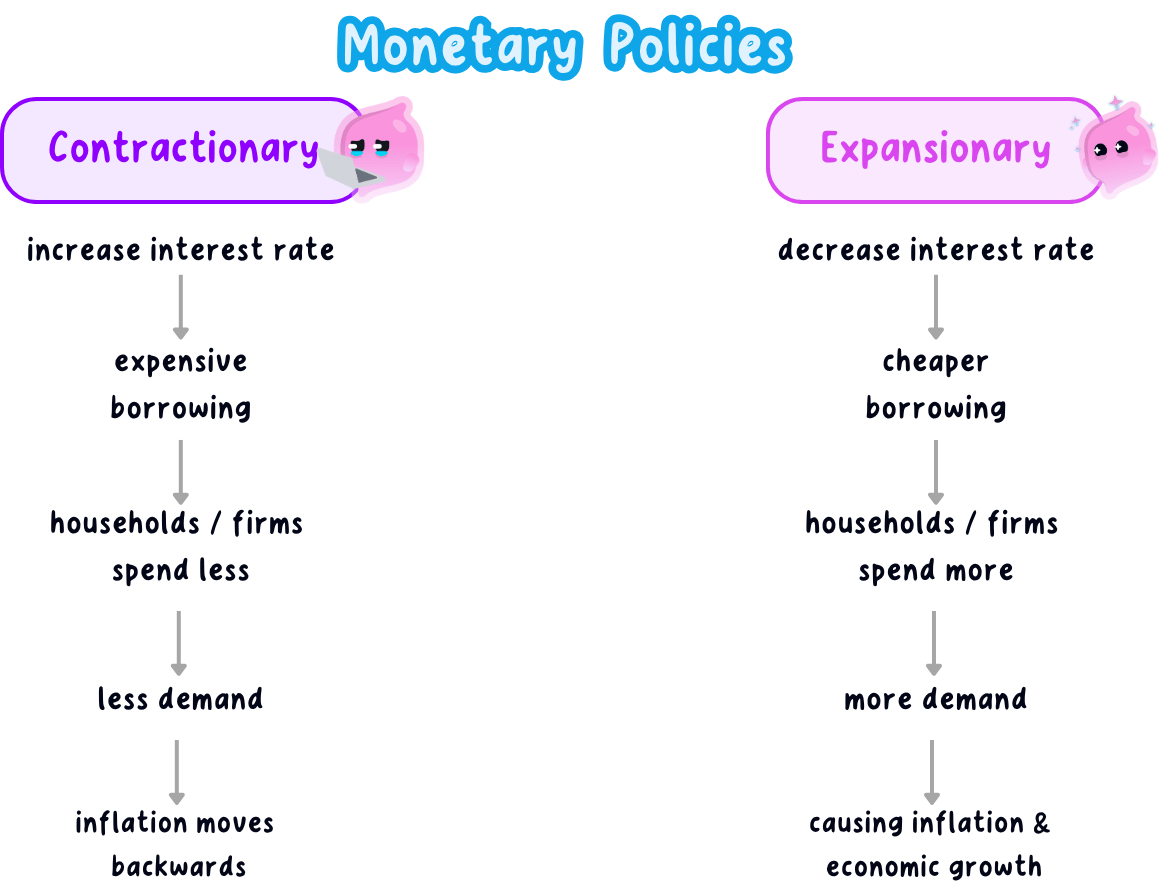
A higher Bank Rate slows spending and prices
- Borrowing becomes dearer and saving becomes better paid, so households hold money back and firms postpone projects.
- Total spending in the economy then grows more slowly than the economy's capacity to supply goods and services.
- With demand no longer running ahead of supply, sellers lose the room to raise prices, so the inflation rate falls.
- This chain works on demand-pull inflation, covered in 3.4.5, because it is demand that Bank Rate can reach.
Example
- CPI inflation was 2.9% in the year to July 2026, against the 2% target (Source: ONS).
- The Monetary Policy Committee held Bank Rate at 3.75% (Source: Bank of England).
- Holding rather than cutting is itself a decision to keep pressure on prices, since a cut would have added to spending while inflation was still above target.
A lower Bank Rate supports growth and employment
- Cheaper credit brings forward the purchases households were putting off, and cheaper business loans make marginal investment projects worth doing.
- Higher spending on output means firms need more workers to produce it, so employment rises as growth picks up.
- Investment matters twice over, because it raises output now and adds to the economy's capacity later, as in 3.1.5.
Monetary policy arrives only after a long delay
Definition
Time lag: the delay between a policy decision being taken and its effect appearing in the economy.
- Most estimates put the full effect of a rate change well over a year away, because borrowers only reprice when their existing deals end.
- The Committee therefore has to act on a forecast of where inflation is heading, not on the figure published this month.
- If the forecast is wrong, the rate change lands when the problem has already changed, which can make the policy add to the swing instead of damping it.
How much monetary policy achieves depends on conditions
- It depends on how much households owe, because a rate change moves spending sharply where borrowing is widespread and barely at all where it is not.
- It depends on confidence, because a firm expecting weak demand will not borrow to invest however cheap the loan becomes.
- It depends on where the inflation came from, because a rate rise works on demand but does little about a cost-push rise in imported energy prices.
- It depends on which objective is being sacrificed, because the rise that brings inflation down also slows growth and raises unemployment.
- Overall: monetary policy is the quickest instrument the UK has for steering demand, and it has a clear target to aim at, but it works with a lag of many months, it reaches indebted households far harder than others, and it cannot fix inflation that started on the supply side.
Exam technique
- For analyse, write the chain in single steps and do not skip from the rate straight to inflation, because the marks are in the links between them.
- Name which objective gains and which loses when you evaluate, since a rate change almost never improves all of them together.
Self review
- Explain how raising Bank Rate brings inflation down.
- Explain how cutting Bank Rate supports growth and employment.
- Why does the Monetary Policy Committee have to act on a forecast rather than the latest inflation figure?
- Why does a rate cut do less for growth when firms lack confidence?
- Reach a judgement: how reliable is monetary policy at delivering the government's objectives?
