Supply-side policy raises the economy's productive capacity
Definition
Supply-side policy: government measures designed to raise the productive capacity and efficiency of the economy over the long run.
Productive capacity: the most an economy can produce when its land, labour and capital are all used fully and efficiently.
- The aim is to change what the economy is able to produce, not how much is being spent in it this year.
- That is usually done by improving the quantity or the quality of the factors of production, or by making markets work better.
- Because skills, roads and machines take years to build, supply-side measures work slowly and are judged over a decade rather than a quarter.
- The payoff is growth that does not push prices up, since output rises alongside the spending that buys it.
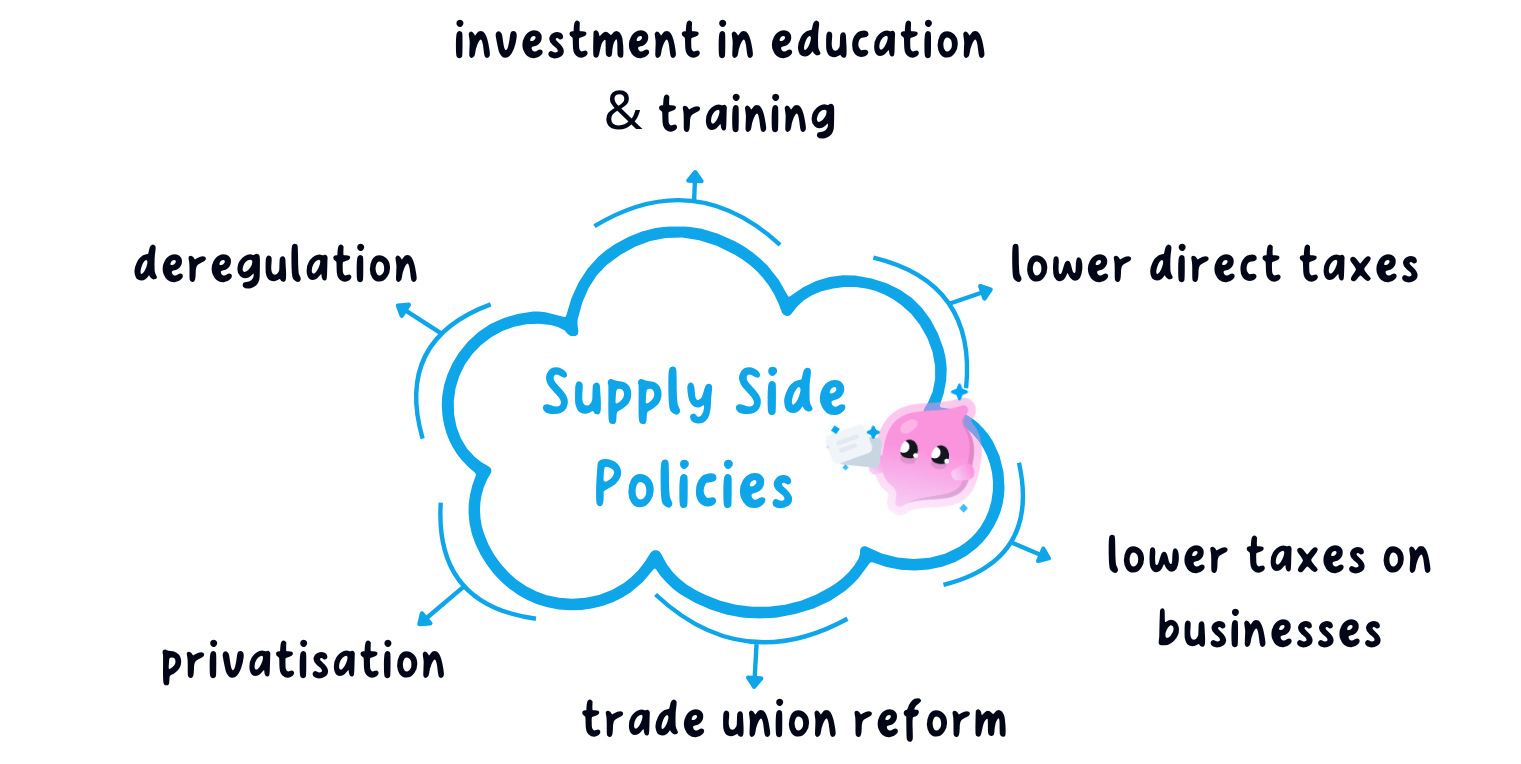
Supply-side measures target skills, tax and competition
Definition
Privatisation: transferring a firm or a service from government ownership into the private sector.
Deregulation: removing or loosening the government rules that restrict how a market operates.
- Education and training: spending to improve workers' skills, such as funding apprenticeships, technical qualifications and adult retraining.
- Infrastructure investment: building the transport, energy and digital networks that firms use to produce and to reach their customers.
- Lower direct taxes: cutting income tax or National Insurance so that workers keep more of what they earn and have more reason to work.
- Lower taxes on business profits: cutting corporation tax so that firms keep more of the return on an investment and undertake more of them.
- Labour market reform: changing employment or trade union law so that workers move more easily between jobs and industries.
- Privatisation and deregulation: exposing firms to competition so they cut costs and improve what they offer.
Supply-side policy differs from demand-side policy
Definition
Demand-side policy: government measures that change the total level of spending in the economy in order to influence output and jobs in the short run.
- Fiscal policy in 3.5.3 and monetary policy in 3.6.1 are both demand-side, because each works by altering how much is spent.
- Supply-side policy works on the other side of the same problem, raising the ceiling that spending runs into.
- The two are used together, since demand-side policy handles the downturn while supply-side policy raises the long-run trend.
Common Mistake
- Supply-side policy is not a remedy for a sudden recession, because almost none of its measures change anything within a year.
- Not all government spending is a supply-side measure, since spending that simply adds demand does nothing to capacity.
Supply-side policy serves the objectives over time
- Growth: more capacity and higher productivity raise the rate the economy can grow at without overheating, as in 3.1.5.
- Employment: retraining reaches structural unemployment, covered in 3.2.5, which extra spending on its own cannot cure.
- Price stability: a bigger capacity means demand can rise further before it starts pulling prices up, which supports the target in 3.4.1.
Exam technique
- Name a specific measure such as retraining or deregulation, because writing that the government supported business earns nothing.
- Say which objective the measure serves and by what route, since the link from the measure to capacity is what is being tested.
Self review
- Define supply-side policy in one sentence.
- Name five types of supply-side measure.
- What is the difference between supply-side and demand-side policy?
- Explain how retraining reduces structural unemployment.
- Why is supply-side policy poorly suited to fixing a sudden recession?
