An exchange rate is the price of a currency
Definition
Exchange rate: the price of one currency expressed in terms of another currency.
Floating exchange rate: an exchange rate set by the demand for and supply of the currency on the foreign exchange market, rather than fixed by the government or the central bank.
- Currencies are bought and sold on the foreign exchange market, where the pound is traded against the dollar, the euro and every other currency.
- A rate is always quoted as a pair, such as one pound buying 1.30 dollars, because a currency has no value on its own, only a value against something else.
Common Mistake
- A floating rate is not a number the government picks, so avoid writing that the UK sets or lowers its exchange rate.
- Policy can change the conditions traders face, but the rate itself is settled by trading in the market.
Who demands pounds on the foreign exchange market
- Foreign buyers of UK exports: a German supermarket buying Scottish salmon has to pay the seller in pounds, so it sells euros and buys pounds first.
- Foreign investors: anyone putting money into UK shares, UK government debt or a UK bank account has to hold pounds to do it.
- Demand slopes downwards: the cheaper the pound is in foreign currency, the better value UK goods, UK assets and UK holidays look, so more pounds are wanted.
Who supplies pounds to the same market
Note
Every foreign exchange deal is two things at once. A UK family buying euros is supplying pounds and demanding euros in the same transaction, which is why the pound market and the euro market are simply the same trade seen from opposite ends.
- UK buyers of imports: a British greengrocer buying Spanish oranges has to pay in euros, so it offers pounds to the market in exchange for them.
- UK investors going abroad: a UK pension fund buying American shares has to give up pounds to obtain dollars.
- Supply slopes upwards: the dearer the pound is, the more foreign currency each pound buys, so foreign goods, foreign assets and foreign holidays look cheap and more pounds are offered.
Where the two curves cross sets the rate
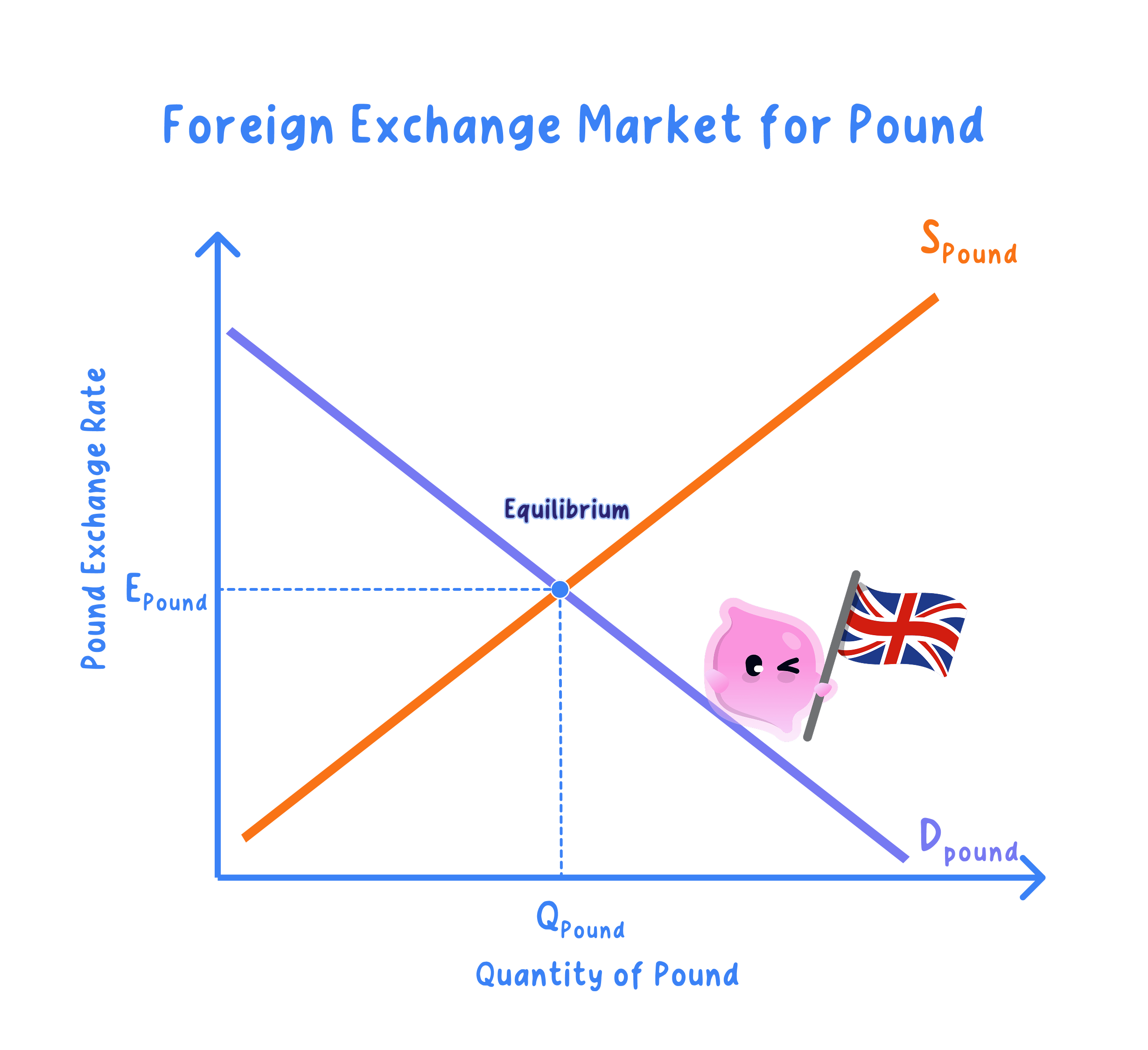
- The equilibrium exchange rate is the rate at which the quantity of pounds demanded equals the quantity supplied, so everyone who wants to trade at that price can.
- Put the exchange rate, meaning the price of a pound in foreign currency, on the vertical axis and the quantity of pounds traded on the horizontal axis. Demand slopes down, supply slopes up, and the equilibrium rate is read across from the point where they cross.
- Reading across gives the rate and reading down from the same point gives the quantity of pounds changing hands, so one crossing answers both questions.
Self review
- In a floating system, what two forces decide the exchange rate?
- Name what goes on each axis of the currency demand and supply diagram.
- Give one group that demands pounds and one group that supplies them.
- Why does the demand curve for pounds slope downwards?
- What happens to the rate when there is a surplus of pounds?
