Demand pull and cost push causes
Definition
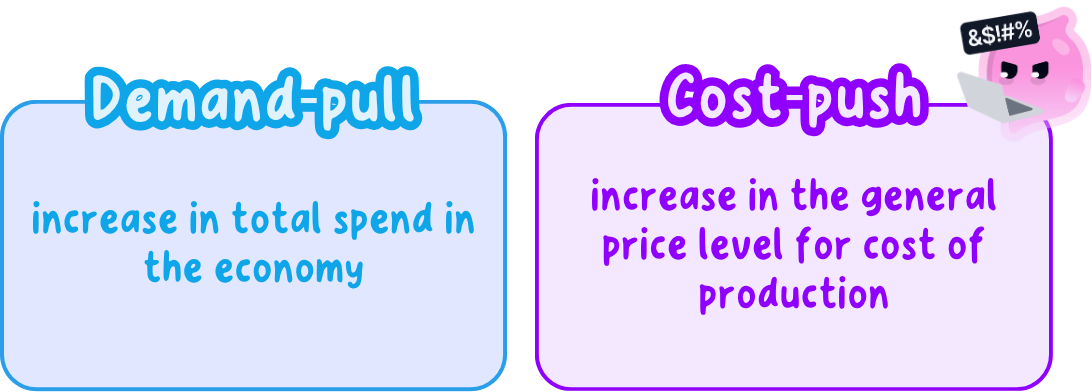
Demand-pull inflation: inflation caused by total spending in the economy growing faster than the economy can produce, so firms raise prices rather than output.
Cost-push inflation: inflation caused by a rise in the costs of producing, so firms raise prices to protect their margins even though demand has not grown.
- The two are told apart by asking what moved first: spending, or costs.
- Demand-pull inflation can occur when total spending rises faster than the economy’s ability to produce. In a boom, firms may increase output and employ more workers at first; once capacity is stretched, prices rise.
- Cost-push inflation occurs when firms’ production costs rise, for example because of higher wages, energy or raw-material prices. Firms may pass these costs on through higher prices; output may fall if firms cut production.
- Also, a faster-growing money supply can cause inflation if it leads to spending rising faster than output.
Example
- The rise in UK inflation to 11.1% in October 2022 was cost-push, because it began with gas and electricity prices rather than with a spending boom (Source: ONS).
- Energy is an input to almost everything, so the increase spread from bills into food, transport and manufactured goods.
Consumers and savers lose buying power
- Consumers: prices rise faster than many incomes, so the same pay buys less, and households spending most of their income on essentials are hit hardest.
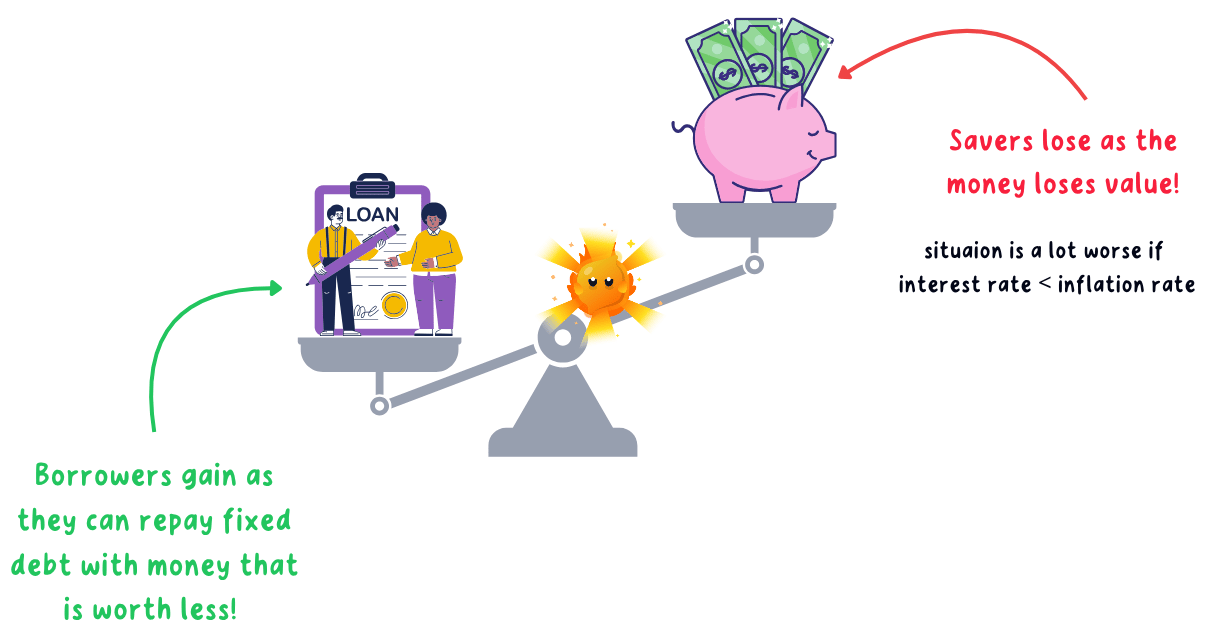
- Savers: interest below the inflation rate means the real value of a balance falls even while the cash total grows.
- Borrowers are the mirror image, because inflation shrinks the real value of a debt fixed in cash terms.
- Anyone on a fixed income: a pension or benefit that is not raised in line with prices loses value every single year.
- The effect on any one household therefore depends on whether its income is tied to prices and on what it spends its money on.
Producers and government face mixed effects
- Producers: rising input costs squeeze margins, and uncertainty about future prices makes investment harder to justify.
- A firm able to pass its costs on suffers far less, which is why the effect depends on how much competition it faces.
- Government: inflation raises tax receipts, because VAT is charged on higher prices and pay drifts into higher income tax bands.
- It also raises what the government must spend, since benefits and pensions are uprated and interest on index-linked borrowing rises.
- High inflation forces a policy response as well, and the higher interest rates used to control it slow growth and raise unemployment.
Common Mistake
- Do not treat inflation as bad for everyone, because a borrower with a debt fixed in cash terms gains, and so does a government whose tax receipts rise.
- Do not assume a producer always loses, since one facing little competition can pass the whole cost increase on to its customers.
How far inflation harms the economy
- It depends on how fast prices are rising, because a low steady rate is easy to plan around while a rapid one destroys the value of contracts and savings.
- It depends on whether it was expected, since pay and contracts can be adjusted in advance for inflation people could see coming.
- It depends on whether pay keeps up, because a household whose income rises with prices loses nothing at all in real terms.
- It depends on what caused it, because demand-pull inflation in a growing economy arrives with extra output and jobs, while cost-push inflation brings higher prices and lower output together.
- Overall: a low and predictable rate does little damage and is clearly preferable to deflation, but inflation that is rapid, unexpected or driven by costs harms consumers, savers and producers at the same time and forces a policy response that itself costs growth.
Exam technique
- Take the groups the question names one at a time, because inflation does different things to a consumer, a producer, a saver and the government.
- Say which cause you are assuming, since the same rate is far worse news when it comes from costs than from demand.
Self review
- What is the difference between demand-pull and cost-push inflation?
- Why do savers usually lose from inflation?
- Give one way the government gains from inflation and one way it loses.
- Why does a producer facing little competition suffer less from cost-push inflation?
- Why does it matter whether inflation was expected?
