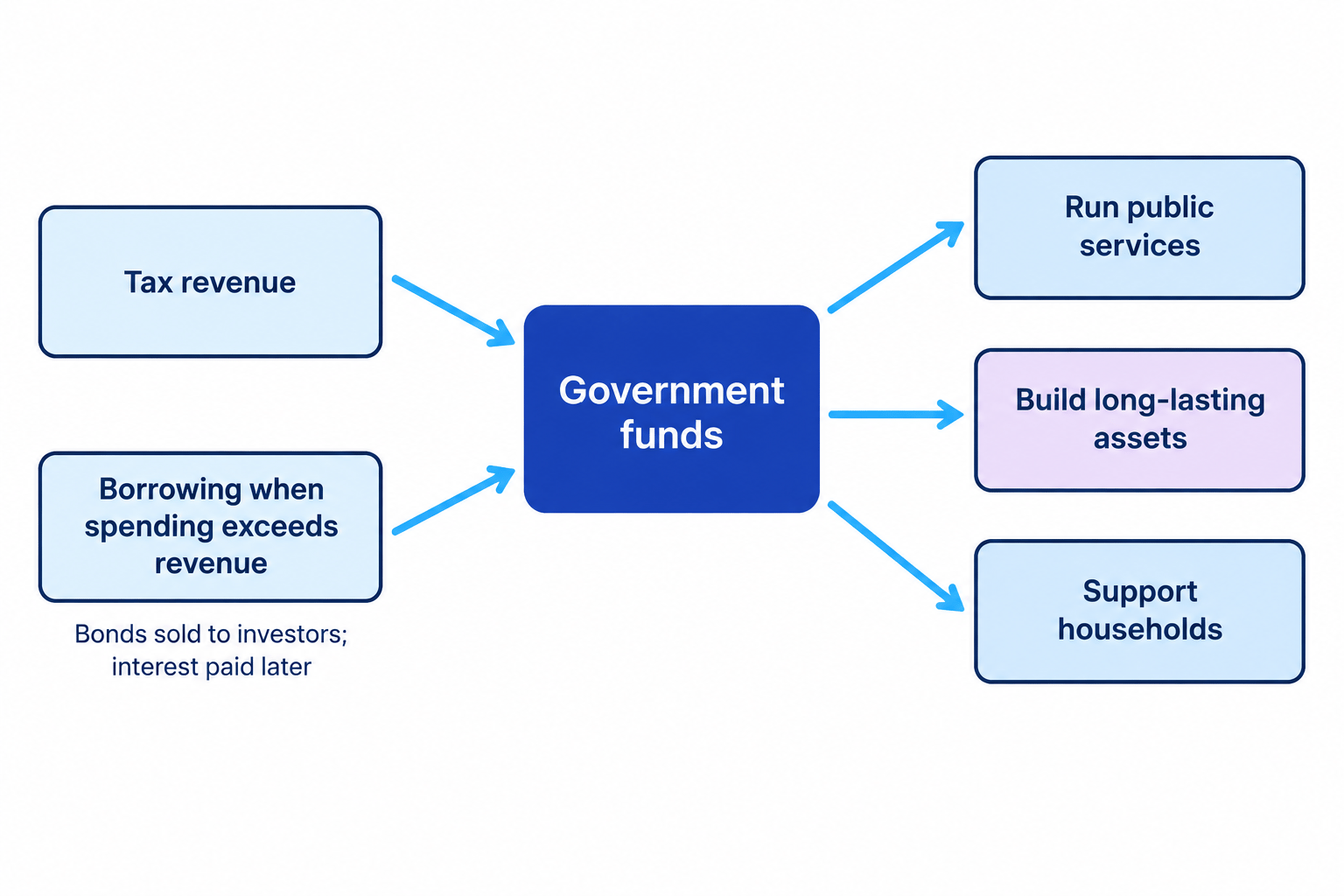
Government spending has three main purposes
Government spending: money the government uses to run public services, build assets and support people, also called public spending.
Government revenue: the money a government raises, mainly through taxation, to pay for its spending.
- Running public services: the NHS, schools, policing and defence all need paying for every year, and this is the largest part of what government does.
- Building assets: hospitals, roads and railways cost money once and then keep producing benefits for decades.
- Supporting people: the state pension and Universal Credit move money to households who would otherwise have very little.
- Correcting problems markets leave behind: spending can fund things a market would provide too little of, such as flood defences or vaccination.
- In 2024/25 UK social protection, which covers pensions and benefits, cost around £384 billion, or 30% of all government spending (Source: House of Commons Library).
- Health came next at about £242 billion, or 19%, followed by general public services at £158 billion and education at £119 billion.
Current, capital and transfer spending differ
Current spending: regular day-to-day spending on running public services, which repeats every year and is used up quickly.
Capital spending: spending on new long-lasting assets that will be used for many years.
Transfer payments: payments to individuals for which the government receives no good or service in return.
- The test is what the money buys, not how much of it there is, so a small purchase of equipment can still be capital spending.
- Building a new hospital is capital spending, while the wages of the nurses working inside it are current spending every year afterwards.
- The split matters because capital spending adds to what the economy can produce in future, while current spending mostly maintains what already exists.
- Transfer payments are different again, since nothing is produced in exchange and the money simply moves from taxpayers to recipients.
- Do not classify spending by its size, because a new railway line is capital spending while the far larger yearly bill for running the trains on it is current.
- Do not treat a transfer payment as buying a service, since the government receives nothing produced in return for it.
Taxation is the main source of revenue
Direct tax: a tax charged on income, profits or wealth, paid straight to the government by the person or firm that owes it.
Indirect tax: a tax charged on spending, collected by the seller and passed on to the government in the price of the good or service.
- The main UK direct taxes are income tax, National Insurance and corporation tax on company profits.
- The main indirect taxes are VAT, charged at a standard rate of 20% on most goods and services, along with duties on fuel, alcohol and tobacco.
- Income tax and National Insurance together raise more than any other source, and VAT is the next largest.
- Smaller amounts come from charges and fees, such as passport fees and the fares paid on publicly owned transport.
- The difference matters because a direct tax follows the taxpayer's income while an indirect tax follows what they choose to buy.
Borrowing fills the gap that remains
- When spending is higher than revenue the government borrows the difference, mainly by selling bonds to investors.
- Borrowing is not free money, because it has to be repaid with interest, and that interest is itself government spending in later years.
- Heavy borrowing today therefore leaves less room for services tomorrow, which is why the gap between spending and revenue is watched so closely.
What that gap is called, and how it is worked out, is covered in 3.5.2.
- Name the three main purposes of government spending.
- Is a teacher's salary current or capital spending, and why?
- What is the difference between a direct tax and an indirect tax?
- Give two examples of a direct tax and two of an indirect tax.
- Why is borrowing not a costless way to fund spending?