The current account records dealings with the world
Definition
Balance of payments: a record of all the money flowing between one country and the rest of the world over a period of time.
Current account: the part of the balance of payments that records trade in goods and services together with income and transfers.
- The balance of payments is kept over a stated period, usually a quarter or a year, so it measures flows of money rather than a stock of wealth held at one moment.
- Money coming into the UK from the rest of the world is an inflow, and money leaving the UK to pay the rest of the world is an outflow.
- The current account is the part of that record you are examined on, and it covers what the UK earns and pays through trade, income and transfers.
- It is built from four components, and adding their balances together gives the current account balance for the period.
Four components make up the current account
- Trade in goods: exports and imports of physical products such as cars, oil, machinery and food.
- Trade in services: exports and imports of services such as tourism, banking, insurance and shipping, where nothing physical crosses the border.
- Primary income: income earned from owning assets abroad or working abroad, such as interest, profits, dividends and wages.
- Secondary income: transfers where nothing is given in return, such as foreign aid, grants and money workers send home to their families.
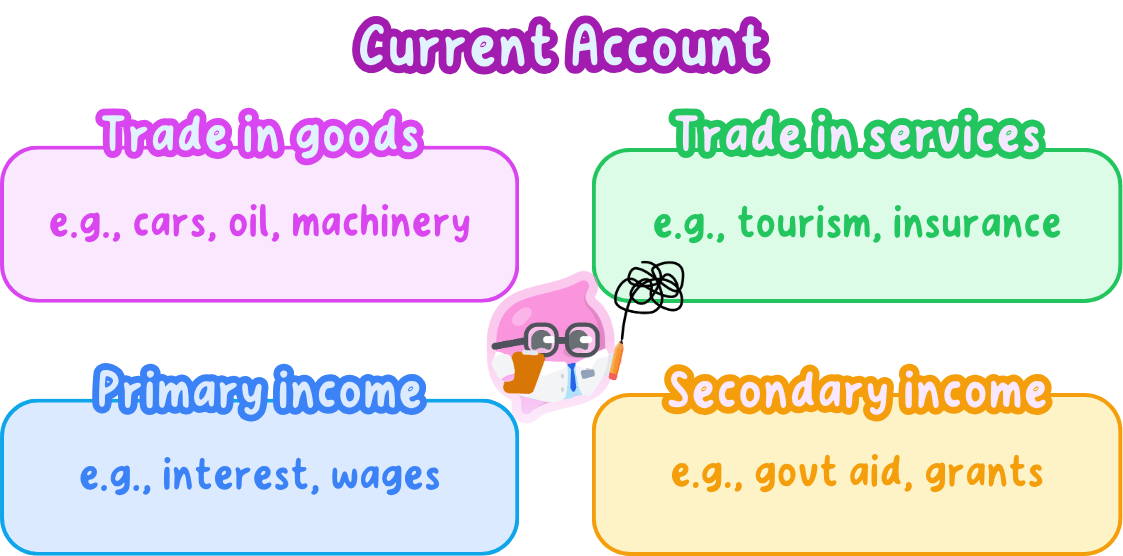
Each component has an inflow and an outflow
- Every component records both money earned from foreigners and money paid to foreigners.
- Trade in goods: a UK firm selling machinery to Japan is an inflow, while a UK shop buying Japanese televisions is an outflow.
- Trade in services: a French family staying in a Cornish hotel is a services export and an inflow, while a UK consumer spending on holiday in Greece is a services import and an outflow.
- Primary income: interest earned by a UK saver on a French bank account is an inflow, while profits a foreign owner takes out of a UK factory are an outflow.
- Secondary income: foreign aid sent abroad by the UK government is an outflow, while grants received from abroad are an inflow.
Investment flows are not on the current account
- The current account covers products, income and transfers only, so money that buys an asset is recorded elsewhere in the balance of payments.
- A Spanish firm buying land in the UK to build a factory is investment, not current account, because the money buys an asset rather than a product, income or a transfer.
- The profits that same firm later sends home from its UK factory do appear on the current account, as an outflow of primary income.
- So the test is what the money buys, not who is paying or where they live.
Common Mistake
- A UK consumer spending on holiday in Greece is on the current account, because a service is being bought.
- Foreign aid sent abroad is on the current account, because a transfer is being made with nothing given in return.
- Interest earned from a French bank account is on the current account, because income is being earned on an asset.
- A foreign firm buying UK land or a UK business is the odd one out, because that is investment.
Sorting a transaction into the right component
- Ask first what is being paid for: a physical product, a service, income from an asset or a job, or a transfer given for nothing in return.
- Then ask which way the money moves, because that decides whether the entry is an inflow or an outflow for the UK.
- The same transaction sits on both countries' accounts in opposite directions, so a UK import of German cars is a German export of goods.
Once the four components are added up the result is a surplus, a deficit or a balanced account, which is where 4.2.2 begins.
Exam technique
- Name the exact component, such as primary income, rather than the vague word income.
- Where money buys an asset abroad, such as land, shares or a factory, keep it off the current account altogether.
- Decide the direction before you write, since one country's inflow is always another country's outflow.
Self review
- Name the four components of the current account.
- Which component records money sent abroad as foreign aid?
- A UK saver earns interest on a French bank account. Which component is that, and is it an inflow or an outflow?
- Why is a Spanish firm buying UK land to build a factory not on the current account?
- Give one example of a UK export of services.
