Three positions the current account can take
Definition
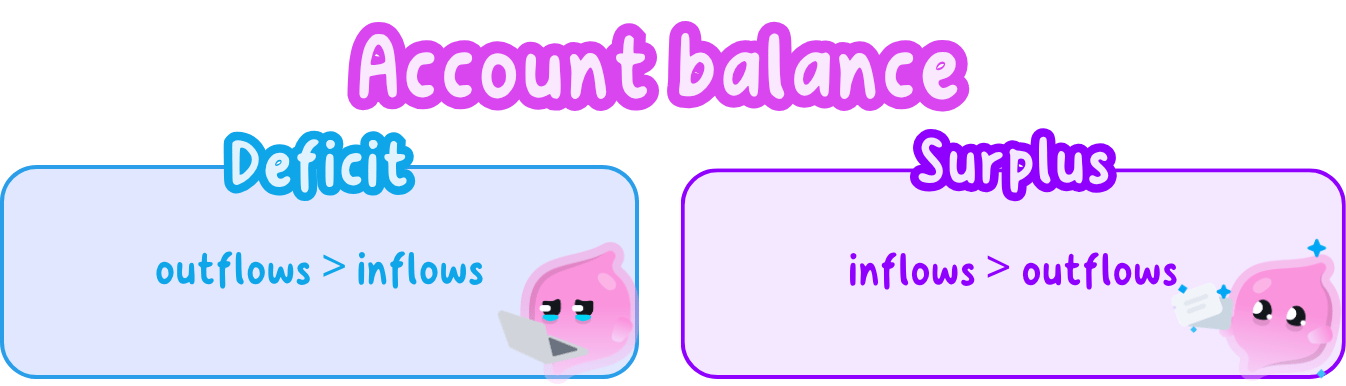
Current account surplus: a position where total inflows on the current account are greater than total outflows, so the balance is positive.
Current account deficit: a position where total outflows on the current account are greater than total inflows, so the balance is negative.
Balanced current account: a position where inflows and outflows are equal, so the balance is exactly zero.
- The three positions are decided by one comparison, between what the country earns from the rest of the world and what it pays out over the same period.
- A balanced account is rare in practice, because inflows and outflows almost never land on exactly the same figure.
- The word balanced is therefore used loosely in commentary to mean close to zero, but in a definition it means precisely zero.
- All three positions are flows measured over a period, so a country can be in surplus one quarter and in deficit the next without anything dramatic happening.
The sign tells you which position it is
- A positive figure is a surplus and a negative figure is a deficit, so the sign carries the meaning and must never be dropped.
- A deficit is usually written with a minus sign, as in a balance of (minus) -£15 billion, and in words as a deficit of £15 billion.
- Because the figure belongs to a named period, a balance quoted without its quarter or year cannot be judged at all.
Size matters as well as direction
- Direction alone says almost nothing, because every large economy runs balances of billions in one direction or the other.
- The usual way to judge size is as a share of GDP, which scales the balance against the size of the economy that has to carry it.
- That also makes countries comparable, since a deficit of £5 billion is small for the UK but would be enormous for a much smaller economy.
Reading a balance means sign and size together
- Read the sign first to name the position, then read the size as a share of GDP to judge how much it matters.
- Compare one period with the one before it, because a deficit that is shrinking tells a different story from one that is growing.
- A country can stay in deficit throughout while the size falls in cash terms and as a share of GDP, and that is a real change even though the position has not changed.
- Describing that as an improvement is fair, while describing it as a surplus would be wrong, which is why sign and size are read together.
Note
- A deficit is not the same as government debt, because the current account records the whole country's dealings with abroad, not money the government has borrowed.
- A deficit is not automatically bad and a surplus is not automatically good, so the position on its own is a description rather than a verdict.
Self review
- Define a current account surplus in one sentence.
- What does a negative current account balance tell you?
- Why is a balanced current account rare?
- Why is a balance often quoted as a share of GDP rather than in pounds alone?
- Why can a deficit shrink without the current account moving into surplus?
