Five routes lead to the same lower cost
- Section 1.4.3a established that an economy of scale is a fall in average cost as output rises, so the work here is to name the route and trace it to the cost of one unit.
- A growing firm usually collects several routes at once, since the supermarket ordering more stock is also buying bigger lorries and hiring specialist buyers in the same year.
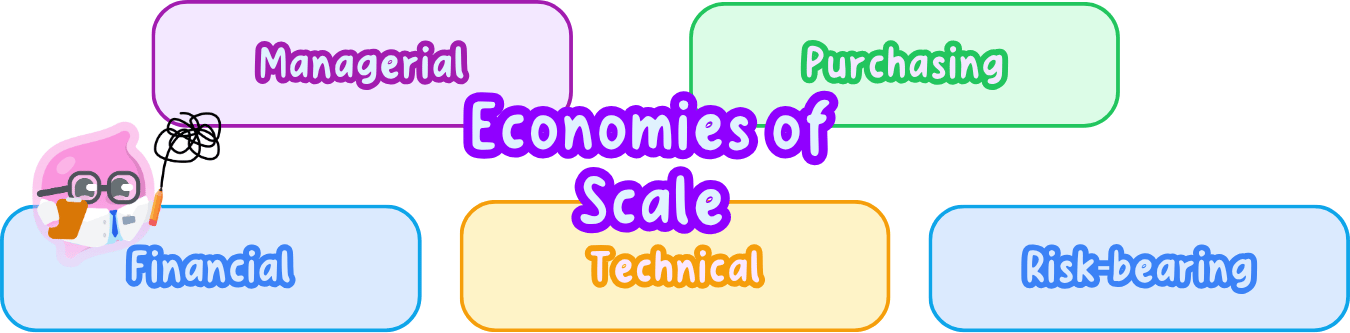
Managerial, purchasing and financial economies come from organisation
Definition
Managerial economies: savings that come from employing specialist managers for separate parts of the business.
Purchasing economies: savings that come from buying materials and stock in larger quantities.
Financial economies: savings that come from being able to borrow and raise money more cheaply.
- Managerial: a small firm's owner has to be accountant, buyer, marketer and production manager at once, and is unlikely to be good at all four. Only at high output is a full-time specialist for each worth their salary, and then average cost falls twice over: better decisions waste less, and the salaries are divided between a very large number of units.
- Tesco employs separate directors and whole teams for buying, logistics, property, technology and people, and their pay spread across billions of pounds of sales adds a fraction of a penny to each item; the same salaries in a corner shop would be impossible.
- Purchasing: a supplier shipping one large order instead of forty small ones spreads its own delivery, invoicing and selling costs over more units, so it can charge less per unit and still profit. Materials are often the buyer's largest single cost, so its average cost falls with them.
- The NHS buys medicines and equipment for around 1.5 million staff and the whole of England at once, securing prices no single hospital could negotiate, and Aldi's narrow range of about 2,000 lines means each line is ordered in huge volume.
- Financial: a bank judges a large, established firm less likely to fail and has more assets to seize if it does, so it lends at a lower rate, and a large firm can skip the bank altogether by issuing shares or bonds. Interest is a cost like any other, so cheaper money on the same machine lowers average cost at every level of output.
- Tesco can borrow by selling bonds to investors while the independent grocer down the road negotiates an overdraft, and the gap between the two rates of interest is the economy.
Example
- Flour for a bakery: an independent shop buys 500 sacks a year and pays £14.00 a sack, while a national chain buying 20,000 sacks pays £11.00 a sack, and one sack makes 100 loaves.
- The loaf, the recipe and the oven are identical, so the whole 3p comes from the size of the order. At two million loaves a week that is £60,000 the chain can hand to customers as a lower price or keep as profit.
Technical and risk-bearing economies come from scale
Definition
Technical economies: savings that come from using larger or more specialised machinery, plant and vehicles.
Risk-bearing economies: savings that come from spreading risk across more products, customers and markets.
- Technical: a large machine or production line only repays its purchase price at high output, but once running it makes each unit more cheaply than smaller equipment can, and high output also makes it worth breaking production into specialised stages so each machine and worker repeats one task.
- Larger containers, lorries and ships cost less per unit of what they carry, because doubling the size of a tank costs far less than doubling the metal around it.
- Nissan's Sunderland plant runs robotic body and paint lines that only make sense at roughly 300,000 vehicles a year, and JCB machines digger parts on dedicated lines rather than general purpose tools.
- Risk-bearing: a firm with one product in one town loses everything if tastes move, while a firm with twenty products in ten countries loses one twentieth of its sales.
- That steadiness lowers cost without any supplier cutting a price, since lenders and insurers charge less for a business whose income is steady, the firm can afford to test products that may fail, and it can hold less idle cash against a bad month.
- JCB sells many machine models into dozens of countries, so a construction slowdown in one market no longer threatens the whole firm, and Tesco spreads risk across groceries, clothing, banking and several countries.
Common Mistake
- Lower total cost is not the test: total cost almost always rises with output, and it is average cost that has to fall.
- Getting bigger is not the test either: a firm can double output and sales with the cost of each unit unchanged.
Spotting which type a question is describing
- Ask what the firm bought or hired, since machinery and vehicles point to technical, materials and stock to purchasing, and managers to managerial.
- Ask who charged less, because a lender charging less is financial while a supplier charging less is purchasing, and candidates lose marks by swapping the two.
- Ask whether the saving came from safety rather than from a bill going down, since risk-bearing works through spread and steadiness rather than a visible discount.
- Then name the type, give the firm that shows it, and finish with the same sentence every time: the cost of each unit falls, so average cost falls.
Self review
- Name the five types of economy of scale AQA lists.
- Which type explains a large firm borrowing at a lower rate of interest than a small one?
- Flour costs £14.00 a sack on a small order and £11.00 on a large one, and one sack makes 100 loaves. How much does the large order save on each loaf?
- Explain how a technical economy of scale lowers average cost.
- Why does a rise in total cost not rule out an economy of scale?