Higher production can lower the cost per unit
Definition
Economies of scale: a fall in the average cost of production as a firm raises its output.
Average cost: what it costs a firm to produce one unit of its output.
- The formula puts output underneath: average cost=total costoutput\text{average cost} = \frac{\text{total cost}}{\text{output}}average cost=outputtotal cost, so average cost falls as output rises whenever total cost rises by proportionally less than output does. This is the one sentence 1.4.3b and 1.4.3c both build on.
- Fixed costs are the clearest route, because rent, machinery, insurance and head office are paid whatever the output, so every extra unit carries a smaller share of them.
- Section 1.4.1b sets out fixed, variable, total and average cost in full, so all you need here is the single division.
- Total cost almost always rises as output rises, since more flour, more electricity and more hours are used, which is why the saving can only be seen per unit.
- The gain is captured only when the larger output is actually made and sold, because a half empty factory spreads its fixed costs over fewer units, not more.
Example
- A bakery raising weekly output: fixed costs are £12,000 a week and each loaf uses £0.40 of flour, packaging and power.
- Total cost rose by £16,000 while output tripled, so every loaf now costs 40p less to make. That 40p is the economy of scale, and a student who looked only at the £16,000 would have concluded the opposite.
Cheaper units change how firms behave
- Growth becomes an objective in its own right, because a larger output is the only way to reach the lower average cost, so firms open branches, buy rivals and chase volume they do not immediately need.
- A large firm can undercut a small one and still profit, since a price leaving 10p on each of its units can leave a loss on each of the smaller rival's dearer units.
- Some firms cut price deliberately to win volume, because the extra sales lower average cost further, which pays for the next price cut, and Aldi has used that loop to take share from far larger grocers.
- The cost gap works as a barrier to entry, as a new firm necessarily starts small and so starts with a higher average cost than the firms it is trying to beat on price.
- Industries where the saving is large end up concentrated in a few big producers, which is why car assembly, water, electricity networks and groceries are dominated by a handful of names.
- Where the saving is small, as in hairdressing, plumbing and independent cafes, thousands of tiny firms survive side by side.
- Firms redesign what they make, favouring standard products in long runs, because standardisation is what makes the big machine and the long run possible in the first place.
Case study
- Nissan's Sunderland plant builds a few models in very high volume, so presses, paint shop and robots costing hundreds of millions of pounds are spread over roughly 300,000 vehicles a year.
- Aldi stocks around 2,000 lines against roughly 30,000 in a large Tesco, so each line is ordered in enormous quantity: both firms chose a narrow range on purpose, because that is what raises output per line and pulls average cost down.
- Amazon UK spreads the cost of writing its ordering software over every parcel it ships, so the cost per parcel of that software falls each time volume grows.
Growth brings lower costs, market power and finance
- Lower unit costs are the benefit AQA cares about most, and can be taken as a lower price to win customers or as a wider margin at the old price.
- Market power grows with size, so a bigger firm can press suppliers for better terms and raise its own price with less fear of losing customers.
- Finance becomes easier and cheaper, because a large firm has more assets to offer as security and can raise money by issuing shares or bonds, which is closed to a corner shop.
- Risk is spread once the firm sells several products in several places, so a bad year in one market no longer threatens the whole business.
- Survival improves, since a firm with lower average costs can trade through a price war or a recession that bankrupts higher cost rivals.
Growth costs control, flexibility and safety
- It becomes harder to manage and coordinate, because decisions one owner used to take alone now pass through layers of managers, and each layer adds delay and salary.
- Flexibility and personal service are lost, since a plant built for long runs cannot switch quickly to a new design and a national chain cannot know its customers the way a single shop does.
- Borrowing rises, and the interest is owed whether the extra output sells or not, so a firm expanding on debt into a falling market can be pushed into losses.
- Diseconomies of scale become a real risk, meaning average cost turns back upwards past a certain size, which is 1.4.3c.
- Growth by takeover is expensive in itself, because the buyer pays a premium for the target and then has to merge two workforces, two computer systems and two sets of habits.
Common Mistake
- Bigger is not automatically cheaper: say why average cost falls in this particular firm.
- Rising sales revenue is not an economy of scale: the test is the cost of each unit.
- A cheaper supplier at unchanged output is not an economy of scale: scale means the fall came from producing more.
Whether growth pays off depends on the firm
- It depends on the industry, because scale is decisive where machinery is huge and products standard, as in car assembly or cement, and worth almost nothing to a plumber whose job differs in every house.
- It depends on whether the extra output can be sold, since a firm that produces more cheaply and then cannot shift the units has raised its costs and its stock, not lowered them.
- It depends on how the growth is paid for, because expansion funded from retained profit can be slowed if demand disappoints, while expansion funded by borrowing carries interest that cannot.
- It depends on how well the firm is organised, as splitting a large business into divisions with their own budgets can hold average cost down at sizes that would otherwise become unmanageable.
- It depends on whose interests you are judging, since owners collect the lower unit costs while customers gain only if competition forces the saving into prices, and workers may face a less personal employer.
Note
Judgement: growth is worth its costs up to the output at which average cost stops falling, because the cost advantage is structural and permanent while most of the costs of growth are management problems a well run firm can fix, so the sensible target is the size that minimises average cost rather than the largest size the firm could reach.
Growth pays off until average cost stops falling
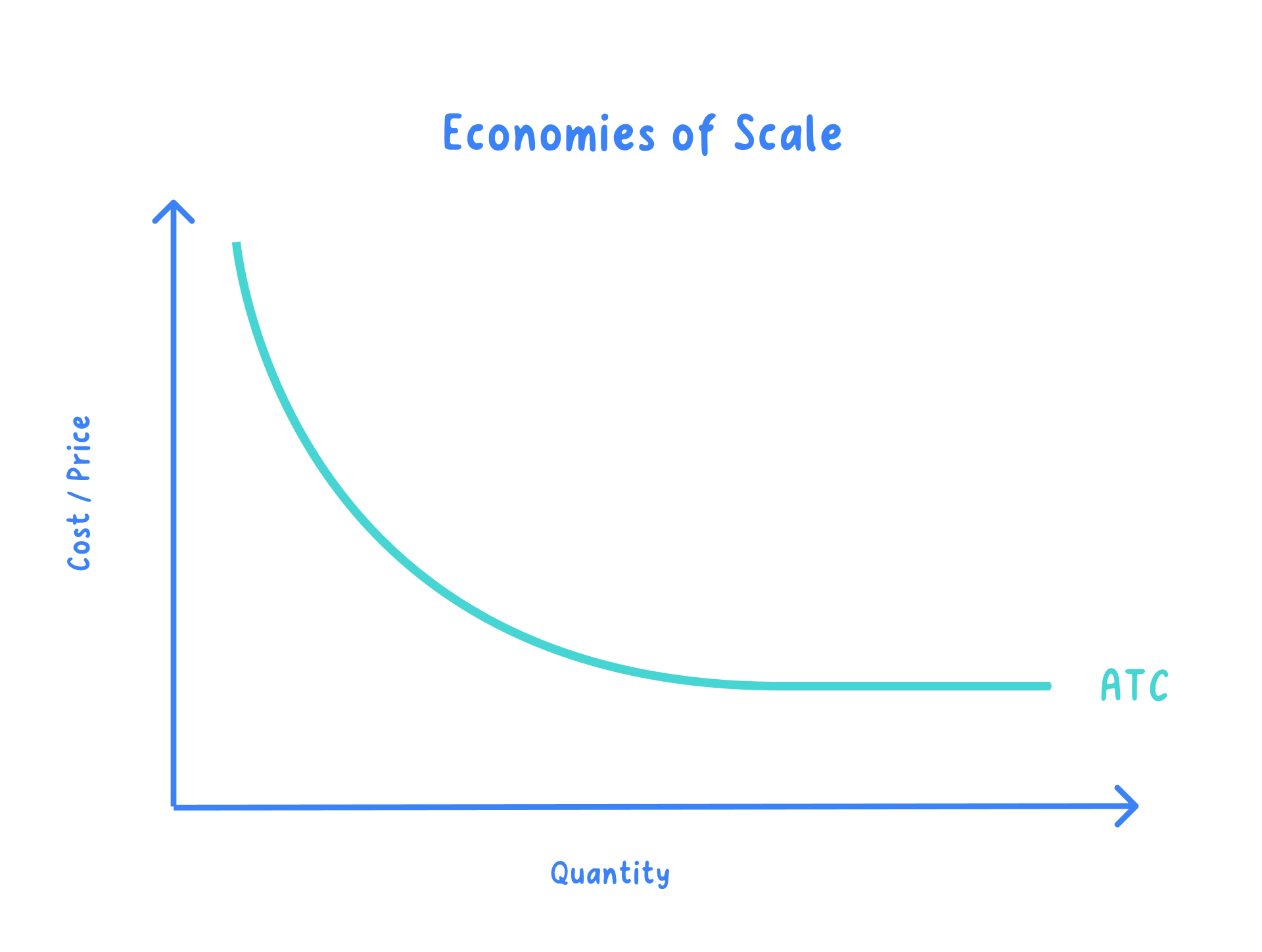
- Average cost sits on the vertical axis and output on the horizontal axis; the curve falls as economies of scale are captured, then reaches a minimum.
- That minimum is the output a firm chasing lower costs is aiming for; beyond it the curve turns upward into the U shape covered in 1.4.3c.
Exam technique
- Divide total cost by output at both given outputs and quote both average costs.
- For "evaluate", weigh the benefits of growth against its costs, then state what your judgement depends on.
- Judge how large the saving is likely to be for the given firm: decisive for a car plant, negligible for a hairdresser.
Self review
- Define an economy of scale.
- A bakery's total cost rises from £20,000 at 20,000 loaves a week to £36,000 at 60,000 loaves. What happens to average cost, and by how much?
- Give two ways economies of scale change how a firm behaves.
- Give two benefits and two costs of growth for a business.
- Why is a rise in sales revenue not evidence of an economy of scale?