Monopoly means one seller, oligopoly a few
Definition
Monopoly: a market supplied by a single seller, or dominated by one firm large enough to set its price without regard to any competitor.
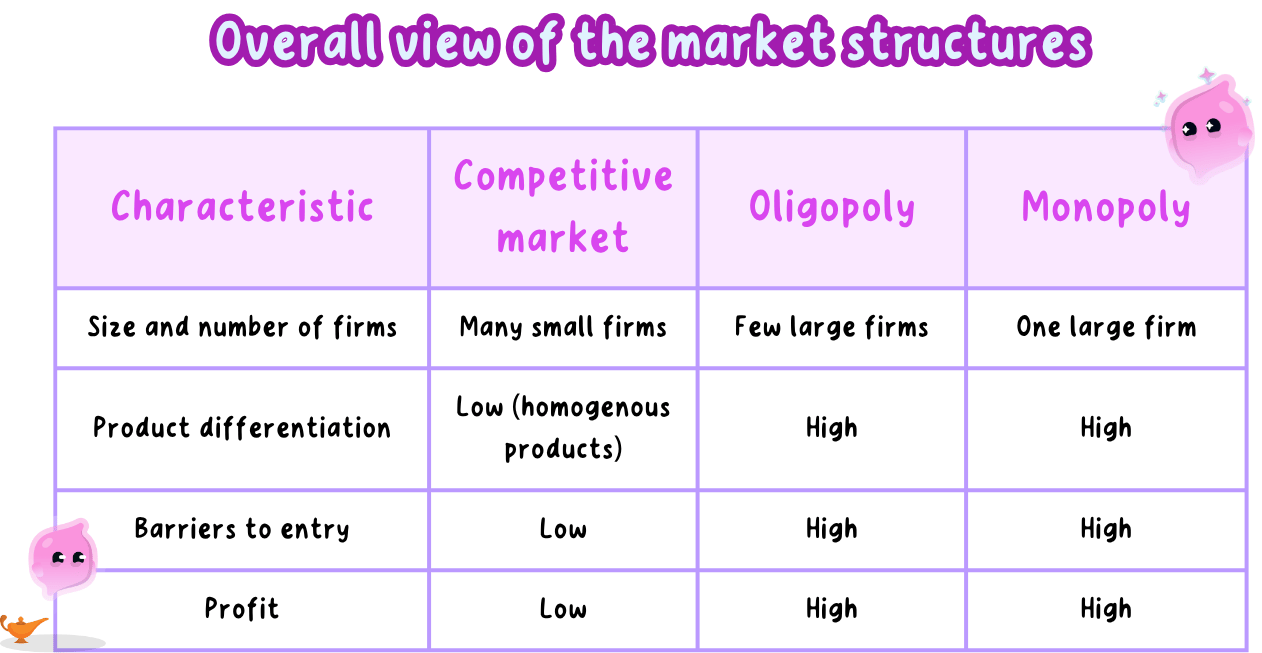
- Both sit at the concentrated end of the range of market structures set out in 1.5.3a, where barriers to entry are what make the power last, and they differ in one thing only: how many firms hold it.
- Monopoly in practice:
- A pure monopoly with literally one seller is rare, so competition authorities work with dominance instead, treating a large enough market share as monopoly power.
- A share above about 40 per cent is usually enough for a UK firm to be examined as dominant, and a share above half makes dominance very likely.
- The clearest UK cases are those where a single network makes a second seller pointless, such as mains water in a region.
Definition
Oligopoly: a market dominated by a few large firms, each of them big enough to affect the price and each watching what the others do.
- Oligopoly in practice:
- A few large firms supply most of the market, and a fringe of small firms can exist alongside them without affecting what the big ones do.
- Each firm is interdependent, judging how rivals will react before it changes its price, which is why prices here often move together and change rarely.
- Because a price cut invites a matching cut and wins no extra customers, the firms compete through advertising, branding and loyalty schemes instead.
- Concentration measures both cases, by adding together the market shares of the largest few firms.
- On that measure mains water and letter post are close to monopoly, while UK groceries, energy supply, mobile networks and banking are oligopolies.
Example
- A market with four large operators, illustrative figures: total market revenue is £20 billion a year, of which the largest operator earns £6 billion.
- The largest operator holds 30 per cent of the market, a large share but nothing like a monopoly.
- Adding the four largest operators: 30 per cent, 25 per cent, 20 per cent and 15 per cent.
- The four largest operators hold 90 per cent between them, with the remaining 10 per cent shared among smaller firms on the fringe of the market.
- Shares like these shift over time as firms merge, grow or lose customers, so always work concentration out from the figures a question gives you rather than from memory.
Monopolistic and oligopolistic power has identifiable causes
- Legal protection names one lawful seller, as a patent does for a new medicine and a licence does for a radio frequency or a rail franchise.
- Control of a key resource or network needs no law, as Network Rail shows: a rival without access to the track cannot run any trains.
- Very large economies of scale can make one supplier the cheapest way to serve a whole market, which is a natural monopoly, since a second water network would raise the cost per user for everybody.
- High sunk costs deter entry even where nobody is excluded, because money spent on track, pipes or a licence cannot be recovered if the venture fails.
- Brand strength built over decades can hold a large share on its own, because buyers who ask for a name rather than a product give a newcomer nothing to compete against.
- Merger and takeover concentrate a market directly by turning several rivals into one larger firm, which is why the Competition and Markets Authority examines large mergers first.
- Network effects concentrate a market quickly, because a service becomes more useful the more people already use it, so buyers gather on the largest platform and make it larger still.
Case study
- Thames Water: the only mains water and sewerage supplier for about 16 million people, because a duplicate set of pipes would make no economic sense.
- Mobile networks: a small number of firms own network infrastructure, which is why the CMA examines large mergers between them in detail, as it did with the Vodafone UK and Three UK merger completed in 2025.
- Patented medicines: a pharmaceutical firm holds a lawful monopoly on its new treatment until the patent expires and generic makers can enter.
Higher prices, less choice, weaker service usually follow
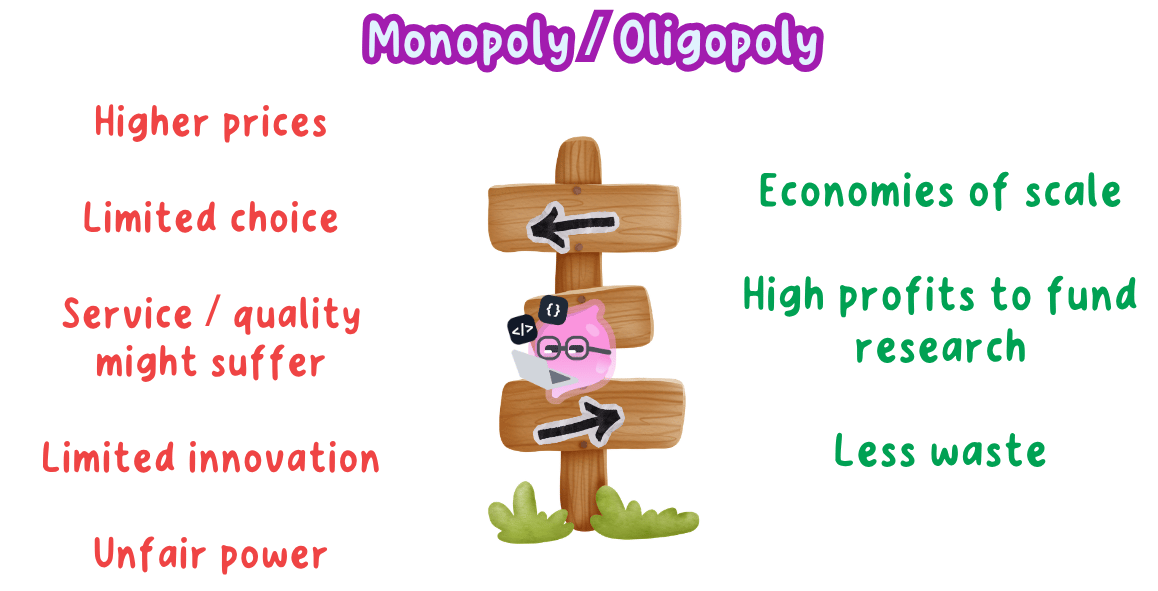
- Price is higher and output lower than a competitive market would produce, because a price maker with no serious rival can hold quantity back and charge well above the cost of supply.
- Buyers who would have paid a competitive price go without, so the harm reaches people who never appear in the firm's sales figures.
- Choice is narrower, since one firm offers one range and drops the lines that suit only a small group of buyers.
- Service and quality suffer where customers cannot leave, which is why complaints about water companies and rail operators have so often outlasted the promises to improve.
Weaker innovation, rising costs and unfair power also follow
- The incentive to innovate weakens, because a protected firm gains little from making its own product obsolete.
- Costs drift upwards without competitive pressure, and a comfortable profit hides the overstaffing and waste that would sink a firm with rivals.
- Income moves from consumers to the owners of the firm, so a dominant seller tends to widen inequality as well as raise the price.
- A dominant firm is often also the only buyer its suppliers can sell to, letting it force down the price it pays a farmer or small manufacturer with nowhere else to go.
Common Mistake
- A monopoly does not always charge a high price: large economies of scale can let it undercut several smaller firms.
- Monopoly is not illegal: holding a dominant position is lawful, and it is abuse of that position that is acted against.
- An oligopoly is not a fixed number of firms: the test is whether a few dominate.
The same power can fund scale and research
- Economies of scale make the strongest case for size, because one firm supplying the whole market spreads its fixed costs over the largest possible output and its cost per unit falls.
- High profits can fund research, and a firm shielded from immediate imitation can spend for years on a new medicine before the work pays.
- Patents exist for that reason, because a firm commits years and large sums to a new drug only if it expects to recover the cost from sales afterwards.
- A single owner can plan and maintain a network as one system, so upgrades to the track or the grid are coordinated rather than split between firms with different plans.
- Scale allows a firm to compete internationally and to hold reserves that carry an essential service through a downturn, which a string of small suppliers could not.
How much this power harms consumers depends
- It depends on whether entry is a real threat, because a firm that expects a newcomer if it pushes its price too far behaves much like a firm with rivals, which is why the big four held prices down against Aldi and Lidl.
- It depends on whether a regulator is active, since a price cap from Ofgem, a licence condition from Ofcom or a merger decision from the CMA removes much of the harm.
- It depends on whether the economies of scale are passed on, because a falling cost per unit helps buyers only if the price falls with it.
- It depends on whether the profits fund genuine innovation rather than being paid straight out to shareholders.
- It depends on the time horizon, since a patent that raises the price of a medicine for a few years may be why the medicine exists, and the harm ends when the patent expires while the benefit does not.
- It depends on which market you are looking at, because a natural monopoly in water genuinely is the cheapest way to supply households while a dominant soft drinks brand carries no such cost advantage.
Note
Judgement: market power is neither good nor bad in itself, because the same size that lets a firm hold its price up is what lowers its cost per unit, so the balance turns on whether the threat of entry or an active regulator forces that cost advantage through into the price. That is why UK policy acts against the abuse of market power rather than against being large.
UK policy targets abuse, not size
- How the UK responds to this power, through the CMA and sector regulators, is 1.6.1b.
Exam technique
- Define monopoly and oligopoly first, then say which one your example is.
- Keep causes of market power separate from its consequences.
Self review
- What is the difference between a monopoly and an oligopoly?
- Name four causes of monopolistic or oligopolistic power.
- Four operators hold shares of 30, 25, 20 and 15 per cent, so what share do they hold together, and what share is left for smaller firms?
- Give two consequences of market power that harm consumers.
- Give two consequences of market power that can benefit consumers.