Wages are set by demand and supply
Definition
Demand for labour: the number of workers, or hours of work, that firms are willing and able to hire at each wage rate.
Supply of labour: the number of workers, or hours of work, that people are willing and able to offer at each wage rate.
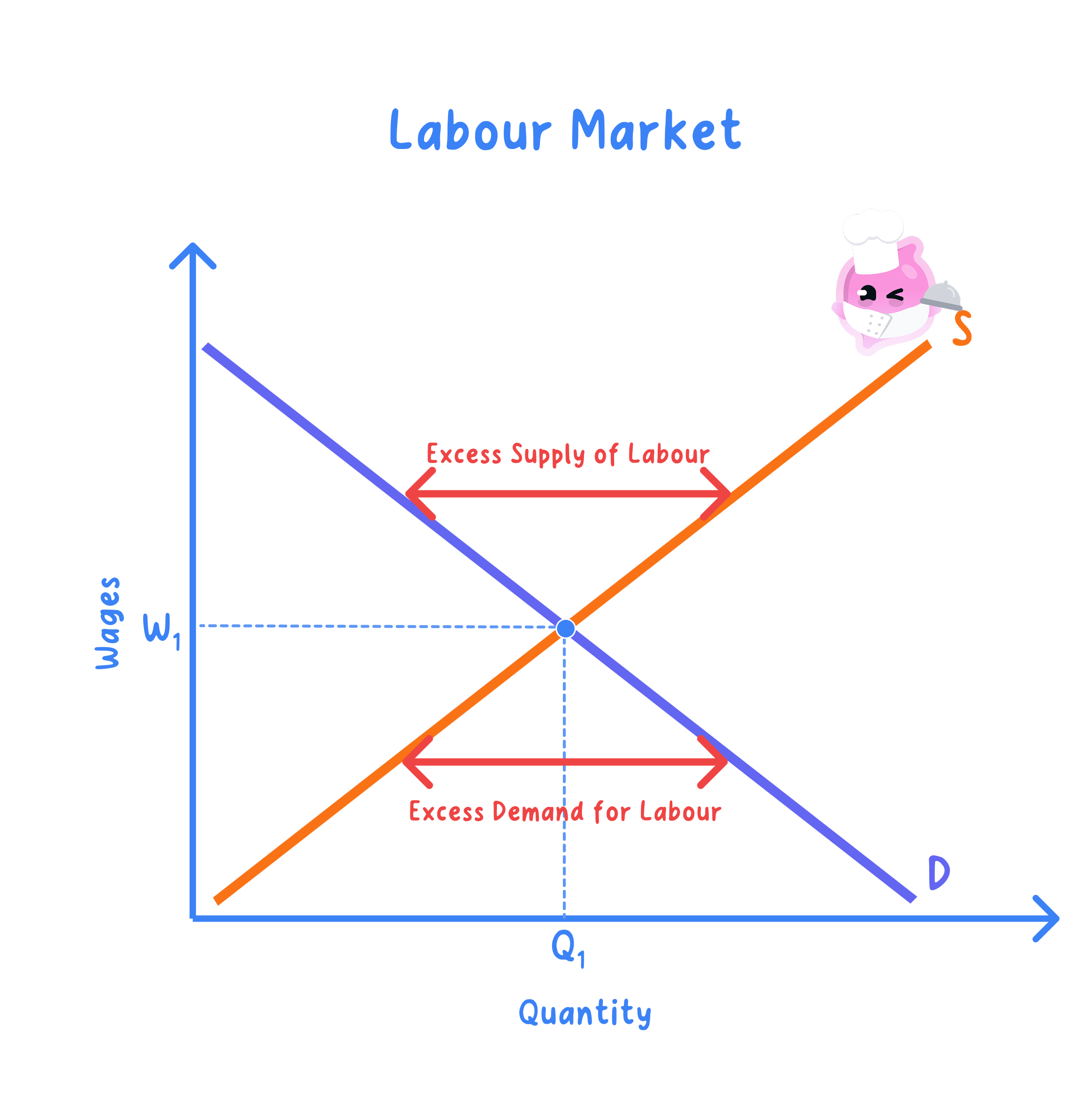
- The labour market works like any other market with the roles reversed: households sell, firms buy, and the price being settled is the wage rate.
- The demand curve for labour slopes downwards, since a higher wage makes every worker more expensive and firms respond by hiring fewer of them or using machinery instead.
- The supply curve for labour slopes upwards, since a higher wage draws in people working elsewhere, tempts in people who were not working and buys extra hours from existing staff.
- The curves cross at the equilibrium wage, which also fixes the number of workers employed.
- Above the equilibrium wage, an excess supply of labour bids the wage down. Below it, an excess demand for labour bids the wage up.
Example
- Warehouse staff in one town: at £11 an hour local firms want 900 workers but only 600 people offer to work, so 300 posts are unfilled, an excess demand for labour of 300, and employers start offering more.
- At £15 an hour 1,000 people offer to work but firms want only 700, leaving 300 people without a job, which is an excess supply of 300.
- At £13 an hour both figures are 800, so £13 is the equilibrium wage and 800 is the quantity of labour employed.
- A new distribution centre opens: at £13 an hour firms now want 1,000 workers rather than 800, a rightward shift of the demand for labour.
- Firms bid the wage above £13, the higher rate draws more people in, and the new crossing point has a higher wage and more than 800 workers employed.
Demand for labour depends on product, productivity, machines
- The demand for labour is a derived demand, meaning it exists only because buyers want the goods and services those workers produce.
- So when demand for the product rises, firms need more output and the demand for that labour shifts right, raising both the wage and employment.
- When demand for the product falls the curve shifts left, which is why weaker high street spending shows up as fewer retail vacancies and slower pay growth.
- Higher productivity raises the demand for labour, because a worker who produces more per hour is worth more to the employer.
- Productivity rises with training, better machinery and better management, which is part of why workers in high-technology firms are paid more than workers doing similar tasks by hand.
- The price of capital matters because machinery substitutes for labour, so cheaper robots or self-service tills shift that demand left, while expensive machinery makes hiring a worker the cheaper option and shifts it right.
- Anything that adds to the cost of employing somebody, such as a rise in employer National Insurance, acts like a higher wage and reduces the number of workers firms want.
Case study
- Self-service tills: they replaced a share of checkout work in every large UK chain, shifting the demand for cashiers to the left.
- Online shopping: it did the opposite for warehouse and delivery work, and Amazon and the supermarkets competed for drivers by raising pay.
- Lorry drivers: UK haulage pay jumped in 2021 when the number of qualified drivers fell while demand for haulage held up, a leftward shift of supply meeting an unchanged demand.
Labour supply depends on who can and will work
- The qualifications required limit supply, because only people holding the degree, licence or trade certificate can offer themselves for the work at any wage at all.
- The length and cost of training limits it further, so a job needing seven years of study and heavy fees attracts far fewer entrants than one that trains a worker in a fortnight.
- How pleasant the work is shifts supply, since dangerous, dirty or unsociable work has fewer willing workers at any wage than comfortable work with long holidays.
- Wages in other occupations matter, because a rise in warehouse pay pulls people out of hospitality and shifts the supply of hospitality labour left.
- Migration adds to or subtracts from the pool directly, and the fall in the number of EU workers in UK agriculture and hospitality after 2020 shifted that supply left.
- The size of the working population sets the overall total, changing with the birth rate a generation earlier, the retirement age and how many people choose to work at all.
- Anything that adds to supply shifts the curve right, so the crossing point slides down the demand curve and the wage falls while employment rises; anything that cuts supply does the reverse, which is what happens when a licence becomes harder to obtain.
Common Mistake
- A shift is not a movement: a change in the wage moves along the curve, while a change in qualifications, training or migration shifts it.
- The employer does not simply decide the wage: one offering less than the going rate cannot fill its vacancies.
Between occupations, differentials come from the same curves
- A wage differential is a difference in pay, and it comes in two kinds: between occupations and within one occupation.
- Between occupations the difference is simply where each occupation's own demand and supply curves happen to cross.
- A surgeon against a shop assistant.
- The supply of surgeons is very small, because the work needs a degree, years of specialist training and a licence, and the demand is high because the value of what one surgeon produces in a day is very large.
- A small supply meeting a high demand crosses at a high wage.
- The supply of shop assistants is very large, because the job needs no formal qualification, and the value each adds per hour is modest, so that large supply crosses demand at a much lower wage.
- On illustrative figures, a consultant surgeon on about £90,000 a year against a retail assistant on about £22,500 is a differential of four times:
- Dangerous or unpleasant work pays more than pleasant work needing the same skill, because fewer people are willing to do it and its supply curve sits further left.
- Productivity and the value of output explain why the same qualification pays differently in different industries, since a worker in a high-value industry adds more to the employer's revenue.
- Bargaining strength decides where pay settles inside the range the two curves leave open, so an occupation whose workers are organised and hard to replace settles nearer the top of it.
Example
- A refuse collector against a receptionist: both jobs need little formal training, yet the refuse collector is often paid more.
- The work is heavy, dirty and starts before dawn, so fewer people are willing to do it at any wage and the supply curve lies further left, which lifts the crossing point.
Within an occupation, the worker and place matter
- Two people doing the same job are often paid differently, and the explanation is still demand and supply, applied to a narrower market.
- Experience and extra qualifications raise an individual's productivity, so an employer pays more for a worker who needs less supervision and makes fewer mistakes.
- Region matters most in the UK, because London employers face a smaller supply of workers willing to work there at any given wage and a higher cost of living, which is why the same job carries London weighting.
- A job paying £30,000 outside London and £34,500 in London is a differential of 15 per cent:
Employer, contract and law open the rest
- Employer size and ability to pay: a large profitable firm can outbid a small one for the same worker, which is why a mechanic at a main dealer often earns more than one at a village garage.
- The sector: the same accountant is paid on a national scale in the public sector and at whatever a City firm has to offer to win them.
- Hours and contract type: full-time, part-time and agency staff doing the same work are often on different rates.
- Discrimination: it can open a gap that demand and supply do not explain, and UK equal pay law exists because differences in pay by sex or ethnicity are not accounted for by productivity.
- The National Living Wage: it compresses these differences at the bottom by setting a floor the lowest-paid workers in an occupation cannot be paid below.
Exam technique
- Label the axes correctly and mark the crossing point as the equilibrium wage.
- Decide whether an influence shifts demand or supply before stating the effect on the wage.
- Cover differentials within an occupation, not just between occupations.
Self review
- Which way does the demand curve for labour slope, and which way does the supply curve slope?
- Why is the demand for labour called a derived demand?
- Name three influences on the supply of labour.
- At £15 an hour 1,000 workers offer their labour and firms want 700, so how large is the excess supply?
- Using demand and supply, why does a surgeon earn more than a shop assistant?