Intervention works by changing the incentives people face
- A government cannot order households to want different things, so it changes the price, the rules or the supply until private decisions line up with what society wants.
- Where a good is over-provided, intervention makes it dearer, harder to obtain or illegal, so less of it is bought.
- Where a good is under-provided, intervention makes it cheaper, compulsory or free at the point of use, so more of it is consumed.
- The test of every method is the same: does output move closer to the quantity society would choose?
Taxes and subsidies both work through the price
Definition
Indirect tax: a tax placed on the sale of a good or service, collected from the seller and passed on to the buyer through a higher price.
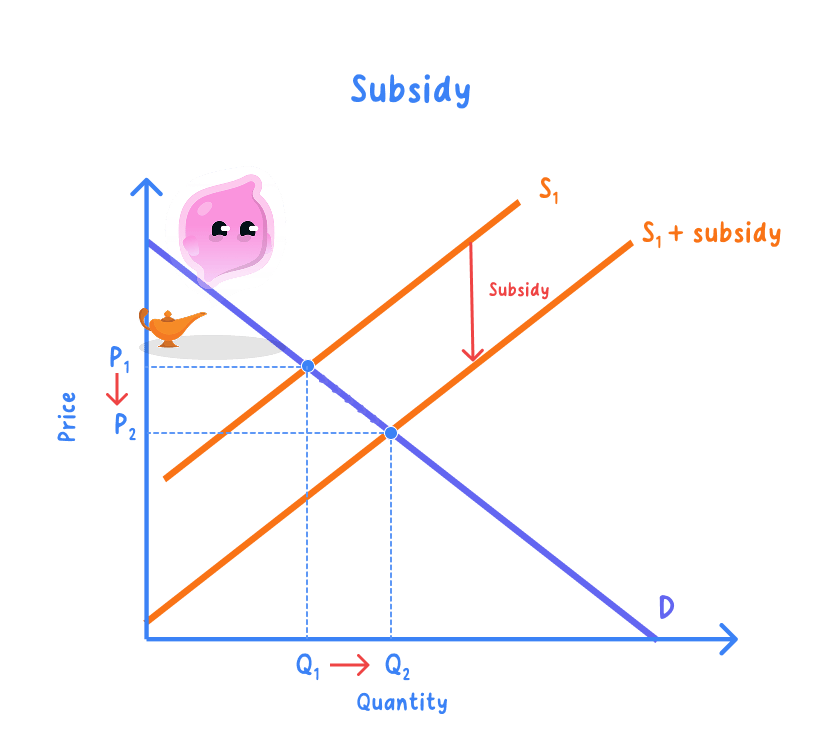
Subsidy: a payment from the government to a producer or consumer that lowers the cost of supplying or buying a good, so more of it is sold at a lower price.
- The two are mirror images on a supply and demand diagram, since a tax adds to the cost of supplying each unit and shifts supply left, while a subsidy cuts that cost and shifts supply right.
- Neither method forbids anything, so anyone who still values the good enough goes on buying it, which is why both are chosen where the aim is to reduce an activity rather than end it.
An indirect tax makes buyers pay for the harm
- The tax raises the price, quantity demanded contracts, fewer units are produced and so less of the associated harm is created.
- The Soft Drinks Industry Levy, introduced in 2018 at 18p a litre above 5g of sugar per 100ml and 24p a litre above 8g, changed producers as much as buyers, because most manufacturers reformulated their drinks to fall below the threshold.
- The landfill tax has risen from around £7 a tonne in 1996 to over £100 a tonne, which made recycling and recovery cheaper than dumping and pulled waste away from landfill sites.
- Tobacco and alcohol duties collected by HMRC work the same way, and the revenue can be used to fund the treatment the harm creates.
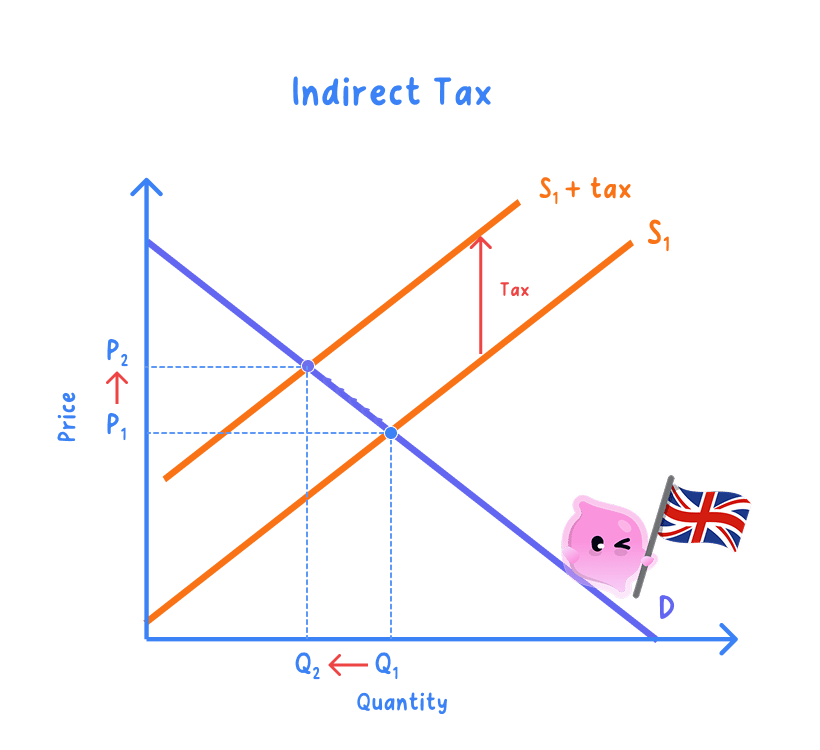
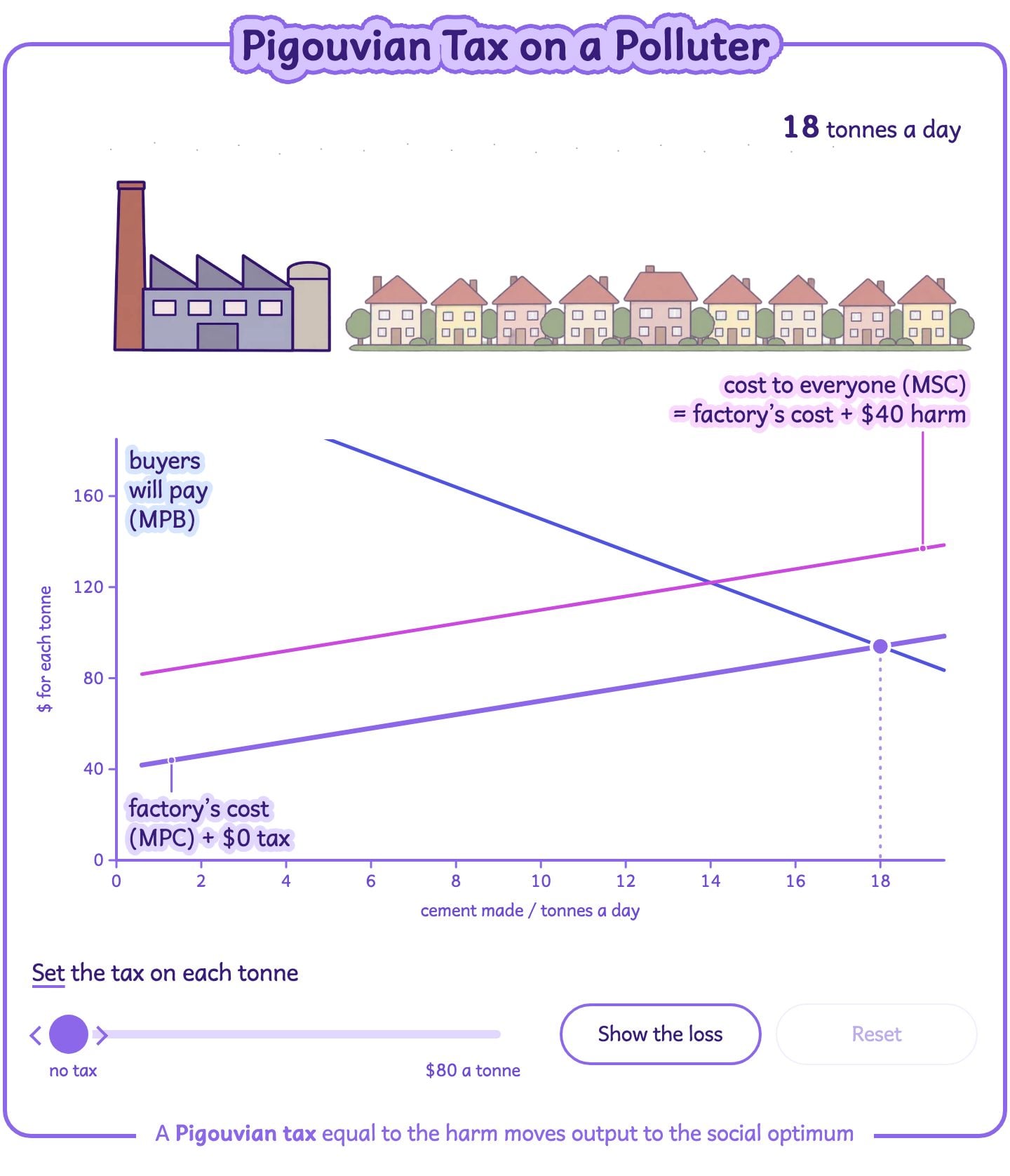
Add a tax equal to the harm and watch output fall towards the level that is best for society.
Subsidies make beneficial goods cheap enough to buy
- The subsidy lowers the price and quantity demanded extends.
- Bus services outside London are supported by local authority funding, which keeps fares low enough that passengers switch off the roads.
- Government grants towards heat pumps and home insulation cut the up-front cost, so more households install them and national energy demand and emissions both fall.
- Apprenticeship funding pays part of the training bill, which stops firms cutting back on training simply because a trained worker can leave for a rival.
Case study
- The Soft Drinks Industry Levy was deliberately banded rather than flat, so a producer could escape it entirely by cutting sugar below 5g per 100ml.
- Most large manufacturers reformulated within two years, so the sugar bought in soft drinks fell even where sales volumes held up.
- That is the clearest lesson of the policy: a tax can correct a misallocation by changing what is produced, not only by pricing buyers out.
Regulation sets limits that prices alone cannot
- Bans remove the activity altogether where the harm is too serious to price, as with the smoking ban in enclosed public places in force across the UK by July 2007, which cut second-hand smoke for staff and customers at a stroke.
- Limits and minimum standards cap the harm rather than the activity, as the London ULEZ does by charging the most polluting vehicles to enter and leaving cleaner ones free.
- Legal requirements on retailers work through a small charge, and the 5p plastic bag charge from 2015, later raised to 10p, cut single-use bag sales at the main supermarkets by more than 95 per cent.
- Licensing and industry regulators police standards where a market would not, so Ofgem and Ofwat set what energy and water suppliers may charge and must deliver, Ofcom regulates telecoms and the CMA acts against firms that abuse their market position.
- Regulation bites hardest where the harm is concentrated and easy to inspect, because a rule with no inspector behind it changes nothing.
State provision and information campaigns fill the gap directly
- State provision means the government supplies the good itself out of taxation, rather than waiting for a market to do it.
- The NHS is free at the point of use, so nobody leaves an illness untreated because they cannot afford the fee.
- State schooling is compulsory as well as free, which removes the choice that would otherwise leave education under-consumed.
- Information and education campaigns change what people want rather than what they can afford, which is why the effect lasts once the campaign stops.
- NHS public health campaigns on smoking, drinking and healthy eating give people the information the seller has no reason to supply.
- Compulsory health warnings and plain packaging on cigarettes, and decades of drink-drive advertising, changed what UK consumers regarded as normal behaviour.
Common Mistake
- A subsidy shifts supply, not demand: it cuts the producer's cost, it does not make buyers want the good more.
- A tax on a good with inelastic demand raises revenue, it does not stop the behaviour.
- Intervention is not automatically an improvement: get the size wrong and the government has simply moved the misallocation.
Success depends on how people respond
- It depends on how responsive demand is to price, because tobacco duty barely changes the habit of an addicted smoker and mostly raises revenue, while the sugar levy worked because producers could respond by reformulating.
- It depends on how easily the policy can be enforced, since the ULEZ has a camera on every entry point while the landfill tax pushed some waste into fly-tipping that nobody was watching for.
- It depends on whether a ban pushes trade underground, because outlawing something people still want moves it to illegal sellers, where there is no safety standard, no age check and no tax collected.
- It depends on the time horizon, as a tax or a ban changes behaviour on the day it starts while an education campaign shifts habits over a generation and is far harder to judge in the meantime.
It also depends on cost, and on who pays
- It depends on whether the government can judge the size of the harm, because a tax set too low leaves the misallocation in place while one set too high drives resources out of a market society still wants served.
- It depends on who bears the cost, since an indirect tax takes a larger share of a low income than a high one, so a policy that corrects a misallocation can widen inequality at the same time.
- It depends on the opportunity cost of the money, because every pound spent on a subsidy, an inspectorate or state provision is a pound not spent on the next most valuable public service.
- It depends on whether the government gets it wrong, since poor information, lobbying by affected firms and unintended side effects can leave resources allocated worse than they were before the policy.
Note
Judgement: intervention is worth using where the harm is large, measurable and enforceable, as with the landfill tax and the ULEZ, but no single method is reliably best, because a tax changes the price, regulation sets the limit and information changes what people want in the first place.
In practice, governments combine several methods
- UK smoking policy stacked four of the five methods together, using tobacco duty as the tax, the ban in enclosed public places and plain packaging as regulation, NHS campaigns and the warnings on the packet as information, and free NHS stop smoking services as state provision.
- The methods reinforce each other, because the tax makes the habit expensive while the campaign makes giving it up seem worth doing, and adult smoking rates fell further than any one measure would explain.
- Combining methods also spreads the burden, so the whole cost of correcting the misallocation does not fall on the poorest buyers through the tax alone.
Exam technique
- Decide first whether the question is about cutting consumption or raising revenue: a tax on a good with inelastic demand does the second and hardly the first.
- Name the mechanism, not just the policy: the Soft Drinks Industry Levy worked by pushing manufacturers to reformulate, not simply by making cola dearer.
- When you criticise an indirect tax, say who carries it: it takes a larger share of a low income than of a high one.
Self review
- Name the five main methods a government uses to correct a misallocation of resources.
- Explain the chain from an indirect tax to less of the harm being created.
- Why did the Soft Drinks Industry Levy change producers as well as buyers?
- Give one UK example of regulation and one of state provision.
- Why can an indirect tax that corrects a misallocation still widen inequality?