Elastic and inelastic supply are judgements about proportions
Definition
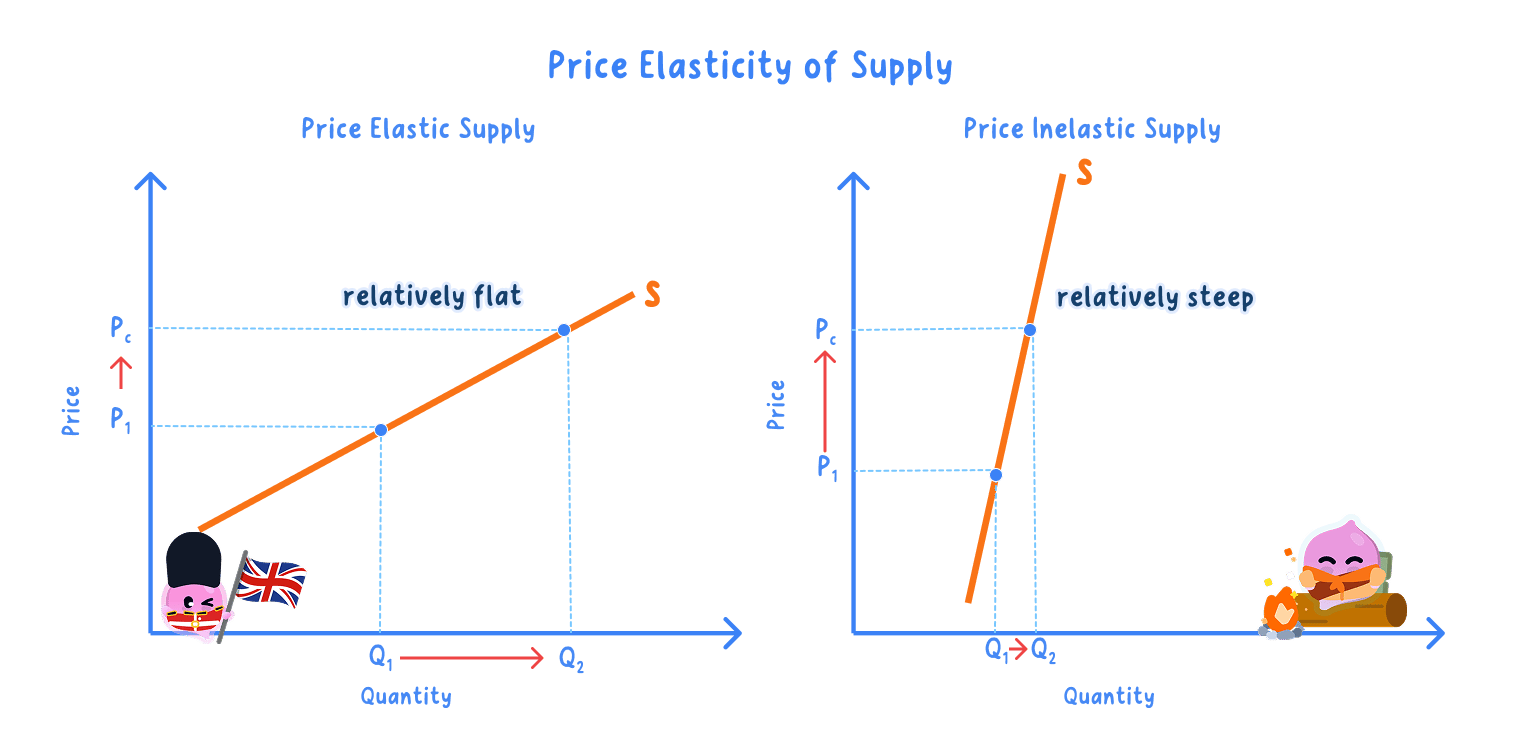
Price elastic supply: supply where the quantity supplied changes by proportionally more than the price that caused the change.
Price inelastic supply: supply where the quantity supplied changes by proportionally less than the price that caused the change.
- The test is a comparison of two percentage changes, so the raw number of extra units settles nothing.
- A steelworks making 50,000 tonnes that adds 500 has barely moved, since that is a rise of 1 per cent.
- A guitar workshop making 600 instruments that also adds 500 has almost doubled its output.
- Both labels work downwards as well as upwards, because a price fall makes producers cut output and that reaction can also be strong or weak.
- Neither label belongs permanently to a good, so the same producer can be inelastic over a fortnight and elastic over five years.
- Every factor below therefore has to be judged against the period the question gives you.
Common Mistake
- Close substitutes, necessities and the share of income belong to demand, not supply.
- A large producer is not automatically elastic, since a firm running flat out is as stuck as a small one.
- Stock releases output that already exists; spare capacity makes output that does not.
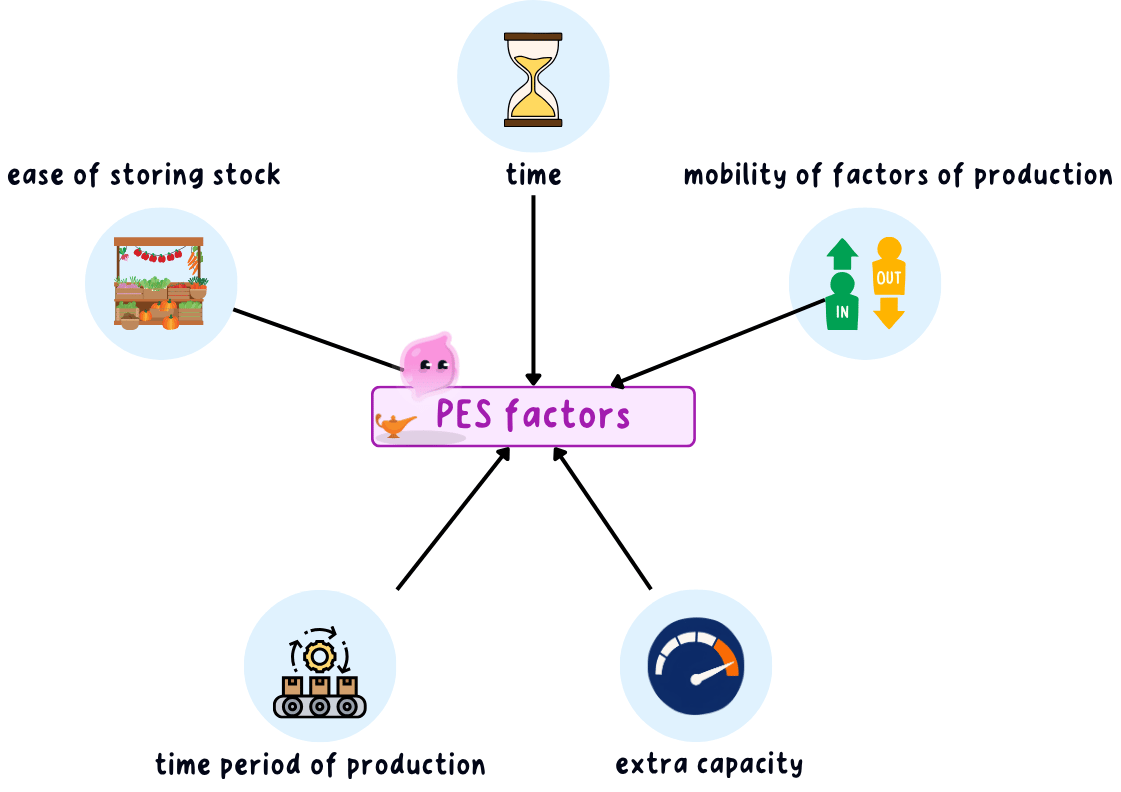
Time matters more than every other factor
- Supply becomes more elastic the longer the period allowed, because every way of raising output takes time to arrange.
- Over a few days a producer can sell only what already exists, so the reaction is close to nothing.
- Over several months it can recruit staff, order more materials and run extra shifts, so the reaction grows.
- Over several years it can build another factory, sink another mine or plant another orchard, so the reaction is at its strongest.
- Each of those arrangements carries its own lead time.
- A Kent apple orchard is the clearest case, since new trees take several years to bear fruit and nothing a grower does in 2026 changes the 2026 crop.
- A single figure for a good is meaningless without the period attached to it.
Case study
- UK wheat in 2022: prices rose sharply after exports from the Black Sea were disrupted, and every arable farmer in the country wanted to sell more grain.
- The 2022 crop had been drilled in the autumn of 2021, so the acreage was already decided before the price was known.
- Inside that harvest year the only extra grain available was whatever was still sitting in farm stores, which made supply strongly price inelastic.
- Farmers answered by drilling more wheat that autumn, so the extra output arrived with the 2023 harvest, a full year after the signal.
- Stretch the period from one season to two and the same crop moves from very inelastic to noticeably more elastic.
Spare capacity decides whether more can be made
- Spare productive capacity means idle machines, unused floor space and workers who are not yet on full hours.
- The chain runs from the higher price to an extra shift, then to more machine hours, then to more units leaving the loading bay within weeks.
- A firm already running every machine flat out has no such chain available, so its supply is inelastic however large the firm is.
- A Jaguar Land Rover plant working one shift can add a second within weeks, while the same plant already running three shifts can add nothing until it builds more capacity.
- Spare capacity also runs out as output rises, which is why many supply curves grow steeper the further right you go along them.
Example
- A clothing factory at half capacity: the price of its garments rises, so it moves from one shift to two, buys more cloth within days and nearly doubles weekly output, so its supply is price elastic.
- The same factory a year later: both shifts run, every machine is in use and the building is full, so the next price rise brings almost no extra output and its supply has turned price inelastic.
- Nothing about the garment changed between those two years, so the answer describes the producer's position rather than the product.
Stock is output already made and waiting
- Ease of storing stock decides whether extra output can reach the market on the day the price rises.
- The chain is short, running from the higher price straight to a warehouse door with no production needed at all.
- Tinned food, coal, bottled water and bricks all keep for months, so a producer can hold them back and release them when the price suits.
- A good that will not keep cannot be held back at all, so the whole of today's output has to be sold today whatever the price is.
- Fresh milk, cut flowers and fish landed at Peterhead are the standard cases, and their supply is inelastic for that reason alone.
- Stock is a one-off cushion rather than a permanent answer, so supply turns inelastic again as soon as the store room is empty.
Mobile factors let a firm switch output
- Mobility of the factors of production means how easily land, labour and capital can be switched from one use to another.
- Where the same premises, machines and workers can turn to a different product, a higher price brings a changeover and extra output within hours.
- A commercial printing works moves between leaflets, posters and packaging in an afternoon, so the supply of each is elastic.
- Highly specialised land, capital and skills have nowhere else to go, so nothing can be redirected into the product whose price has risen.
- A copper smelter can produce nothing but copper, and a workshop of six violin makers cannot recruit a seventh skilled maker in a hurry.
- A firm can raise its own responsiveness deliberately, so buying machinery that makes two products is a decision to make future supply more elastic.
A long production period fixes quantity in advance
- The longer a single unit takes to make or grow, the more inelastic supply is, because a higher price today cannot shorten the process.
- A moulded plastic bucket takes seconds, so output can follow the price almost immediately.
- UK wheat arrives once a year, Scottish whisky has to mature for at least three years, and a new North Sea field takes several years from licence to first oil.
- This is why farming, fishing, mining and oil extraction have inelastic supply while most manufacturing is far more elastic.
- Primary producers also depend on land and natural conditions that cannot be added to, which reinforces the same result.
Name the factor that binds first
- The factors pull against each other, so a producer is held back by whichever of them binds soonest.
- A Greggs bakery has spare oven capacity but cannot store bread, so its supply is elastic within a day and no more elastic over a month.
- No amount of spare capacity or factor mobility gets a crop out of the ground before it has grown.
- Naming the binding factor is what turns a list into an explanation, since the rest of the list is then beside the point.
- Bottled water from a plant on a single shift is elastic, because a second shift can start within a week and the bottles keep indefinitely.
- A crop of Lincolnshire onions a fortnight from harvest is inelastic, because the quantity is already in the ground.
- Parking spaces along a seafront are perfectly inelastic, because the number is fixed whatever the charge.
- Printed T-shirts from a firm that also prints mugs are elastic, since the same presses and staff move between the two jobs in hours.
Self review
- State the difference between price elastic and price inelastic supply.
- Why is supply more elastic over five years than over five days?
- A steelworks raises output from 50,000 tonnes to 50,500 while a guitar workshop raises output from 600 instruments to 1,100: what is each percentage rise, and which producer has the more elastic supply?
- Why is the supply of fresh milk more inelastic than the supply of tinned soup?
- Why does a firm running every machine flat out have inelastic supply even if it is very large?