Elastic and inelastic are judgements about proportions
Definition
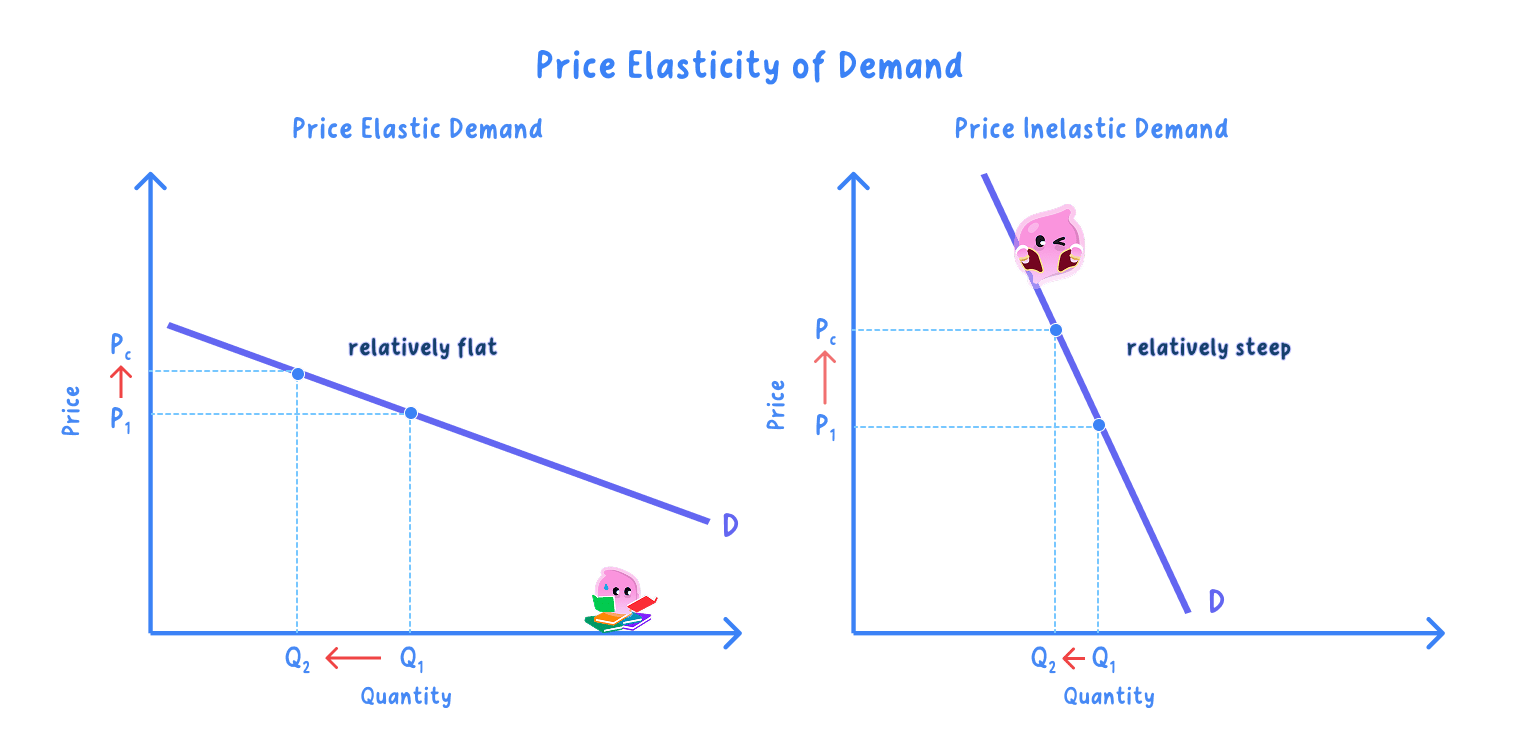
Price elastic demand: demand where the quantity demanded changes by proportionally more than the price that caused the change.
Price inelastic demand: demand where the quantity demanded changes by proportionally less than the price that caused the change.
- The test is a comparison of two percentage changes, never a judgement about how many units moved.
- Twenty fewer loaves out of 500 is a tiny reaction, while twenty fewer new cars out of 40 is an enormous one.
- On a demand diagram, with price on the vertical axis and quantity demanded on the horizontal axis, the difference shows up as steepness: a steep demand curve is inelastic and a flat one is elastic.
- The extreme cases are a vertical curve for perfectly inelastic demand and a horizontal one for perfectly elastic demand.
- Compare steepness only on the same axes and the same scale, since stretching an axis can make an identical curve look steeper than it is.
- The same good can be elastic over one stretch of its curve and inelastic over another, so neither label is ever permanent.
Example
- Tesco own-label baked beans, price up 5 per cent: the tin goes from 40p to 42p and weekly sales of that label fall by about 20 per cent, four times the size of the price change, so demand for that label is price elastic.
- Baked beans across every brand, the same 5 per cent price rise: total tins sold in the UK fall by about 1 per cent, one fifth of the price change, so demand for beans as a whole is price inelastic.
- Nothing about the bean has changed between the two rows, only how widely the market was drawn.
Close substitutes settle most cases
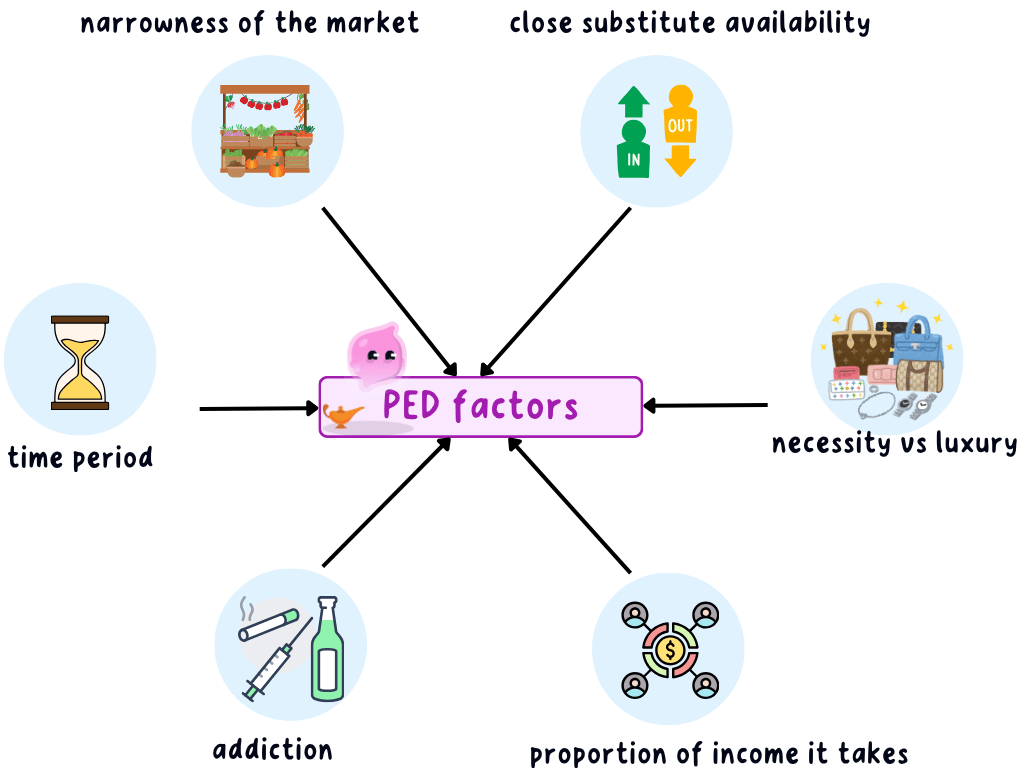
- The availability and closeness of substitutes settles more cases than any other factor, because a price rise sends the buyer to a rival instead of costing them the purchase.
- Demand for Walkers crisps is elastic, since a shopper who spots the higher price can drop a bag of Pringles or an own label into the trolley instead.
- Demand for crisps as a whole is far less elastic, since nothing else fills quite the same place in a lunchbox.
Necessity, luxury and the share of income
- Whether the good is a necessity or a luxury decides whether the purchase can be dropped at all.
- A necessity such as bread, salt or a prescription medicine has inelastic demand, because the buyer cannot go without it whatever the price does.
- A luxury such as a week in Spain or a meal out has elastic demand, because the whole purchase can simply be abandoned.
- Water supplied by Thames Water sits near the limit of this, since a household cannot stop drinking and washing when the bill rises.
- The proportion of income the good takes decides whether the price rise is even noticed.
- A good taking a large share of income, such as a new car or a summer holiday, has more elastic demand, because a price rise costs real money.
- A good taking a tiny share, such as a box of matches or a first-class stamp, has inelastic demand, because the extra pence are hardly felt.
- Judge the share of income rather than the price on the label, since a cheap item bought every day can still take a large share.
Habit, time and market width
- Habit and addiction remove the buyer's willingness to react at all.
- Cigarettes are the standard UK case, where rising duty pushes the price up year after year and the quantity sold falls only slightly.
- Brand loyalty is a milder version of the same thing, which is why firms advertise so heavily to build it.
- The time period decides how many escape routes the buyer has found, so demand becomes more elastic the longer the period allowed.
- A driver meeting a 10p rise in the pump price can do almost nothing this week, so demand looks inelastic.
- Over five years that driver buys a smaller or electric car, works from home more often, or moves closer to work, so demand looks far more elastic.
- How narrowly the market is defined can flip the answer for what is physically the same purchase.
- Demand for petrol from one Shell forecourt is elastic, because a BP station a mile away is a very close substitute.
- Demand for petrol across the UK is inelastic, because widening the definition makes the substitutes vanish.
Common Mistake
- Spare capacity and stock levels decide the elasticity of supply, not of demand.
- Judge the share of the buyer's income, not the price on the label.
- Naming a factor earns nothing until you say which way it pushes.
Name the factor that dominates
- Cigarettes take a large share of a smoker's income, which on its own points to elastic demand, yet demand stays inelastic because addiction outweighs that.
- A Sainsbury's own-label loaf is a necessity, which points to inelastic demand, yet demand for that particular loaf is elastic because rival loaves sit on the same shelf.
- So weigh the factors and name the one doing the most work, rather than counting how many point each way.
- Insulin for a diabetic patient is strongly inelastic, with no substitute, no way of waiting and no real choice about buying.
- A cinema ticket is elastic, since streaming, television and a night in are all substitutes and the outing is easy to drop.
- Petrol splits the factors, coming out inelastic over a week and considerably more elastic over a decade.
Self review
- State the difference between price elastic and price inelastic demand.
- Name six factors that affect the price elasticity of demand for a good.
- A tin of own-label beans rises in price by 5 per cent and sales of that label fall by 20 per cent: is demand for it price elastic or price inelastic?
- Why is demand for petrol from one Shell forecourt more elastic than demand for petrol across the UK?
- Why does a longer time period make demand more elastic?