A stronger pound raises export prices for foreign buyers
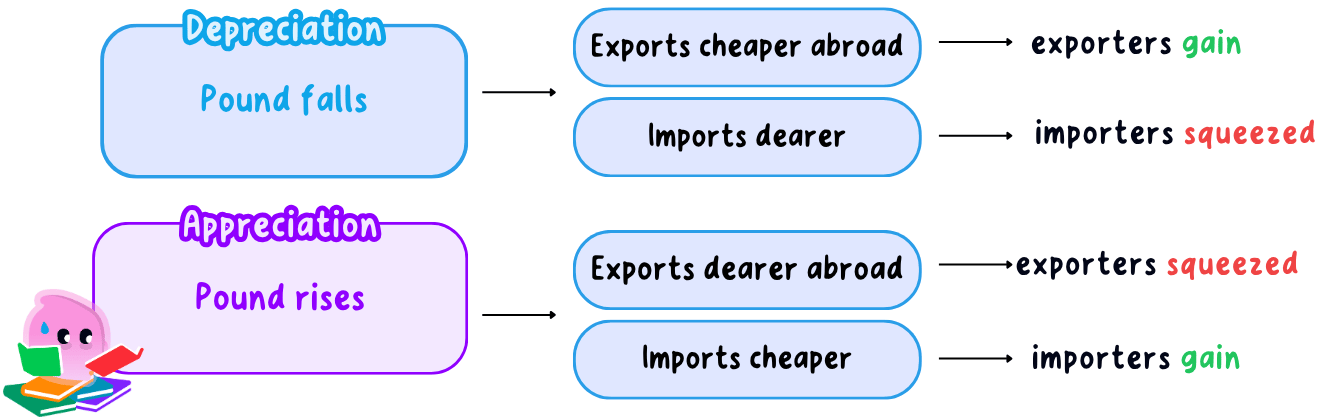
- After the pound appreciates, foreign buyers need more of their own currency to pay the same price, so UK exports become more expensive abroad.
- Higher prices abroad tend to reduce the quantity of exports that foreign customers buy, especially where those buyers are sensitive to price.
- UK exporters lose competitiveness, because rival firms in other countries now look cheaper by comparison.
Key Idea
- SPICED: Strong Pound, Imports Cheaper, Exports Dearer.
- Reading it left to right gives the direction of both price changes at once.
A stronger pound makes imports cheaper for UK buyers
- Imports become cheaper, because each pound now buys more foreign currency than before.
- Cheaper imports tend to increase the quantity that UK households and firms buy from abroad, and firms that import raw materials face lower costs.
- Importers and consumers gain from wider choice and lower prices, even as exporters lose sales.
Common Mistake
- A strong pound is not automatically good for the whole economy.
- An appreciation helps importers and consumers but hurts exporters, who lose sales.
Converting a price shows exactly what appreciation does
- Suppose the pound appreciates from 1.30 to around 1.35 dollars to the pound, close to its rate in August 2026, and trace the effect on one export price and one import price.
Example
- Export: a UK-made good priced at £20,000.
Step 1: at the old rate of 1.30 dollars to the pound, the US price is:
£20,000×1.30=$26,000 \pounds20{,}000 \times 1.30 = \text{\textdollar}26{,}000 £20,000×1.30=$26,000Step 2: at the new, appreciated rate of 1.35 dollars to the pound, the US price is:
£20,000×1.35=$27,000 \pounds20{,}000 \times 1.35 = \text{\textdollar}27{,}000 £20,000×1.35=$27,000- The export price rises by 1,000 dollars for the US buyer, so the good becomes less competitive.
- Import: a US-made good priced at 900 dollars.
Step 1: at the old rate of 1.30 dollars to the pound, the UK price is:
$900÷1.30=£692.31 \text{\textdollar}900 \div 1.30 = \pounds692.31 $900÷1.30=£692.31Step 2: at the new, appreciated rate of 1.35 dollars to the pound, the UK price is:
$900÷1.35=£666.67 \text{\textdollar}900 \div 1.35 = \pounds666.67 $900÷1.35=£666.67- The import price falls by about £25.64 for the UK buyer, so the good becomes more attractive.
Appreciation feeds into the current account and jobs
- Dearer exports and cheaper imports tend to worsen the current account, as export sales fall and import spending rises.
- The size of this effect depends on how strongly buyers respond to the price changes.
- Export industries may cut output and jobs if a strong pound lasts, even while consumers enjoy cheaper imports.
A weaker pound makes exports cheaper abroad
- After the pound depreciates, foreign buyers need less of their own currency to pay the same price, so UK exports become cheaper abroad.
- Lower prices abroad tend to increase the quantity of exports that foreign customers buy, especially where those buyers are sensitive to price.
- UK exporters gain competitiveness, because their goods now look cheaper than foreign rivals.
Key Idea
- WPIDEC: Weak Pound, Imports Dearer, Exports Cheaper.
- The word spells out both price changes in one go, so the direction is never mixed up.
A weaker pound makes imports dearer for UK buyers
- Imports become more expensive, because each pound now buys less foreign currency than before.
- Dearer imports tend to reduce the quantity that UK households and firms buy from abroad, and firms that rely on imported raw materials face higher costs.
- Higher import prices can also add to inflation across the economy.
Common Mistake
- A weak pound is not automatically bad for the whole economy.
- A depreciation helps exporters but raises prices for importers and consumers.
Converting a price shows exactly what depreciation does
- Suppose the pound depreciates from 1.20 to around 1.17 euros to the pound, close to its rate in August 2026, and trace the effect on one export price and one import price.
Example
- Export: a UK-made car priced at £20,000.
Step 1: at the old rate of €1.20 to the pound, the EU price is:
£20,000×1.20=24,000 euros \pounds20{,}000 \times 1.20 = 24{,}000\text{ euros} £20,000×1.20=24,000 eurosStep 2: at the new, depreciated rate of €1.17 to the pound, the EU price is:
£20,000×1.17=23,400 euros \pounds20{,}000 \times 1.17 = 23{,}400\text{ euros} £20,000×1.17=23,400 euros- The export price falls by €600 for the EU buyer, so the car becomes more competitive.
- Import: an EU-made good priced at €50.
Step 1: at the old rate of €1.20 to the pound, the UK price is:
50 euros÷1.20=£41.67 50\text{ euros} \div 1.20 = \pounds41.67 50 euros÷1.20=£41.67Step 2: at the new, depreciated rate of €1.17 to the pound, the UK price is:
50 euros÷1.17=£42.74 50\text{ euros} \div 1.17 = \pounds42.74 50 euros÷1.17=£42.74- The import price rises by about £1.07 for the UK buyer, so the good becomes dearer.
Depreciation feeds into the current account and jobs
- Cheaper exports and dearer imports tend to improve the current account, as export sales rise and import spending falls.
- The size of this effect depends on how strongly buyers respond to the price changes.
- Export industries may raise output and jobs if a weak pound lasts, even while consumers face higher import prices.
Exam technique
- Before calculating, decide whether the pound has appreciated or depreciated, since that decides whether you multiply or divide by the exchange rate.
- For a price in foreign currency, multiply the pound price by the rate; for a price in pounds, divide the foreign price by the rate.
- When asked to evaluate the effect of a rate change, weigh which side, consumers, exporters or importers, is affected more heavily rather than just listing that there are winners and losers.
Self review
- Explain why exporters lose out but importers gain when the pound appreciates.
- Explain why exporters gain but importers lose out when the pound depreciates.
- A UK export priced at £20,000 sells into the US at a rate of 1.30 dollars to the pound. What does it cost in dollars? What does it cost if the rate rises to 1.35 dollars to the pound?
- What do SPICED and WPIDEC each stand for?
- How does a change in the exchange rate affect the current account?