Free trade means countries trade without barriers
Definition
Free trade: the buying and selling of goods and services between countries with no barriers such as taxes or limits getting in the way.
Trade barrier: anything a government uses to make trade with other countries harder or more expensive.
- Barriers can take the form of taxes on imports, limits on the quantity allowed in, or rules that foreign firms find hard to meet.
- Under free trade a country removes these barriers so that goods, services and money can move in and out freely.
Free trade lowers prices and widens choice for shoppers
- Lower prices: imports are not taxed at the border, so foreign goods reach shoppers more cheaply.
- Wider choice: people can buy goods that are not made at home, from a much larger range of producers.
- More competition: rival imports push home firms to keep their own prices down and their quality up.
Example
- A UK shopper can buy bananas from the Caribbean, a phone assembled in Asia and cheese from France, often more cheaply than if trade barriers blocked these imports.
- This chain of reasoning matters: cheaper imports lead to lower prices, which raise real incomes and living standards.
Free trade lets firms reach bigger markets and specialise
- Bigger markets: home firms can sell to customers all over the world, not just at home.
- Selling more units lets firms spread their costs and often produce each item more cheaply.
- Greater efficiency: firms face world competition and have to use resources well to survive.
- Gains from specialisation: each country concentrates on what it produces best and trades for the rest, so world output rises.
Protectionism uses barriers to shield industries from imports
Definition
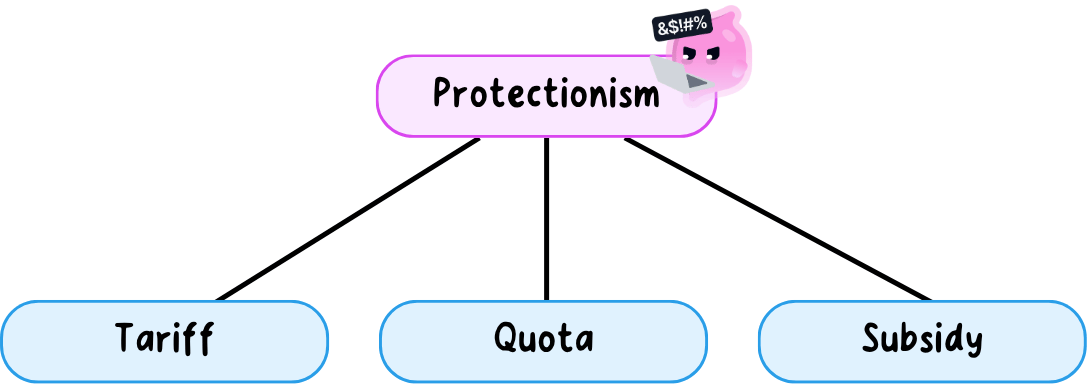
Protectionism: government policies used to shield home industries from foreign competition.
Definition
Tariff: a tax on imported goods, which raises the price shoppers pay for them.
Quota: a limit on the quantity of a good that can be imported.
Subsidy: a payment from the government to home producers that lowers their costs so they can compete with cheaper imports.
- A tariff makes an import dearer, so shoppers are more likely to buy the home-produced alternative instead.
- A quota caps how much of a good can be sold from abroad, whatever price it is offered at.
- A subsidy lowers a home producer's own costs, letting it match cheaper imports without taxing or limiting them.
Protecting industries can still carry real costs
- Home producers undercut: cheaper foreign goods can take sales from domestic firms that cannot match the price.
- Job losses: if firms cannot compete they may shrink or close, and workers in those industries can lose their jobs.
- These losses are often concentrated in particular towns or regions, which makes them painful even when the country as a whole gains.
- Infant industries: new industries that are just starting out may struggle to grow if they face full foreign competition before they become efficient.
Common Mistake
- Free trade does not mean every firm or worker gains.
- It raises total output and average living standards, but some producers and workers clearly lose out, so do not claim it is good for everyone.
How far free trade's benefits outweigh its costs
- It depends on how much prices fall and choice widens, because a bigger fall in import prices and a wider range of goods available raises the benefit to shoppers.
- It depends on how many jobs are at risk and how easily those workers can retrain, because job losses concentrated in one town with few other employers hurt more than losses spread across a flexible labour market.
- It depends on whether the industry is genuinely uncompetitive or just new, because protecting a permanently inefficient industry wastes resources, while briefly protecting a promising new industry can let it establish itself.
- Most economists judge that free trade raises average living standards, but a strong answer names who gains, who loses and why, rather than treating free trade as good for everyone.
Exam technique
- When a question gives you a specific industry, decide first whether it is genuinely uncompetitive or merely new, since infant industries and permanently struggling ones deserve different judgements.
- Support a benefit or cost with a concrete example, such as tariffs on Chinese steel or a subsidy to a home producer, rather than describing free trade only in the abstract.
- A judgement only earns credit if it says who gains and who loses, not just that free trade is 'good' or 'bad'.
Self review
- Can you define free trade and protectionism in one sentence each?
- Can you name a tariff, a quota and a subsidy, and say what each one does?
- Can you give two benefits of free trade for shoppers and two for firms?
- Can you explain why free trade can still harm some home industries?
- Can you reach a balanced judgement on whether free trade is worth its costs?
