One price makes both plans agree
Definition
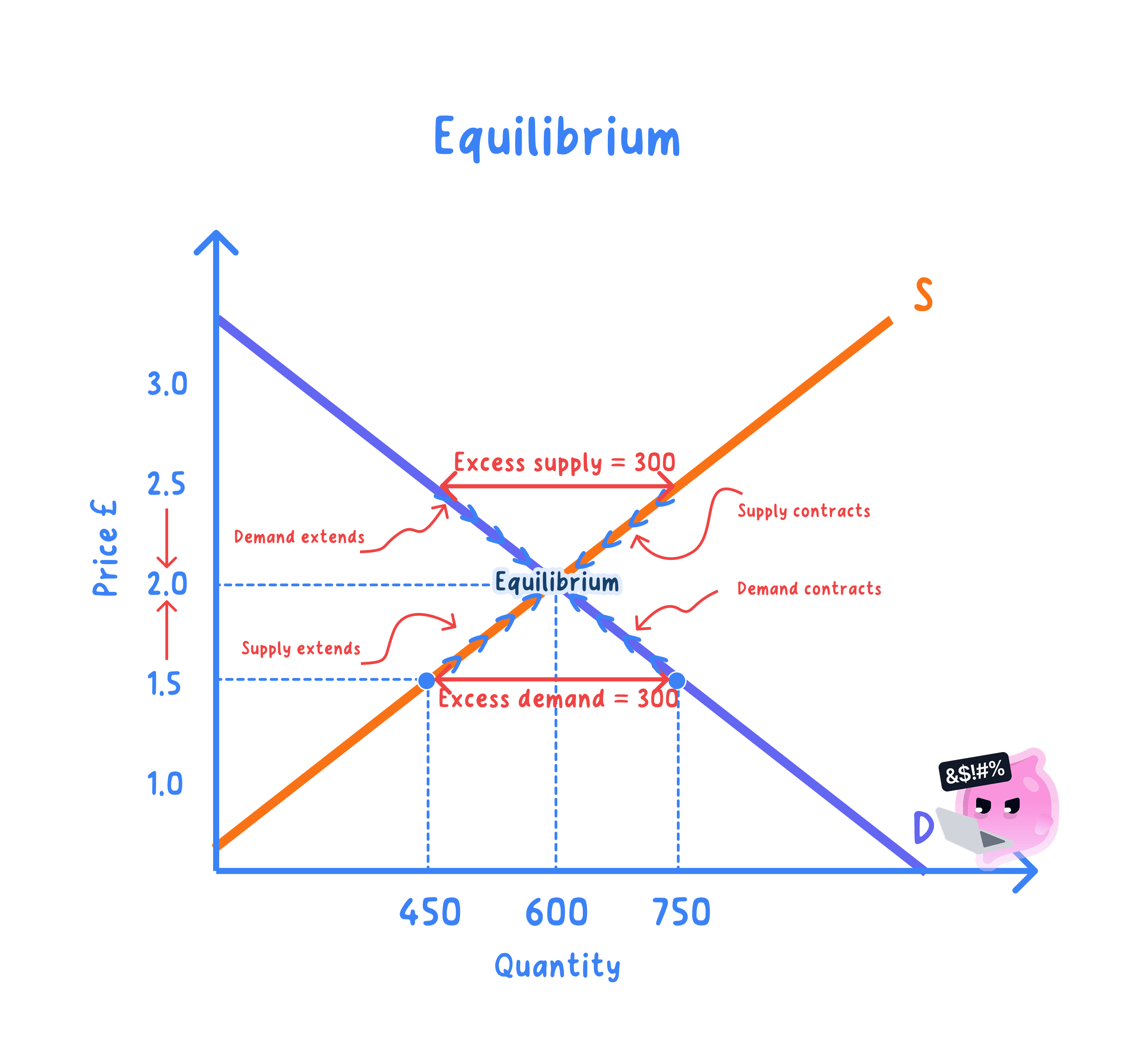
Equilibrium price: the price at which the quantity demanded equals the quantity supplied, so the market clears.
- No single buyer and no single seller chooses this price. It is the outcome of thousands of separate decisions to buy and to sell.
- Only one price does this, because the two curves slope in opposite directions and so meet at exactly one point.
- At every other price one side of the market is frustrated, and frustrated buyers or sellers are what make the price move.
- Too high a price leaves sellers holding stock they cannot sell.
- Too low a price leaves willing buyers going away with nothing.
- The equilibrium quantity is the amount actually traded at that price, read off the quantity axis.
- Once a market clears it stays there until demand or supply itself changes, because nobody is left with a reason to bid differently.
Find the row where quantities match
- A demand and supply schedule lists both quantities at each price, so the equilibrium can be found by arithmetic rather than by drawing.
- Work down the schedule subtracting quantity supplied from quantity demanded: the equilibrium is the row where that subtraction gives zero.
- A positive answer is excess demand and a negative answer is excess supply.
- The two quantities move in opposite directions as you read down the price column, which is why the gap changes sign only once.
Example
- The UK market for 2 kg bags of British potatoes: quantities are thousands of bags a week.
| Price | Quantity demanded | Quantity supplied | Gap |
|---|---|---|---|
| £1.00 | 900 | 300 | +600, excess demand |
| £1.50 | 750 | 450 | +300, excess demand |
| £2.00 | 600 | 600 | 0, the market clears |
| £2.50 | 450 | 750 | -300, excess supply |
| £3.00 | 300 | 900 | -600, excess supply |
Step 1, test £1.00 by subtracting quantity supplied from quantity demanded.
900−300=+600 thousand bags 900 - 300 = +600\text{ thousand bags} 900−300=+600 thousand bagsStep 2, test £3.00 the same way.
300−900=−600 thousand bags 300 - 900 = -600\text{ thousand bags} 300−900=−600 thousand bagsStep 3, the sign has changed, so test the price in between.
600−600=0 thousand bags 600 - 600 = 0\text{ thousand bags} 600−600=0 thousand bags- The equilibrium price is £2.00 a bag and the equilibrium quantity is 600 thousand bags a week, the only row where neither side is frustrated.
- The gap narrows from 600 thousand bags at £1.00 to 300 thousand at £1.50 and to nothing at £2.00, which is the adjustment below happening one step at a time.
Excess supply pushes the price down
Definition
Excess supply: the amount by which quantity supplied exceeds quantity demanded at a price above the equilibrium price, known in everyday language as a surplus.
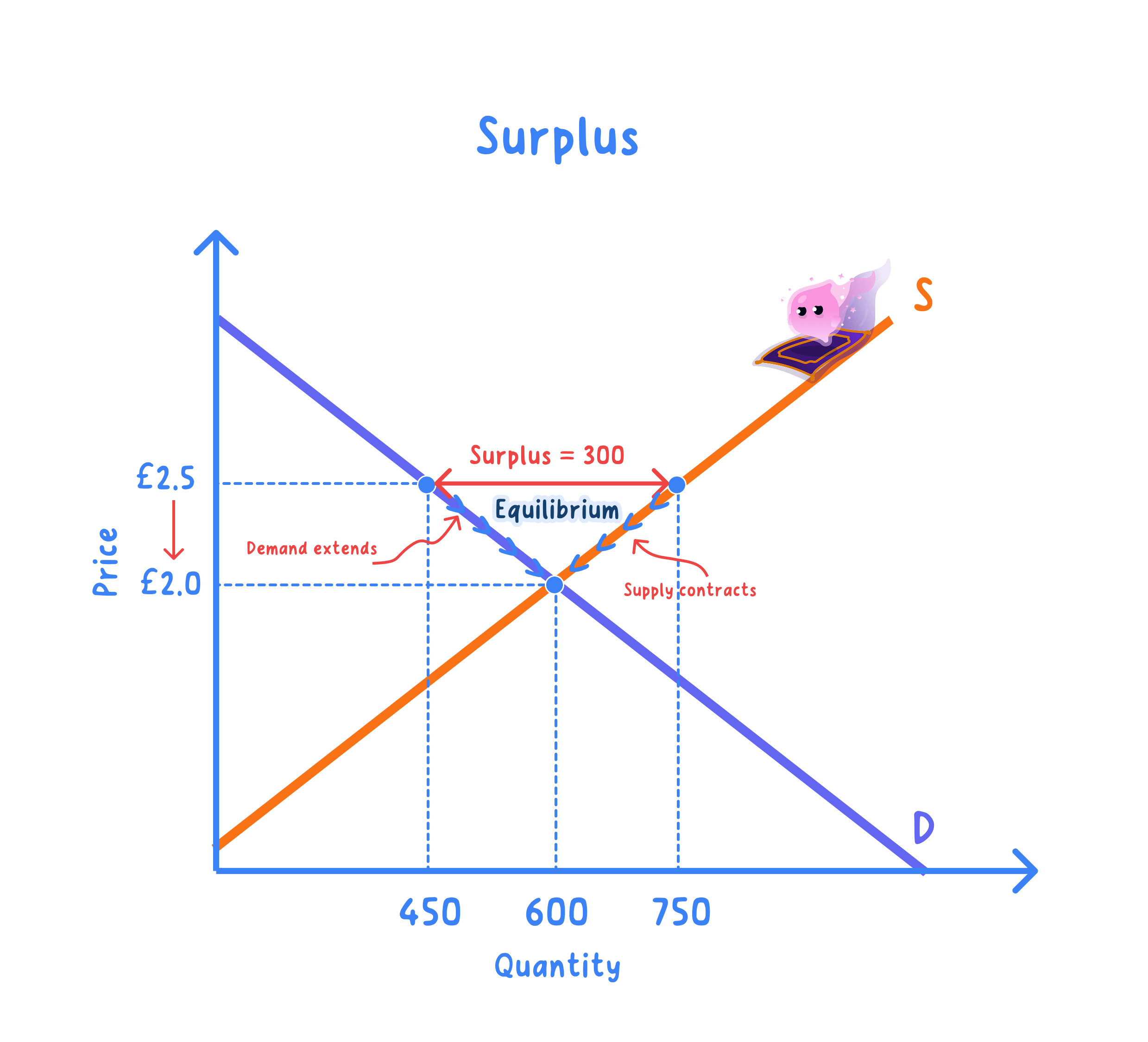
- Start at £2.50, where growers offer 750 thousand bags a week but shoppers want only 450 thousand.
- The 300 thousand unsold bags cost money to store and will eventually rot, so at least one seller cuts the price to shift them.
- Rivals must match the cut or watch their own bags sit unsold, so the lower price spreads.
- The lower price makes potatoes better value against everything else in the trolley, so quantity demanded extends along the unchanged demand curve.
- It also makes the least efficient growers unprofitable, so quantity supplied contracts along the unchanged supply curve.
- Those two movements attack the gap from opposite ends at once, so the surplus is smaller after every cut.
- Cutting stops at £2.00, because no seller is left with stock to clear.
Common Mistake
- Excess demand does not mean demand has risen: no curve has moved, the price is simply too low.
- Sellers do not pick the equilibrium price: name a higher one and stock goes unsold.
- A shortage is not scarcity: scarcity is permanent, a shortage is one market at one price.
Excess demand pushes the price up
Definition
Excess demand: the amount by which quantity demanded exceeds quantity supplied at a price below the equilibrium price, known in everyday language as a shortage.
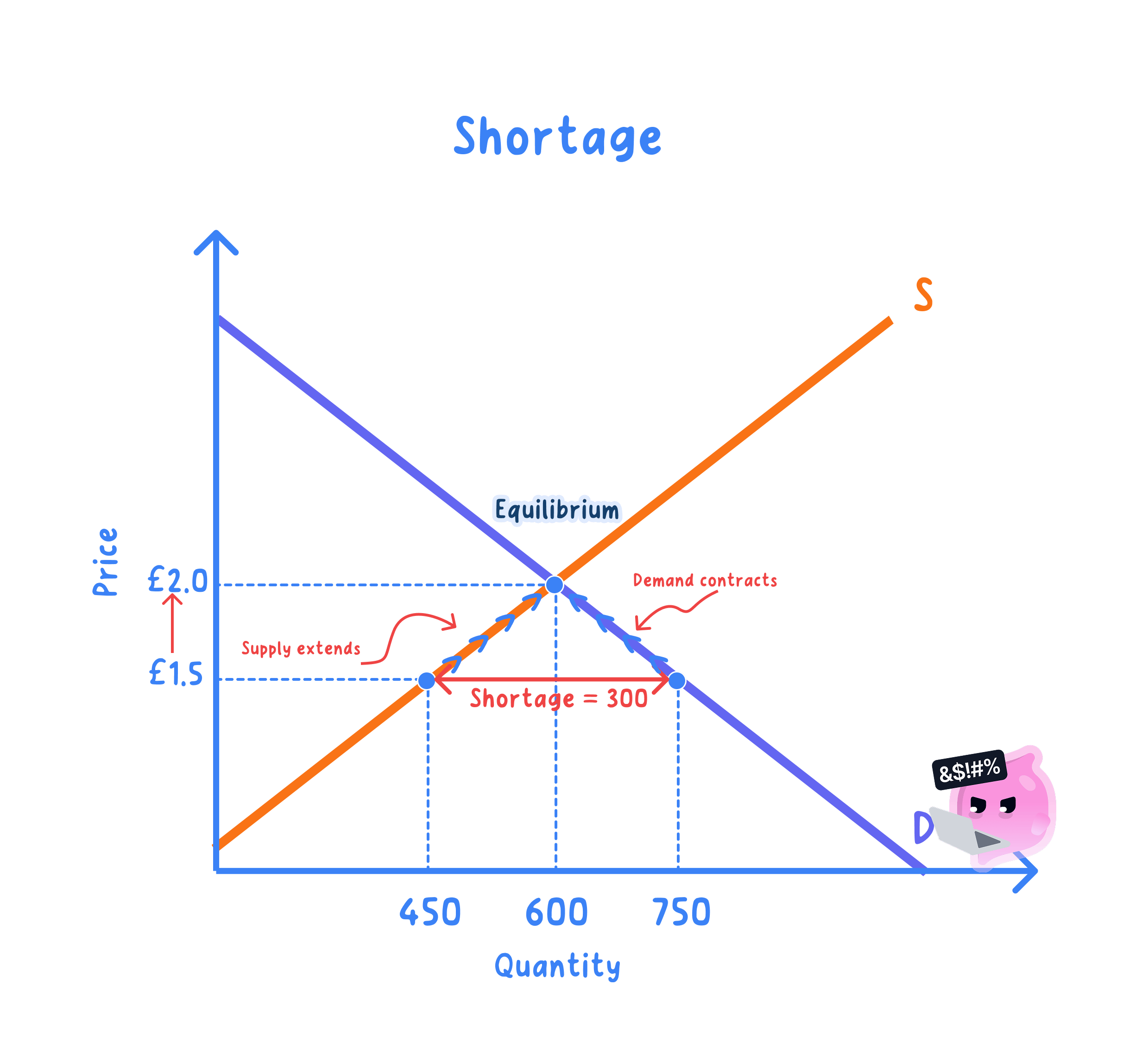
- Start at £1.50 instead, where shoppers want 750 thousand bags a week but growers offer only 450 thousand.
- Shelves empty early and 300 thousand bags' worth of buyers go away with nothing, so sellers learn they can charge more and still sell everything.
- Buyers compete for what is left, which is why a shortage in a resale market shows up as buyers openly bidding the price up.
- The higher price prices out the buyers who valued the good least, so quantity demanded contracts along the unchanged demand curve.
- It also makes it worth planting and lifting more, so quantity supplied extends along the unchanged supply curve.
- The shortage therefore shrinks with every rise, from 300 thousand bags at £1.50 to nothing at £2.00.
- Because both adjustments push towards the same single price, a competitive market is self-correcting, with nobody in charge of the outcome.
Exam technique
- Compare the given price with the equilibrium price first: that alone settles whether it is excess demand or excess supply.
- Show the subtraction and give the units, so 750 minus 450 is a surplus of 300 thousand bags a week.
- Say extends or contracts for the return to equilibrium, and save shift for a change in demand or supply.
Self review
- At the equilibrium price, how does quantity demanded compare with quantity supplied?
- In the potato schedule, what are the equilibrium price and quantity?
- At £2.50 a bag, is there excess demand or excess supply, and how big is it?
- Which way does excess demand push the price, and why?
- Why does quantity supplied contract as the price falls?
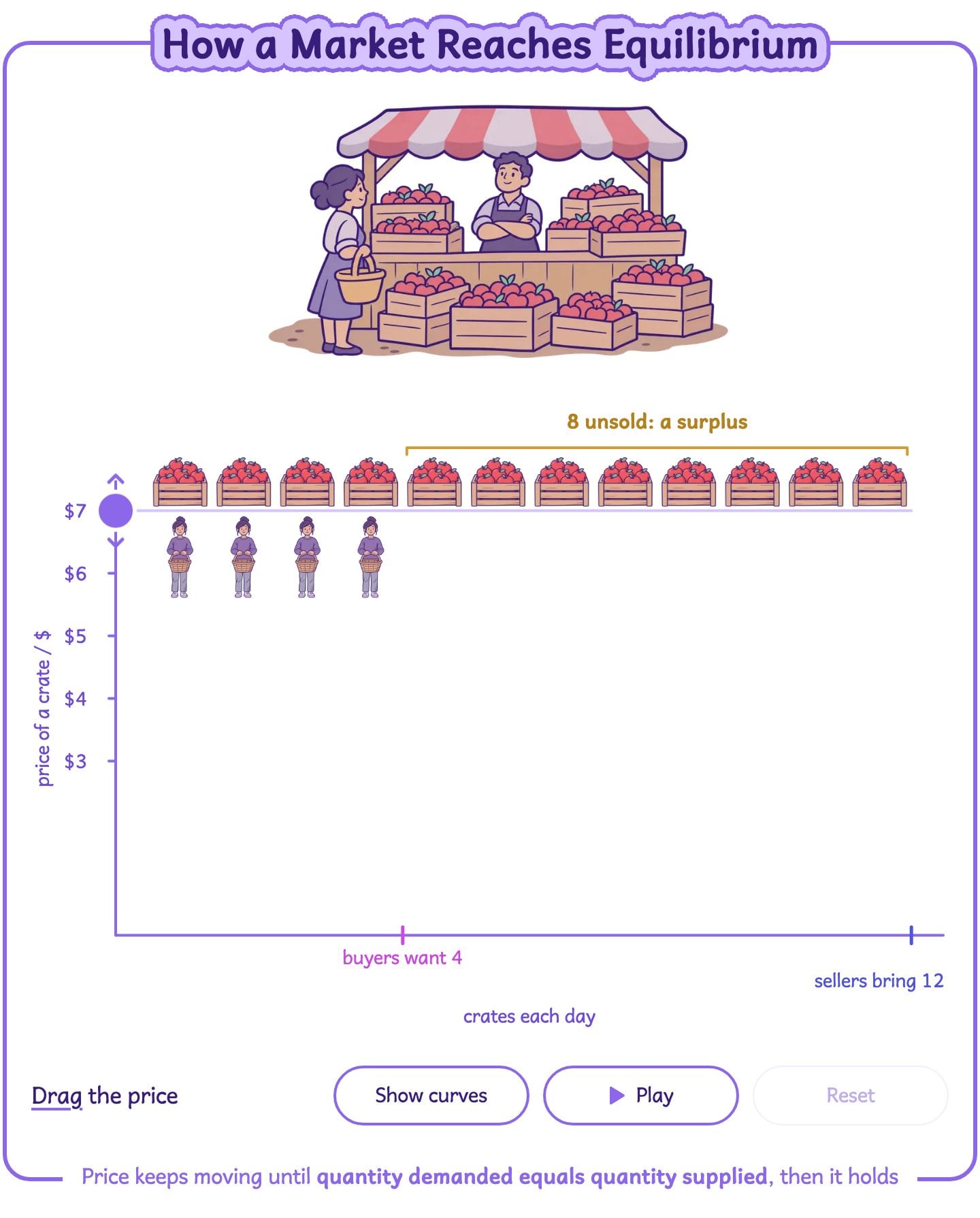
Set a price above or below equilibrium and watch it move until demand equals supply.