Surplus and deficit describe opposite imbalances
Definition
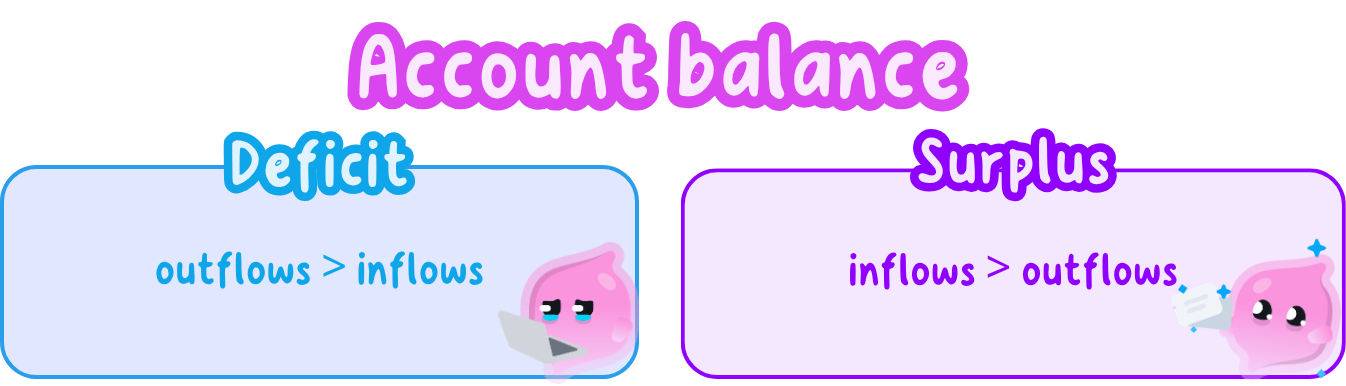
Surplus: a current account position where total inflows are greater than total outflows, so the balance is positive.
Deficit: a current account position where total outflows are greater than total inflows, so the balance is negative.
- A surplus arises when inflows exceed outflows: a country that earns £600bn from foreigners and pays out £550bn to foreigners has inflows above outflows, so it runs a surplus.
- A deficit arises when outflows exceed inflows: a country that pays out more than it earns over the same period runs a deficit.
A balanced position means inflows exactly equal outflows
Definition
Balanced: a current account position where inflows and outflows are equal, so the balance is exactly zero.
Note
A balanced position is rare in practice, since a country's inflows and outflows so rarely land on exactly the same figure.
The causes of an imbalance work through trade
- A deficit or surplus depends on the value of what a country sells abroad compared with the value of what it buys.
- Relative prices and costs: matter, because if a country's goods become dearer than rivals' goods, exports fall and imports rise.
- Quality and competitiveness: matter, because poor design, reliability or service makes goods harder to sell abroad and easier for rivals to beat at home.
- The exchange rate: matters, because a strong currency makes exports dearer and imports cheaper, while a weak currency does the opposite; exchange rates are covered fully in 2.4.2.
- Relative growth and incomes: matter, because a country that grows faster or has higher incomes than its trading partners tends to buy more imports.
Example
- If a country's wages and costs rise faster than its rivals', its exports become dearer and it can slide towards deficit.
- A country with cheap, high quality exports and a competitive currency tends to run a surplus.
Faster growth than partners tends to widen a deficit
- When incomes rise, households spend more, and part of that extra spending goes on imported goods and holidays abroad.
- If a country grows faster than its trading partners, its demand for imports rises faster than their demand for its exports.
- A persistent imbalance usually comes from a lasting problem, such as weak competitiveness or a currency that stays too strong for too long.
Common Mistake
- A deficit is not caused only by consumers spending too much, because competitiveness and the exchange rate matter just as much.
- A surplus is not proof of hard work, since it can simply reflect a weak currency or weak domestic demand.
A deficit or surplus changes demand in the economy
- Spending on imports is money leaving the economy, so a deficit is a net leakage of demand.
- Earnings from exports are money entering the economy, so a surplus is a net injection of demand.
- This is why a large, persistent imbalance can affect output, jobs, prices and the currency.
The main consequences of a persistent deficit
- Slower growth and fewer jobs: can follow, because a net leakage of demand reduces spending on domestic output.
- A financing need: arises, because a deficit must be paid for by borrowing from abroad or selling assets to foreigners.
- Downward pressure on the currency: can build up, because a persistent deficit means more of the currency is being sold to buy imports.
Example
- If a weaker currency then raises the price of imports, it can add to inflation.
- A short deficit while a country invests in new machinery may pay off later, so timing matters.
A surplus brings benefits but is not always good
- A surplus adds to demand and can support output and jobs in export industries.
- A very large surplus can point to weak spending at home, or add to inflation if the extra demand is strong.
- A large surplus can also cause tension with trading partners who are running deficits.
Whether a deficit matters depends on several factors
- It depends on the size of the deficit relative to GDP, because a small deficit is easy to finance, while a large, persistent one signals a deeper problem.
- It depends on what is causing it, because a deficit caused by importing machinery to invest for the future may pay off later, while one caused by weak competitiveness can persist and worsen.
- It depends on how it is financed, because a deficit financed by stable, long-term investment is less risky than one financed by short-term borrowing that could be withdrawn quickly.
- It depends on how long it lasts, because a temporary deficit during one strong year of investment is less concerning than one that persists year after year.
Note
A deficit is not automatically a problem: what matters is its size, its cause, how it is financed and whether it persists, not simply the fact that a minus sign appears in front of the figure.
Self review
- Define a current account surplus, deficit and balanced position.
- Give three causes of a current account imbalance.
- Explain why a strong currency tends to widen a deficit.
- Explain why a deficit is a leakage and a surplus is an injection.
- Explain why a large deficit is not automatically a serious problem.