Governments can act on demand, trade or competitiveness
- To correct a deficit a government can try to reduce total spending, switch spending away from imports, or make its firms more competitive.
- The aim is to bring inflows and outflows closer together so the balance is more stable.
- Some measures work quickly on demand, while others work slowly by improving the supply side of the economy.
- Reducing spending lowers imports because people buy less of everything, including imports.
- Switching spending changes what people buy, steering them towards home-produced goods instead.
Expenditure-reducing policy cuts total demand in the economy
Expenditure-reducing policy: a policy that cuts total demand in the economy, through higher taxes, lower government spending or higher interest rates, so as to reduce spending on imports.
- Expenditure-reducing policy lowers growth and can raise unemployment, because it cuts demand across the whole economy, not just spending on imports.
- This also often leads the general price level to fall.
Expenditure-switching policy shifts spending towards home producers
Expenditure-switching policy: a policy that makes imports dearer or exports cheaper, using tariffs, quotas or a lower exchange rate, to switch spending towards home-produced goods.
- Expenditure-switching policy can raise the price of imports, which adds to the cost of living, and a lower exchange rate is covered fully in 2.4.2.
Tariffs and quotas are the main protectionist tools
- Tariff: a tax on imports; it raises the price shoppers pay, so some switch to home-produced substitutes, imports fall and the current account improves, and it also raises government revenue.
- Quota: a limit on the quantity that may be imported; it caps supply directly, so home producers fill the gap and the price often rises too, but unlike a tariff it raises no government revenue.
- The catch: other countries can retaliate, cutting UK exports, and the UK's trade agreements limit what it can impose; both tools are covered in full in 2.4.3a.
- A tariff on imported cars raises their price, so buyers switch towards cars made at home.
- Spending on training and infrastructure can lower firms' costs and make their exports easier to sell.
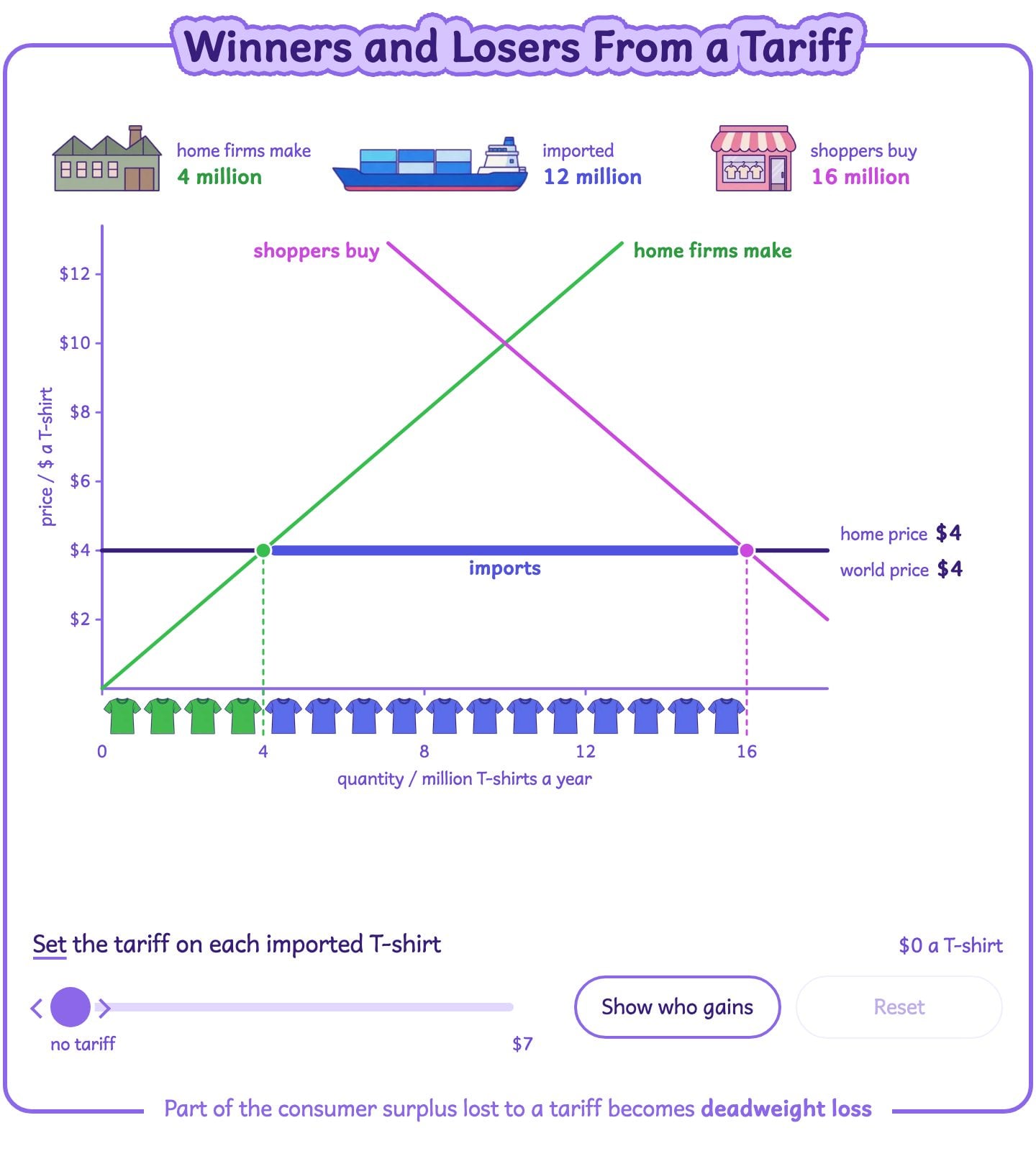
Add a tariff and see imports fall and the price rise, helping producers but hurting consumers.
Supply-side policy raises long-term competitiveness and quality
Supply-side policy: a policy that raises productivity, quality and skills so exports become more competitive over the long term.
- Supply-side measures are usually slow to work and can be costly for the government to fund.
- The mechanism: supply-side policy targets producers' competitiveness rather than demand, so better quality, lower costs and higher productivity make UK goods easier to sell abroad and home substitutes more attractive than imports.
Two routes build long-run competitiveness
- Investment in skills and infrastructure: education, training and research and development raise workers' productivity and lower firms' costs.
- Lower taxes on profits: this encourages firms to invest in both areas.
- The limitation: these routes work slowly, over years not months, so they do nothing for this year's deficit and cost money upfront; covered in full in 2.3.3a and 2.3.3b.
- Protection is not a free fix, because trading partners can hit back with tariffs of their own.
- A lower exchange rate helps the balance but makes imports dearer, so it can raise living costs at home.
Choosing a policy means weighing cause against cost
- It depends on what is causing the deficit, because a demand-driven deficit responds well to expenditure-reducing policy, while a competitiveness problem needs supply-side reform instead.
- It depends on the impact on growth and jobs, because expenditure-reducing policy can correct the balance but slow the whole economy and raise unemployment.
- It depends on how trading partners react, because tariffs and other protectionist measures can invite retaliation that leaves both countries worse off.
- It depends on how quickly a result is needed, because supply-side measures can work well but take years, while demand-side measures act faster at a higher immediate cost.
There is no single best policy: the right choice matches the cause of the imbalance and accepts a trade-off between fixing the balance quickly and protecting growth, jobs and prices.
- Explain the difference between expenditure-reducing and expenditure-switching policies.
- Give one supply-side measure that improves competitiveness.
- Explain why a tariff raises revenue for the government but a quota does not.
- Explain why expenditure-reducing policy can cost jobs even as it corrects the balance.
- Explain why the best policy depends on the cause of the imbalance.