The balance of payments records dealings with the world
- The balance of payments is a record of all the money flowing between one country and the rest of the world over a period of time.
- Money coming into the country counts as an inflow, and money leaving the country counts as an outflow.
- At GCSE level this is studied mainly through its current account, which covers trade and income.
Balance of payments: a record of all the transactions between a country and the rest of the world over a period of time.
Current account: the part of the balance of payments that records trade in goods and services, plus income and transfers, between a country and the rest of the world.
The current account is built from four parts
Trade in goods: exports and imports of physical, visible products such as cars, oil, machinery and food.
Trade in services: exports and imports of invisible services such as tourism, banking, insurance and shipping.
Primary income: income earned from investing or working abroad, such as interest, profits, dividends and wages.
Secondary income: transfers where nothing is exchanged in return, such as government aid, grants and money sent home by workers.
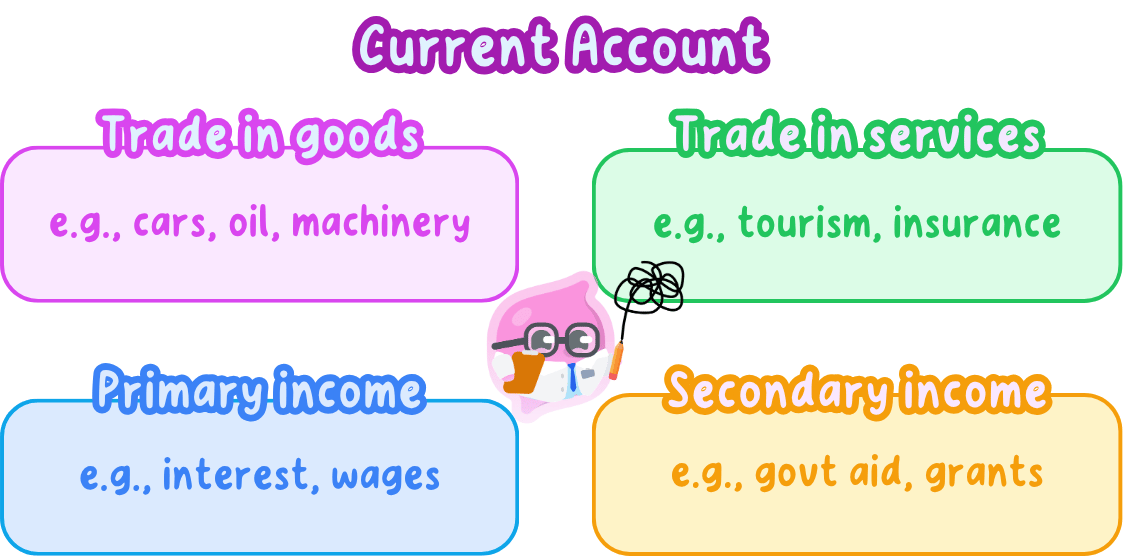
- Trade in goods is usually the largest component for a manufacturing economy: money changes hands whenever cars, oil, machinery or food cross the border, whether coming in as an import or going out as an export.
- Trade in services covers money earned or spent on invisible products, such as a UK bank charging fees to an overseas client, or a British tourist paying for a hotel room abroad.
- Primary income flows from owning assets or working abroad, such as the dividends a UK shareholder receives from a foreign company, or the wages earned by a UK resident working temporarily overseas.
- Secondary income covers transfers with nothing given in return, such as UK government aid paid to another country, or money a foreign worker living in the UK sends home to their family.
- Adding the four parts together gives the current account balance for that period.
Goods are visible trade and services are invisible
- Trade in goods is often called visible trade because the physical products can be seen crossing the border.
- Trade in services is often called invisible trade because no physical item moves, even though money still changes hands.
Balance of trade: the difference between the value of a country's exports and imports of goods and services, not including primary and secondary income.
- The balance of trade only covers goods and services; the current account balance additionally includes primary and secondary income.
- A foreign tourist staying in a UK hotel is an export of services, even though nothing physical crosses the border.
- Money a worker abroad sends home is secondary income, not trade, because no product is bought in return for it.
The current account balance compares inflows with outflows
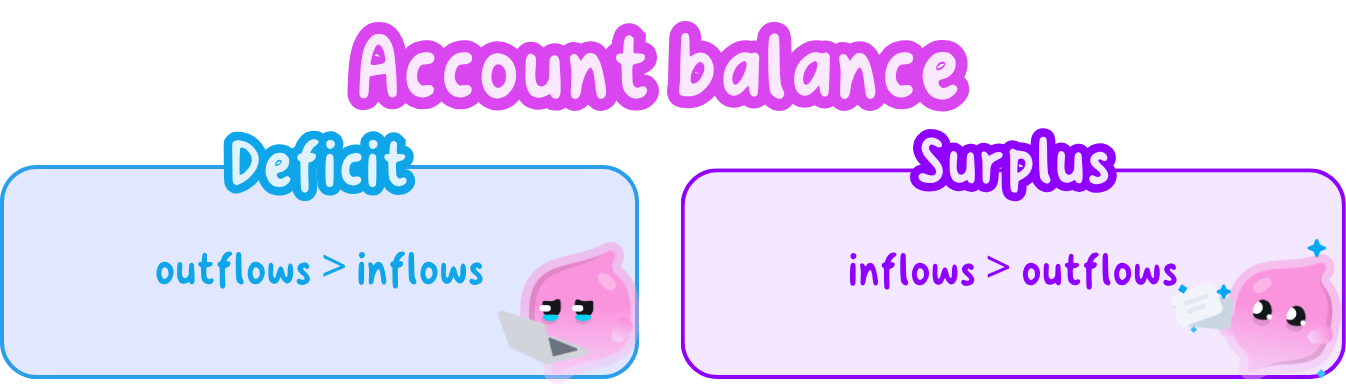
- The current account balance for a period is total inflows minus total outflows.
- A positive balance is called a surplus; a negative balance is called a deficit; their fuller meaning is covered in 2.2.5b.
- The balance is often shown as a percentage of GDP so that economies of different sizes can be compared fairly.
Adding the four parts gives the overall balance
- The overall current account balance is found by adding the balances of all four parts together.
Step 1: write down the balance of trade in goods (a deficit) and trade in services (a surplus):
Trade in goods=−£59.5bn \text{Trade in goods} = -\pounds 59.5\text{bn} Trade in goods=−£59.5bn Trade in services=+£51.8bn \text{Trade in services} = +\pounds 51.8\text{bn} Trade in services=+£51.8bnStep 2: add these two together to find the balance of trade:
Balance of trade=−59.5+51.8=−£7.7bn \text{Balance of trade} = -59.5 + 51.8 = -\pounds 7.7\text{bn} Balance of trade=−59.5+51.8=−£7.7bnStep 3: add the net primary and secondary income to find the current account balance:
Primary and secondary income (net)=−£7.4bn \text{Primary and secondary income (net)} = -\pounds 7.4\text{bn} Primary and secondary income (net)=−£7.4bn Current account balance=−7.7+(−7.4)=−£15.1bn \text{Current account balance} = -7.7 + (-7.4) = -\pounds 15.1\text{bn} Current account balance=−7.7+(−7.4)=−£15.1bn- This matches the UK's actual current account deficit of £15.1bn (1.9 per cent of GDP) in the first quarter of 2026: a goods deficit only partly offset by a services surplus, with a net income outflow adding to the shortfall.
- Show your working as a sum of signed figures, not just the final total, and label each part of the sum.
- Keep the correct sign throughout, since dropping a minus sign turns a deficit into a surplus in your answer.
- Where a question gives a percentage of GDP, use it to judge the scale of the balance, not just its direction.
- Name the four parts that make up the current account.
- Explain the difference between the balance of trade and the current account balance.
- State whether a positive current account balance is called a surplus or a deficit.
- Calculate the current account balance given the balance of trade and net income and transfers.
- Explain why a service can count as trade even though nothing physical crosses a border.