Unemployment harms the people without work
- The unemployed lose their income, so their living standards fall.
- Longer spells can lead to poverty and debt.
- Skills can fade the longer someone is out of work, making it harder to get a job.
- Unemployment can damage physical and mental health and confidence.
Example
- A worker made redundant may struggle to pay rent and fall behind on bills.
- After a long spell out of work, their skills and confidence may have slipped.
Firms and local communities feel the effects too
- With fewer people earning, firms sell less, so their revenue falls.
- Some firms may then cut jobs of their own, spreading the problem.
- High local unemployment can lead to falling spending in the community, with shops closing.
- Areas of high unemployment can suffer more crime and other social problems.
Note
- Think in ripples: one job loss cuts spending, which can cost other people their jobs.
- This is why unemployment can spread through a town, not just one household.
The government and the whole economy lose out
- The government pays more in benefits to support the unemployed.
- It also collects less in tax, because fewer people earn income and spend.
- This can push the government's budget into deficit.
- The economy loses the output those workers could have produced, so total output is lower than it could be.
Example
- Welfare and benefit spending, which includes unemployment-related benefits, was the UK government's largest single spending area at around £313.6 billion in 2024 to 25.
- A rise in unemployment adds directly to this bill while shrinking the tax revenue that pays for it.
The size of the impact depends on the situation
- Short spells of unemployment do less harm than long-term unemployment.
- A strong benefits system can soften the impact on living standards.
- The wider damage is greater when unemployment is high and widespread.
Common Mistake
- Do not treat unemployment as a cost only to the jobless person.
- Taxpayers, firms, communities and the whole economy also bear the cost.
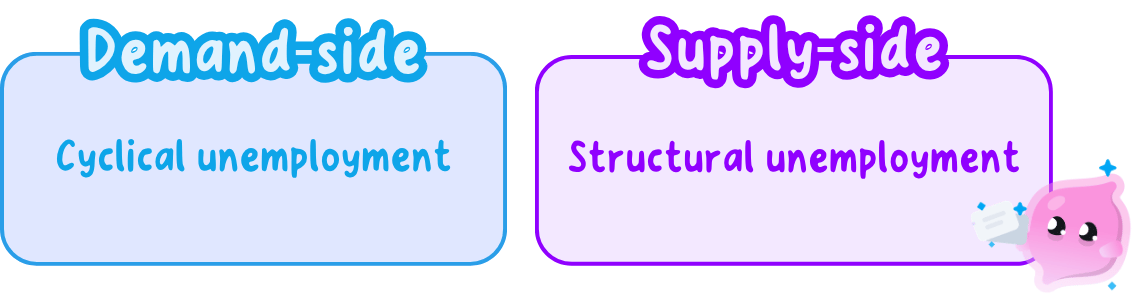
Demand-side policy targets cyclical unemployment
- Cyclical unemployment is caused by weak demand, so governments can use fiscal policy: increasing government spending or cutting taxes to raise spending in the economy.
- The Bank of England can use monetary policy: cutting Bank Rate to make borrowing cheaper, encouraging firms and households to spend and invest more.
- As demand recovers, firms need more workers, so cyclical unemployment falls.
Fiscal policy is covered in full in 2.3.1a, 2.3.1b and 2.3.1c, and monetary policy in 2.3.2a and 2.3.2b.
Example
- Between August 2024 and December 2025 the Bank of England cut Bank Rate six times, from 5.25 per cent to 3.75 per cent, to support demand as inflation eased.
- This is a real example of monetary policy responding to the economic cycle, with Bank Rate held at 3.75 per cent through 2026.
Supply-side policy targets structural unemployment
- Structural unemployment is caused by a mismatch between workers' skills or location and the jobs available, so it needs policies that improve the workforce rather than simply raising demand.
- Government-funded training and retraining schemes help workers whose old skills are no longer in demand gain skills employers want.
- Job centres and careers advice help match unemployed workers to available vacancies, including in other areas.
- These are examples of supply-side policy, which is covered in full in 2.3.3; here they matter because they reduce the mismatch behind structural unemployment.
How far unemployment policies work depends on the type
- It depends on which type of unemployment is being tackled, because demand-side policy can quickly cut cyclical unemployment but does little for structural unemployment caused by a skills mismatch.
- It depends on time lags, because interest rate changes and training schemes both take months or years to change spending and skills, so policies do not fix unemployment overnight.
- It depends on the risk of side effects, because demand raised too far can cause inflation, and spending on training and benefits must be paid for through taxes or borrowing.
- It depends on how well policy is targeted, because retraining and job centre support work best when aimed at the specific skills and locations where structural unemployment is highest.
- Overall, therefore, no single policy solves every type of unemployment: demand-side policy suits a cyclical downturn, while supply-side policy is needed for the longer-term mismatch behind structural unemployment.
Exam technique
- Match the policy to the type of unemployment named in the question, since a demand-side answer to a structural unemployment question is answering a different problem from the one asked about.
- When asked to judge how effective a policy is, refer to time lags and cost rather than simply describing what the policy does.
- Where a question gives data such as the Claimant Count or unemployment rate, use the actual figures to judge the scale of the problem before evaluating the policy.
Self review
- Give two ways unemployment harms the person without work.
- Explain how unemployment affects the government's budget.
- Why is long-term unemployment usually more damaging than a short spell?
- Which type of policy, demand-side or supply-side, is better suited to cyclical unemployment, and why?
- Give one reason why a policy to reduce unemployment might not work quickly.