The same word covers several different kinds of unemployment
- Economists sort unemployment into types so that each can be understood and tackled.
- Each type has a different cause and typical length, so telling them apart is an important skill.
Example
- In 2026, four very different UK workers might all be counted as unemployed: a graduate from Leeds still job-hunting a few weeks after finishing university, a former Port Talbot steelworker whose skills no longer match local vacancies, a seasonal worker laid off once Blackpool's tourist season ends, and a construction worker made redundant during a downturn in house-building.
- Same word, four different situations, which is why the types are worth separating.
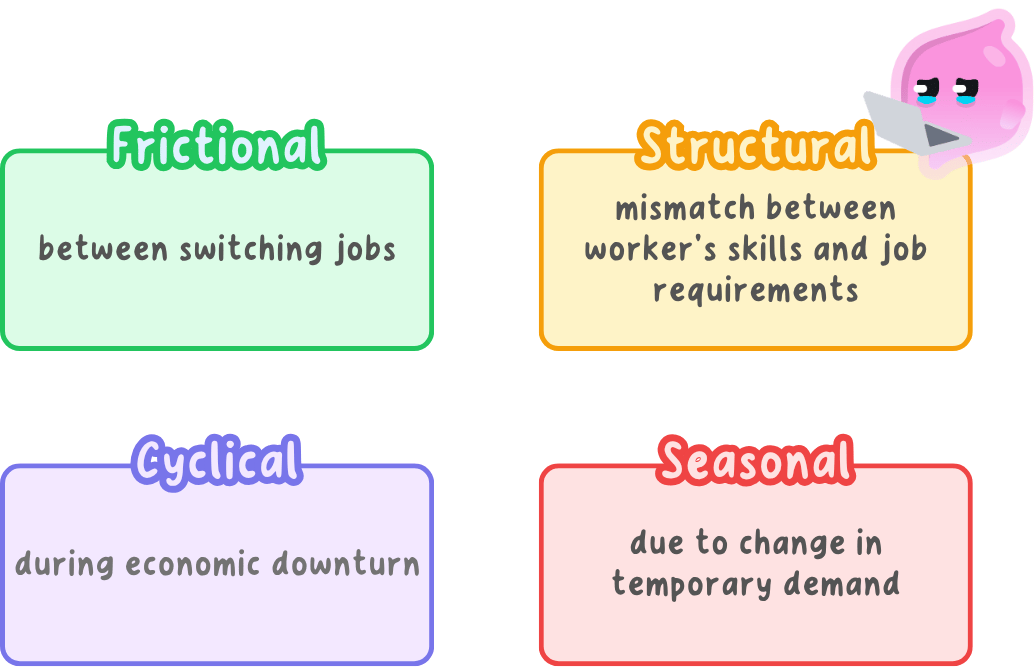
The four main types each have a clear meaning
- Frictional and seasonal unemployment are usually short-lived and exist even in a healthy economy.
- Structural unemployment can last a long time because workers need to retrain or move.
- Cyclical unemployment appears in a downturn and fades in a recovery.
Common Mistake
- Do not treat all unemployment as the same thing.
- Being briefly between jobs (frictional) is not the same as being out of work because demand has collapsed (cyclical).
Frictional unemployment happens between jobs
Definition
Frictional unemployment: short-term joblessness while people move between jobs, searching for a suitable vacancy.
- Frictional unemployment is caused by imperfect information: workers and employers take time to find each other, and finding a suitable vacancy takes time even when jobs exist.
Example
- A university graduate from Leeds spends six weeks applying for graduate schemes before accepting a marketing role in Manchester.
- This is frictional unemployment: the cause is the normal time it takes to search for and match to a suitable job, not a lack of vacancies.
Seasonal unemployment follows the time of year
Definition
Seasonal unemployment: unemployment that rises and falls with the time of year as demand for certain work changes.
- Seasonal unemployment is caused by regular changes in demand across the year, for example in tourism, farming and construction.
Example
- Seasonal workers at Blackpool's seaside attractions are laid off each autumn when the tourist season ends and visitor numbers fall, then rehired the following spring.
- This is seasonal unemployment: the cause is the predictable yearly change in demand for that work, not the state of the wider economy.
Structural unemployment follows long-term change
Definition
Structural unemployment: unemployment caused by a long-term mismatch between workers' skills or location and the jobs available.
- New technology and automation can replace workers with machines.
- Globalisation can move production to countries with lower costs.
- The decline of industries leaves workers with skills that are no longer needed.
- A geographical mismatch means jobs exist, but not where the unemployed live.
Case study
- When Tata Steel closed the blast furnaces at its Port Talbot steelworks in 2024, thousands of steelworkers lost jobs whose specific skills were no longer needed locally.
- This is a clear case of structural unemployment, caused by the long-term decline of a major local industry.
Cyclical unemployment follows the ups and downs of demand
Definition
Cyclical (demand-deficient) unemployment: unemployment caused by a fall in the total demand for goods and services during an economic downturn.
- Cyclical unemployment is caused by a fall in total spending in the economy during a downturn.
- When sales fall, firms produce less and cut jobs; as incomes fall, spending falls further, so still more jobs can be lost.
Case study
- During the COVID-19 lockdowns in 2020, spending collapsed as pubs, shops and hotels closed, and unemployment rose as firms cut jobs and hours.
- This is a clear case of cyclical, demand-deficient unemployment, caused by a sudden fall in total spending across the economy rather than by workers' skills.
The types differ in how long they typically last
- Voluntary unemployment, where specified, is when a person chooses not to take a job at the going wage, rather than being unable to find one.
- Matching a cause to a type is the key skill: ask what the person's situation is, and the type usually becomes clear.
Common Mistake
Do not label someone unemployed when they are in fact economically inactive, for example if they have stopped looking for work altogether.
Naming the type is the key exam skill
- In the exam you often need to match an example to its type and justify your choice by linking it to the cause.
- Support your choice of type with the specific detail in the scenario, such as the season, the industry, or whether demand across the whole economy has changed.
Self review
- Name the four main types of unemployment and give one cause of each.
- Which type tends to last longest, and why?
- A fruit picker has no work in winter. Which type is this, and why?
- Explain why the closure of the Port Talbot blast furnaces is an example of structural unemployment.
- Why is being briefly between jobs not the same as cyclical unemployment?