Inflation is a sustained rise in prices
- Prices for individual goods and services rise and fall all the time, for all sorts of different reasons.
- Inflation is about what happens to prices on average across the whole economy, not the price of any single item.
Definition
Inflation: a sustained rise in the general price level of an economy, so the average of all prices ends up higher than it was before.
Rate of inflation: the percentage increase in the general price level over a period of time, usually a year.
- A single price shock, such as a bad harvest pushing up the price of potatoes, is not inflation on its own.
- It only counts as inflation once it feeds through into a sustained rise across prices generally, not just one product.
- The Office for National Statistics (ONS) announces the UK rate of inflation each month.
Example
- In July 2026, the UK's CPI rate of inflation was 2.9 per cent, so the general price level was 2.9 per cent higher than a year earlier.
- If a weekly shop cost £50 in July 2025 and £51.45 in July 2026, that 2.9 per cent rise matches the economy-wide figure.
Falling inflation is not falling prices
- The rate of inflation can rise or fall from month to month, and this often confuses the word falling.
- If the rate falls from, say, 6 per cent to 3 per cent, prices are still rising, just more slowly than before.
Definition
Disinflation: a fall in the rate of inflation, so prices are still rising but more slowly than before.
Deflation: a sustained fall in the general price level, so prices are actually falling on average and the rate of inflation is negative.
- UK CPI inflation fell from 2.8 per cent in May 2026 to 2.6 per cent in June 2026: prices were still rising each month, just at a slightly slower annual pace, so this was disinflation, not deflation.
- Deflation is rare in the UK. It would show up as a negative CPI rate, for example minus 1 per cent, meaning the general price level had actually fallen.
Common Mistake
- A falling rate of inflation (disinflation) is not the same as falling prices (deflation).
- Only a negative rate of inflation means the general price level is genuinely falling.
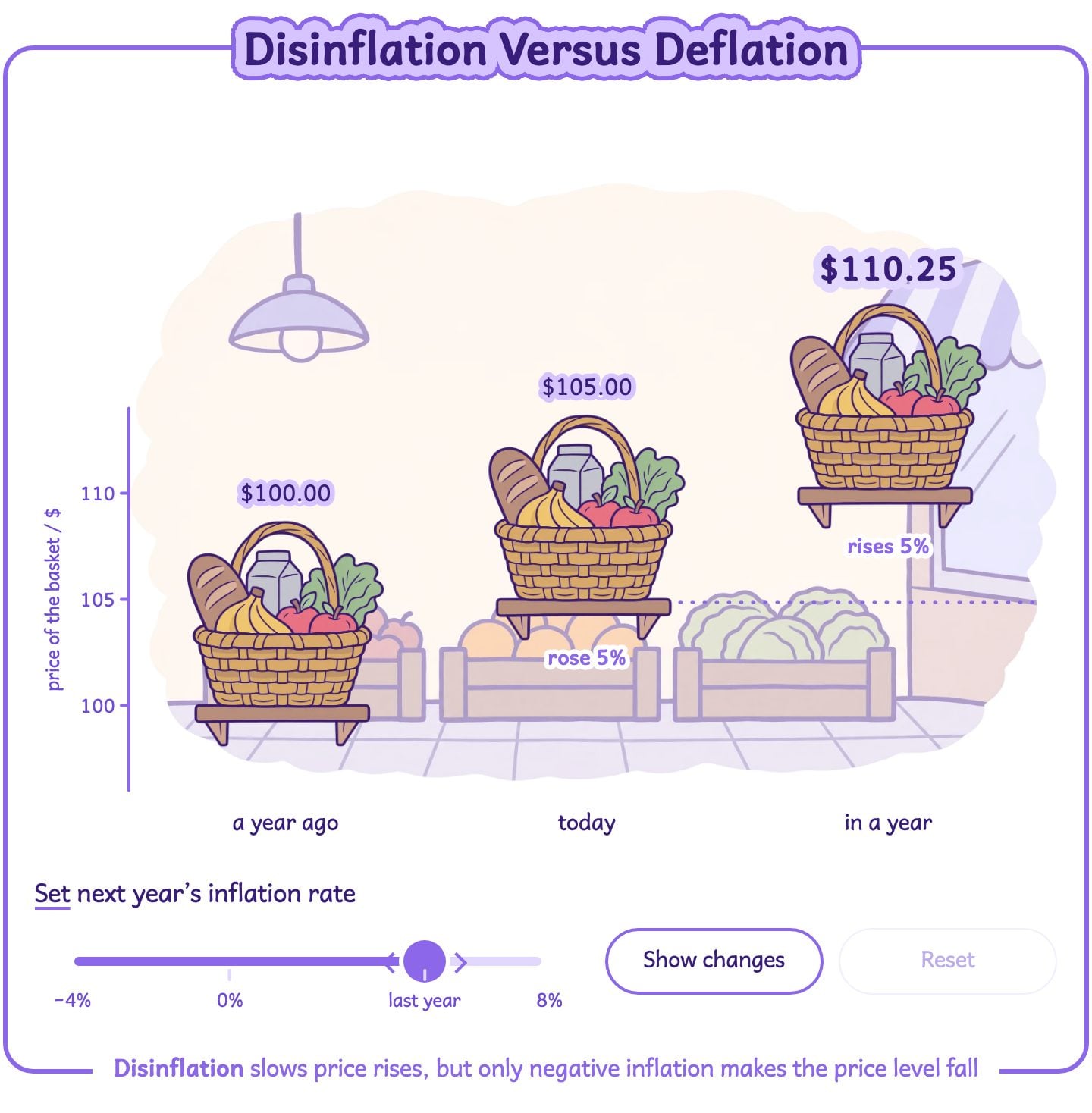
Slow the inflation rate and notice prices still rise until the rate goes negative.
Price stability keeps the economy predictable
- Governments and central banks aim for price stability: low and steady inflation, rather than rapid swings in either direction.
- Very high inflation makes it hard for households and firms to plan, because money loses its value quickly and unpredictably.
- Deflation can also cause problems, because if people expect prices to keep falling they may delay spending, which can weaken the economy further.
- For this reason, a small, stable, positive rate of inflation is usually judged healthier than either high inflation or deflation.
Self review
- State in one sentence what is meant by inflation.
- State what is meant by the rate of inflation.
- Explain the difference between deflation and disinflation.
- Explain why a falling rate of inflation does not mean prices are falling.
- Give one reason why governments aim for price stability.