Sellers hold power over the price
Definition
Non-competitive market: a market supplied by one firm, or by a small number of large firms, where a seller can influence the price instead of having to accept the price the market has already set.
Barriers to entry: anything that makes it difficult or unprofitable for a new firm to start supplying a market, which is what allows that power to last.
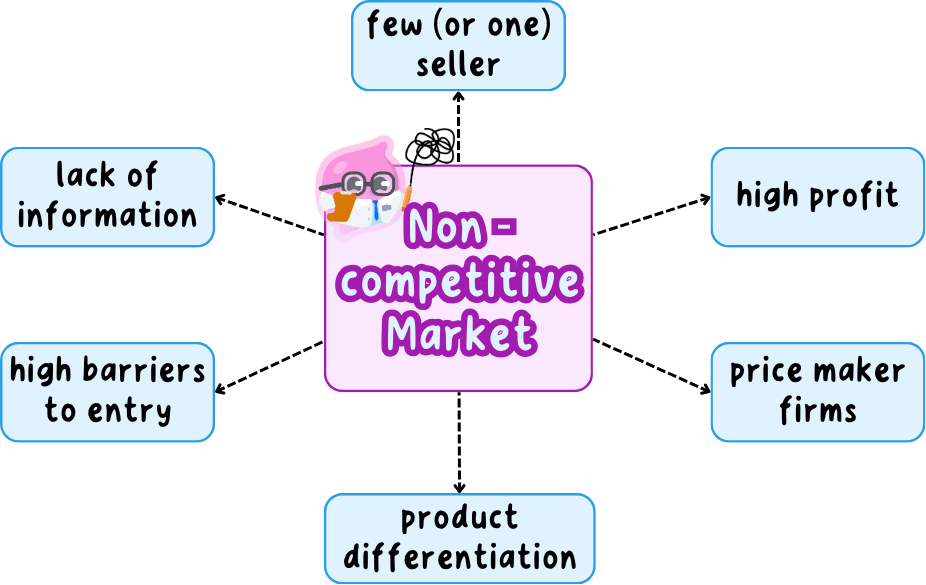
- Few sellers, or only one, because the number of sellers is the number of places a dissatisfied buyer can take their money instead.
- Royal Mail delivers almost every letter posted in the UK, and Thames Water is the only mains water supplier in its region, so an unhappy customer has no second supplier to move to.
- Groceries and energy supply show the other version, where a handful of large firms take most of the spending between them.
- High barriers to entry, so a firm hoping to compete with Network Rail would have to lay its own track and signalling before it carried a single passenger.
- Because entry is so hard, high profits do not pull in newcomers and so are never competed away.
- Products are differentiated or unique, since branding, patents and design make one firm's product hard to replace.
- The less alike two products seem, the less a buyer switches over a small price difference, and the more power each seller keeps.
- Buyers usually know less than sellers, and the complicated tariffs of the big six energy firms made it hard for a household to work out which deal was cheapest.
- Where comparing is hard, buyers stay where they are, and a seller that expects them to stay faces less pressure on its price.
- Firms are price makers rather than price takers, which is the result the other characteristics produce between them rather than a separate cause.
- A price maker chooses the price it charges, knowing that a buyer who refuses it has no close alternative to turn to.
- Even so, no firm can charge any price it likes, because a higher price still loses sales as buyers do without the good altogether.
Case study
- Letter post: Royal Mail carries almost all UK letters under a universal service obligation, and no rival delivers to every address in the country.
- Water: Thames Water supplies about 16 million people through the only set of pipes in the area.
- Rail infrastructure: Network Rail owns almost all the track, signalling and major stations in Great Britain, so every train operator has to deal with it.
- Groceries: Tesco, Sainsbury's, Asda and Morrisons take most grocery spending between them, so each is large enough to affect prices across the market.
- Medicines: a pharmaceutical firm holding a patent on a new treatment is the only lawful seller of it until the patent expires.
Barriers to entry keep the competition out
- Legal barriers name one lawful seller, as a patent does for a new medicine and a licence or franchise does for a rail route or a radio frequency.
- Control of a key resource or network needs no law at all, because a firm that owns the only pipes, track or grid can refuse a rival access to them.
- Very high set-up costs deter entry even where nobody is excluded, since laying a water network costs so much that a newcomer would need a large share of the market to cover the outlay.
- Much of that spending is sunk, meaning it cannot be recovered if the attempt fails, so entering is riskier than the figures alone suggest.
- Economies of scale give an established firm a cost per unit that no small newcomer can match.
- Brand strength built by years of advertising works like a legal barrier, since a newcomer has to spend heavily on marketing before it makes a single sale.
- Existing firms can also raise the barrier deliberately, by tying suppliers into long contracts or buying up a promising rival before it grows.
- The height of the barrier decides whether market power lasts, because power that newcomers can compete away is only temporary.
Common Mistake
- A non-competitive market is not one seller only: a small number of large firms is enough.
- These firms cannot charge any price they like: a higher price always costs them some sales.
- High profits alone prove nothing: the test is whether barriers stop them being competed away.
Concentration is a matter of degree
- Market structures run along a range from many small sellers to a single seller, and non-competitive markets occupy the concentrated end of it.
- Economists therefore measure the share of the market held by the largest firms rather than sorting every market into one of two boxes.
- UK groceries and energy supply are both concentrated but still have several large firms watching one another, whereas mains water in a region has exactly one.
- The more concentrated a market, the more its price and range depend on the decisions of a few firms rather than on rivalry between many.
- Concentration can also fall, and the growth of Aldi and Lidl in UK groceries shows it is not a permanent state of affairs.
What these firms do with that power is section 1.5.3b, and the two named structures at the concentrated end, monopoly and oligopoly, are section 1.5.3c.
Self review
- What is a non-competitive market?
- Give four characteristics of a non-competitive market.
- Name three barriers to entry and say how each keeps a newcomer out.
- Why does product differentiation give a seller power over the price?
- Why is a non-competitive market a matter of degree?