Competitive markets leave no seller able to set price
Definition
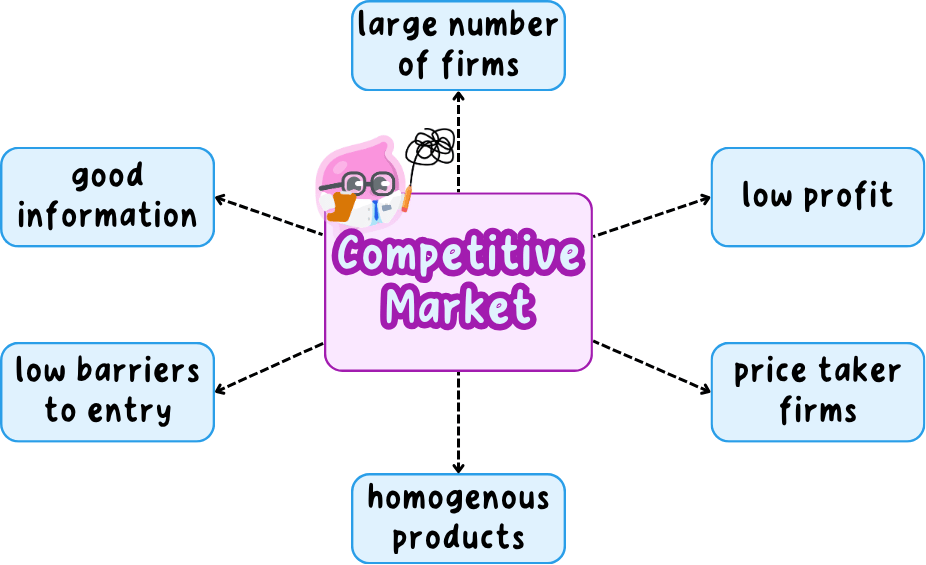
Competitive market: a market supplied by a large number of firms selling close substitutes, which new firms can enter and leave easily, so no single firm is big enough to set the price.
- The word competitive describes the conditions in the market, not how hard the sellers are trying, so two equally hardworking shopkeepers can be in a competitive market and in a sheltered one.
- The conditions have to hold on both sides, because many small sellers facing a handful of large buyers is not a competitive position for the sellers, which is roughly where British dairy farms stand when they sell to processors.
- Each seller's share is small enough that its own decisions do not register in the market total, and that is the practical meaning of being too small to set the price.
- The market price still moves, but because total demand or total supply has moved, not because one firm decided it should.
Case study
- Hairdressing and barbering is about as clear a competitive market as Britain has.
- There are tens of thousands of salons and barbers, and even the largest chain cuts only a tiny fraction of the country's hair.
- A chair, a mirror, a set of clippers and a rented room are enough to start, so a new barber can open within a few weeks.
- Prices for a basic cut in one town cluster within a pound or two, because a customer charged much more walks to the next shop.
- The same pattern runs through window cleaning, gardening, private tutoring, plumbing and market-stall greengrocery.
Close substitutes and good information let buyers act
- Close substitutes matter because a buyer only switches if the alternative does the same job, so the products have to be alike and not merely numerous.
- Good information matters just as much, since a price difference nobody can see disciplines nobody at all.
- The two work as a pair, because information without substitutes only tells a buyer they are paying too much and leaves them nowhere to go with the news.
- Information has become far cheaper to collect, which is why comparison websites made car insurance and household energy behave more competitively without changing the number of sellers in them.
- A supermarket shelf does the same job in miniature, since own-label and branded versions of one item sit side by side with the price per 100 grams printed under both.
Common Mistake
- A competitive market is not a perfect one: no real market has identical products or perfectly informed buyers.
- Many sellers is not enough: buyers who cannot compare or cannot switch leave those sellers undisturbed.
- Firm size is not the test: a village shop five miles from its nearest rival faces little competition, while Aldi and Lidl are large firms in a market that competes hard on price.
Easy entry and easy exit both matter
- Easy entry stops a high profit lasting, since anybody who can see the profit is free to enter and take a share of it.
- Easy exit matters because a firm decides whether to enter by asking what it would lose if the venture failed.
- Exit is easy where most of what a firm spends can be recovered, so a van, a set of tools and a short lease can be sold on or handed back.
- Exit is hard where the spending is sunk, so a purpose-built plant or a buried pipe has almost no value to anyone else and the money is gone.
- The condition is passed only when a firm can get in cheaply and get out again without ruin, which is why the two halves are always stated together.
Example
- A mobile catering van and a water treatment works show the difference in one comparison.
- A van, a fryer and a pitch licence might come to a few thousand pounds, and almost all of it can be sold on second hand if the trade does not work out.
- A treatment works costs hundreds of millions of pounds, is useless for anything else and cannot be moved, so the money can never be recovered.
- That is why one of these markets gains a new seller every month and the other has had the same seller for decades.
Together the conditions fix a price nobody set
- Many sellers, close substitutes, easy entry and exit and well informed buyers reinforce one another, so weakening any one of them weakens the whole result.
- What they produce is a going price that no firm chose, which each firm then has to produce beneath if it wants to stay open.
- That one fact is why a competitive market rewards low costs and punishes waste, whatever the sellers themselves would prefer.
How firms actually behave once the price is out of their hands is section 1.5.2b, and what the whole arrangement does to consumers, producers and workers is 1.5.2c.
Self review
- What is meant by a competitive market?
- Why does a competitive market need many buyers as well as many sellers?
- Why does good information matter as much as the number of sellers?
- Why does easy exit from a market make entry into it more likely?
- Name a competitive UK market, and give two conditions it satisfies.