Profit is revenue left after total costs
Definition
Profit: what is left when total costs are taken away from total revenue, so profit=total revenue−total costs\text{profit} = \text{total revenue} - \text{total costs}profit=total revenue−total costs.
Loss: the shortfall when total costs come to more than total revenue, which is the same subtraction with a negative answer.
- Both figures have to cover the same period, so a year of revenue goes with a year of costs and a week with a week.
- Profit is the reward an owner takes for putting money at risk, and it is also the money the firm reinvests in machinery, premises and staff.
- A firm whose revenue exactly matches its total costs earns neither a profit nor a loss and is still paying every bill, so a year at zero is not the same as failing.
How total revenue, total cost and average cost are each worked out is section 1.4.1b.
Common Mistake
- Revenue is not profit, so take total costs off before you write any profit figure.
- Only total costs go in the formula, so multiply an average cost by output first.
- A negative answer is a loss of that amount, never a profit of minus something.
One workshop's profit in a good and bad year
- A workshop building bicycle frames has fixed costs of £30,000 a year for its unit, its business rates and the lease on its machinery, and every frame adds £15 of variable cost in steel, paint and welders' hours.
- It sells frames at £25 and made 4,000 of them last year, then found orders down to 2,500 this year at the same price.
- The £30,000 falls due either way, which is what makes the two years look so different.
Example
- The good year, 4,000 frames at £25: build the revenue, then the costs, then subtract.
- Average cost was £22.50 a frame against the £25 price, so each frame left £2.50 behind and 4,000 of them left the £10,000.
- The bad year, 2,500 frames at the same £25: only the variable side of the costs comes down with the orders.
- The answer is negative, so the workshop made a loss of £5,000, and the reason is that average cost climbed to £27.00 a frame while the price stayed at £25.
Two routes raise profit: lower cost, higher revenue
- Reducing average cost widens the gap from below, since every pound taken off what a unit costs to make stays inside the firm.
- A firm does it by buying materials more cheaply, by getting more output from the same workers, or by spreading its fixed costs over a larger output.
- Nissan's Sunderland plant is the standard UK example, because building hundreds of thousands of cars on one site spreads the cost of the press shop and the paint line very thinly indeed.
- Increasing revenue widens the gap from above, by selling more units, by charging more where buyers will stay, or by doing both at once.
- Selling more units pulls both routes together, because the extra output also spreads the fixed costs and so drags average cost down on its own.
- Neither route is free, since a cheaper supplier can mean a worse frame and a higher price can send buyers to a rival.
- They can also pull against each other, as cutting the price to shift more units only raises revenue if the extra sales more than make up for the lower price charged on every unit.
Both routes, worked on the same workshop
- Start from the good year again, 4,000 frames at £25 with £30,000 of fixed costs and £15 of variable cost a frame, which gave the £10,000 of profit.
- Change one thing at a time, so the movement in the profit figure can be traced to the route rather than guessed at.
Example
- Route one, a lower average cost: a new steel contract cuts the variable cost from £15 to £13 a frame, with output and price untouched.
- Average cost has fallen from £22.50 to £20.50 and profit has risen by exactly the £2 saved on each of 4,000 frames.
- Route two, a larger revenue: a new stockist lifts sales from 4,000 to 5,000 frames at the same £25, with the variable cost back at £15.
- Profit has doubled to £20,000, which is the £10 each extra frame leaves once its own £15 is paid, and average cost has fallen to £21.00 as well, so raising output pulled both routes at once.
Rising revenue does not mean rising profit
- Revenue is the money coming in at the top and profit is what survives the costs, so the two move together only while costs stand still.
- A firm can raise its price yet cut its variable cost by so little that a rival undercuts it, or hold its price steady while overtime and rush deliveries push costs up faster than the extra sales pay for.
- So a firm announcing record sales has told you nothing about whether it made money, and a change in profit is always the difference between two changes.
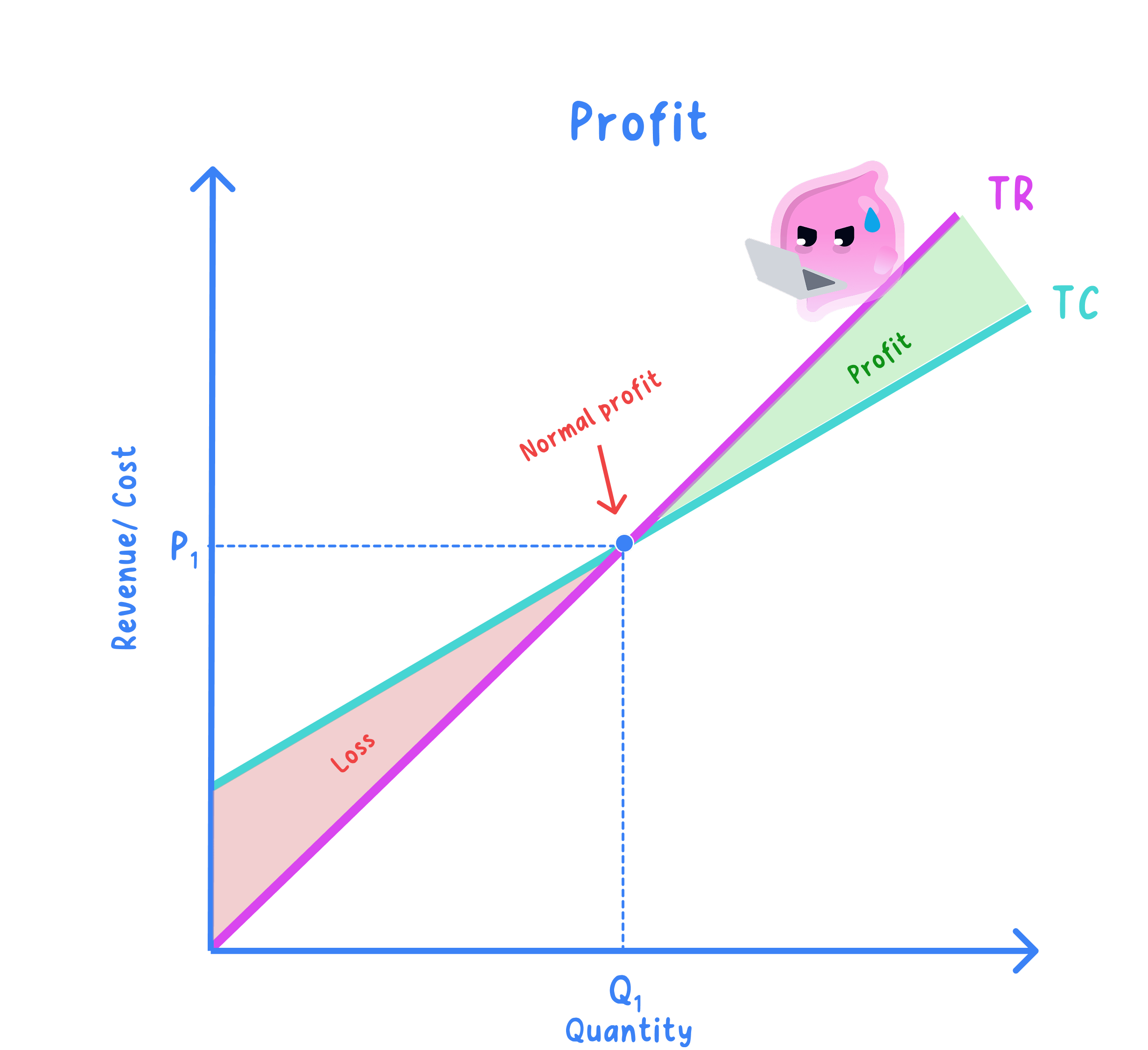
- Drawn against output, profit is the vertical gap between the total revenue line and the total cost line, wherever revenue is the higher of the two.
- The two lines cross where the firm breaks even, which for this workshop is 3,000 frames, and below that output it loses money however hard it works.
Exam technique
- Write profit = total revenue minus total costs before you substitute, then build each total on its own line.
- Keep the £ sign on every figure, and label the answer profit or loss.
- Sense-check the size: a profit bigger than revenue means a figure is in the wrong place.
Self review
- State the formula for profit.
- Total revenue is £62,500 and total costs are £67,500: what is the result, and how should it be written?
- A workshop sells 4,000 frames at £25 with fixed costs of £30,000 and a variable cost of £15 a frame: what is its profit?
- Name the two routes to a higher profit that AQA gives.
- Explain how selling more units can pull average cost down as well as pushing revenue up.