Objectives guide a firm's price and output choices
Definition
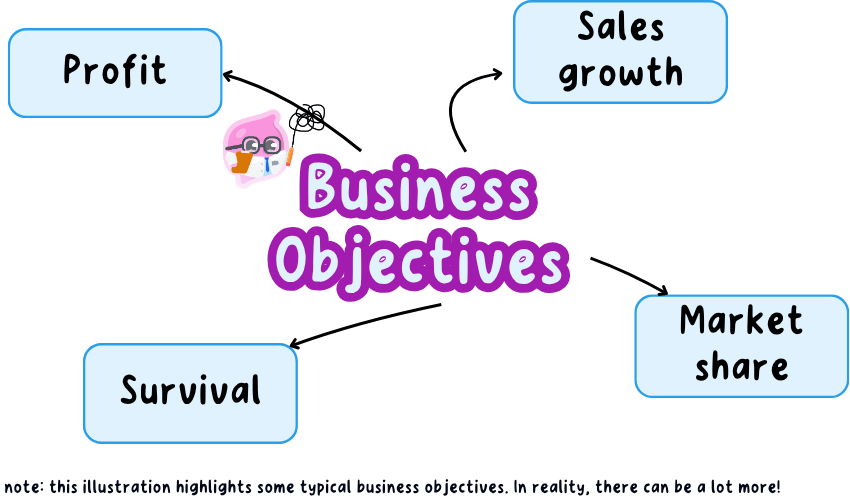
Profit maximisation: making the gap between a firm's total revenue and its total costs as wide as possible.
Sales growth: raising the quantity or the value of what the firm sells, year after year.
Increasing market share: raising the firm's own sales as a share of all the sales made in its market.
- Two firms facing the same costs and the same customers will name different prices if they want different things.
- Market share is a share, so a firm can sell more units than last year and still lose share when the whole market has grown faster than it has.
- Sales growth asks how big the firm is getting, while market share asks how big it is getting compared with its rivals.
- A firm can hold several objectives at once and rank them, chasing share in a city it has just entered while taking profit from the towns where it is already established.
- Shareholders who own a large company want a return on their money, while the salaried managers who run it are judged on how large the business has become.
- That split is why a firm's stated aim and the aim its decisions reveal are not always the same one.
- Every objective is limited by the revenue and cost figures behind it, because the firm still has to cover its costs from somewhere.
Each objective suits a different kind of firm
- Profit suits a firm that answers to outside owners, because Tesco has to hand its shareholders a return, and profit is also what pays for new stores and new machinery.
- Sales growth suits a firm whose product travels well, because Greggs has grown by opening more shops rather than by charging more in the shops it already had.
- Selling more units also spreads the rent and the bakery equipment over a larger output, which brings the cost of each item down.
- Increasing market share suits a firm in a crowded market, because a bigger share gives ASOS more weight when it negotiates with the brands that supply it.
- A larger share also makes it harder for a new rival to get a foothold, since customers who already have somewhere they shop rarely go looking for another.
- Survival comes first for a new or struggling firm, so it holds its price low enough to keep money coming through the till, which is why so many independent shops cut prices rather than shut in a bad year.
Case study
- Grocery price matching: Tesco has spent years matching the prices of cheaper rivals and offering lower prices to shoppers who use its loyalty card.
- The target is market share rather than the price of any one item, because a shopper who moves to a cheaper chain takes a whole weekly basket with them.
- Every price matched narrows the gap between what Tesco charges and what the goods cost it, and only a large established firm can carry that long enough for the share to arrive.
Chasing one objective means giving up another
- Cutting the price to win market share sacrifices profit now, because every unit sold brings in less money while costing exactly the same to make.
- Growing sales quickly raises costs before the extra sales pay for themselves, since the new shop, the extra staff and the longer delivery round are all paid for in the year they are added.
- Survival gives up profit and investment together, so a firm that holds its price down for too long has nothing left to modernise with and slips further behind its rivals.
- Market share bought with discounts is easily lost, while share won by a better product or a more convenient location is far harder for a rival to take back.
- The conflict is a matter of degree rather than a straight choice, since a firm can accept less profit this year to hold the share that earns its profit next year.
Common Mistake
- Sales growth is not profit: a firm can double its sales and earn less than before.
- Market share is a percentage of the whole market, not a number of items sold.
- Profit maximisation is the usual starting assumption, not a fact about every firm.
Whether profit dominates depends on the firm's position
- It depends on who owns the firm, because a company answering to outside shareholders is judged on the return it hands back each year, while an owner run corner shop can settle for a comfortable living.
- It depends on how long the firm has been trading, because a firm in its first year has to survive before it can maximise anything.
- It depends on the time period you look at, because the share bought with this year's discounts is what makes next year's profit possible.
- It depends on how crowded the market is, because a firm with many close rivals that pushes its price up to the profit maximising level simply sends its customers to the shop next door.
- It depends on who actually takes the decisions, since managers rewarded for the size of the business lean towards growth even where the owners would rather have the profit paid out.
Note
Judgement: profit is the objective firms keep coming back to, because survival needs cash, growth needs funds and market share bought with discounts has to be paid for out of profit earned somewhere else.
Judge an objective by actions, not statements
- A firm cutting prices and opening branches while earning very little is pursuing growth or market share, whatever its annual report claims.
- A firm raising prices and closing its weakest branches is pursuing profit, trading customers away for a wider gap on the ones it keeps.
- A firm holding a price that barely covers what each unit costs to make is surviving, picking the smaller of two losses rather than the larger one.
- Look at what the firm did with the money it earned, because profit paid out to owners points one way and profit spent on new outlets points another.
Exam technique
- Use AQA's own terms: profit, sales growth, market share; bring in survival only where relevant.
- Tie every objective you name to a decision on price, output or spending, taken from the source.
- Asked whether a firm should pursue an objective, say what it gives up before you judge.
Self review
- Name the three business objectives AQA lists.
- How can a firm raise its sales and still lose market share?
- Why might a new firm put survival ahead of profit?
- Name a UK firm that has grown by opening more outlets, and say what that growth costs it in the short run.
- Why do the managers who run a large company not always want what its owners want?