Demand-pull inflation comes from too much spending
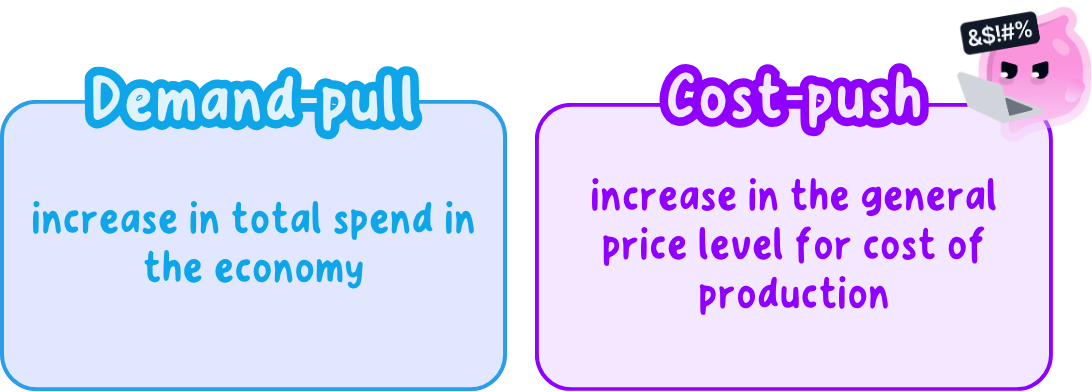
Demand-pull inflation: a rise in the general price level caused by total spending in the economy rising faster than the economy's ability to supply goods and services.
- Demand-pull inflation happens when total spending in the economy rises faster than firms can supply goods.
- When many buyers compete for a limited supply of goods, sellers can raise their prices.
- Lower interest rates can trigger this by making borrowing and spending cheaper, motivating the people in the economy to spend more.
- Rising incomes, greater confidence and higher demand for exports can also push total spending up.
- UK real GDP grew by 1.2 per cent over the year to Q2 2026, showing households and firms were spending more.
- When spending across the economy grows faster than firms can expand supply, sellers find they can raise prices without losing many customers.
Cost-push inflation comes from rising business costs
Cost-push inflation: a rise in the general price level caused by firms facing higher costs of production and passing these costs on as higher prices.
- Cost-push inflation happens when firms face higher costs and pass them on as higher prices.
- Higher wages: raise the cost of employing workers.
- Higher raw material and energy prices: make it dearer to produce goods.
- A weaker pound: raises the price of imported materials, and higher taxes on firms add to costs too.
- When world energy prices jump, firms face much higher gas and electricity bills.
- Many pass these costs on, so prices across the shops rise even though demand has not grown.
Spot the cue that signals each type
- To identify the cause in an exam question, ask whether the pressure is coming from demand or from costs.
- A booming economy with heavy spending and low interest rates points to demand-pull inflation.
- A sudden spike in wages, energy or import costs, with spending otherwise steady, points to cost-push inflation.
Inflation creates winners and losers
- Savers: tend to lose, because the money they have saved buys less over time.
- This is worst when the interest earned on savings is lower than inflation.
- Borrowers: can gain, because they repay a fixed debt with money that is worth less than when they borrowed it.
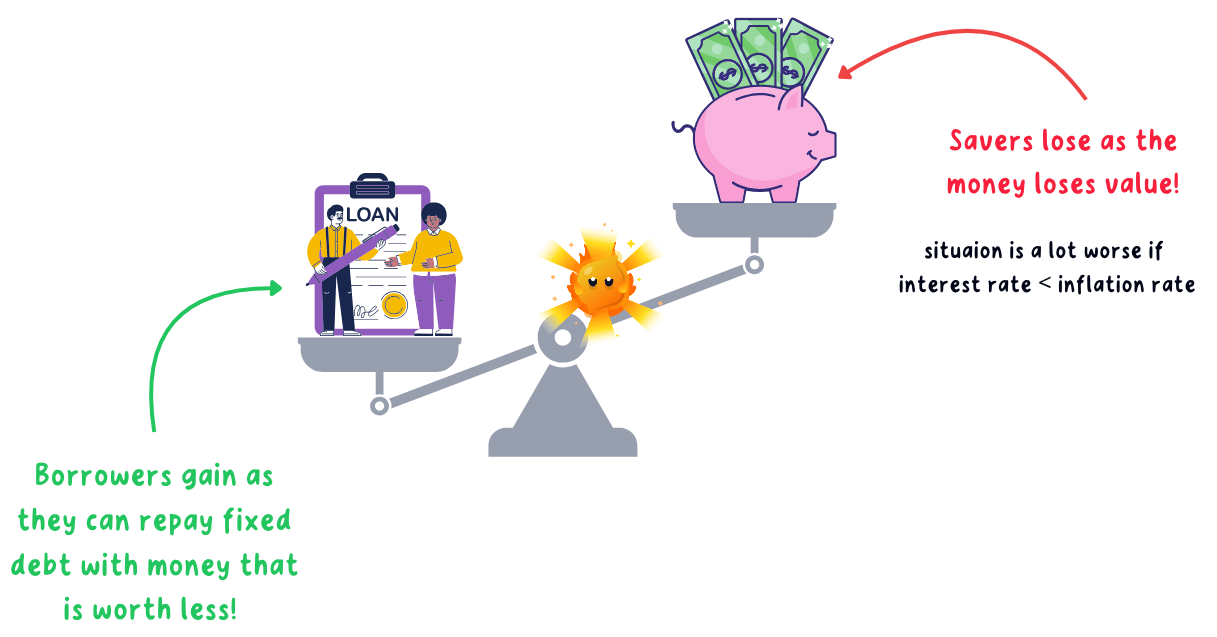
A borrower who takes out a £10,000 loan still repays £10,000 in total, but each of those pounds buys less by the time it is repaid, so the real burden of the debt falls.
Workers and those on fixed incomes feel the squeeze
- If wages rise more slowly than prices, real wages fall and workers can afford less.
- People on fixed incomes, such as some pensioners, lose out because their income does not rise with prices.
- Workers may respond by demanding pay rises to keep up with the cost of living.
- A worker gets a 2 per cent pay rise while CPI inflation is 2.9 per cent.
- Their pay has gone up in cash terms but they are worse off, because prices rose faster than their wage.
Firms face extra costs and uncertainty
Menu costs: the time and money firms spend updating prices, price lists, labels and menus when the general price level changes.
Shoe-leather costs: the extra time and effort people and firms spend moving money around to protect its value when inflation is high.
- Firms face extra costs when they have to change their prices often.
- High inflation also creates uncertainty, which makes it harder for firms to plan and invest for the future.
- Low and stable inflation avoids most of these costs, which is why it is generally preferred to high inflation.
Exporters can lose competitiveness abroad
- If UK prices rise faster than prices abroad, UK goods become more expensive for foreign buyers.
- This can cause exports to fall as customers overseas switch to cheaper suppliers.
- Cheaper imports may also become more attractive than UK-made goods, hurting domestic firms.
- The overall impact depends on how high and how predictable the inflation is, since low steady inflation causes far fewer problems than rapid rises.
The Bank of England and the Government can act
- The main tool for controlling inflation in the UK is monetary policy, where the Bank of England raises interest rates to cool spending. Monetary policy is covered fully in 2.3.2.
- Higher interest rates make borrowing dearer and saving more rewarding, which slows demand-pull inflation by reducing total spending.
- The Government can also use fiscal policy (2.3.1), such as raising taxes or cutting its own spending, to reduce demand in the same way.
- These demand-side policies work best against demand-pull inflation. Cost-push inflation, driven by rising costs rather than excess spending, is much harder for them to fix quickly.
How well anti-inflation policy works depends on the cause
- It depends on the cause of the inflation, because higher interest rates slow demand-pull inflation well, but do little to stop cost-push inflation caused by rising energy or import prices.
- It depends on who is affected, because higher interest rates help savers and squeeze borrowers, the opposite of what unchecked inflation does to each group.
- It depends on the size of the change needed, because a small rate rise may be absorbed easily, while a large rise needed to control high inflation can slow growth and cost jobs.
- It depends on time lags, because interest rate changes can take many months to feed through the economy, so policy may be acting on out-of-date information.
Monetary policy is a reasonably effective brake on demand-pull inflation, but a blunt and slow tool against cost-push inflation, and it always creates winners and losers along the way.
- Explain in one sentence what causes demand-pull inflation.
- Explain in one sentence what causes cost-push inflation.
- Explain why savers tend to lose and borrowers can gain from inflation.
- Explain how high inflation can harm exporters.
- Explain why interest rate rises are a poor tool against cost-push inflation.