2.3.1 Carbon bonding and the variety of organic compounds
Every carbon atom forms four covalent bonds
Organic compound
A compound based on carbon, usually containing carbon bonded to hydrogen.
- Carbon has atomic number 666 and the electron arrangement 2.4, so it has four outer electrons.
- It shares all four to gain a full outer shell, so each carbon atom forms four covalent bonds.
- In methane, CH4\text{CH}_4CH4, one carbon atom is bonded to four hydrogen atoms.
- These bonds can be to hydrogen, oxygen, nitrogen, the halogens or other carbon atoms.
- Carbon can also form double bonds, as in carbon dioxide and ethene, where two shared pairs join the same two atoms.
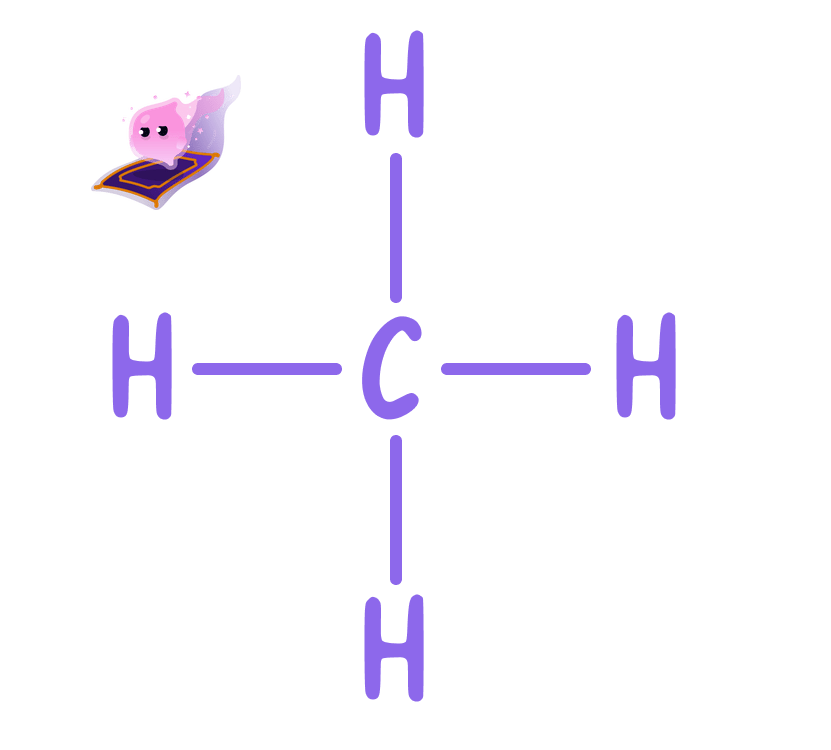
Do not draw a carbon atom with three or five bonds in a displayed formula, because carbon always forms four.
Carbon atoms form long chains, branches and rings
Hydrocarbon
A compound containing carbon and hydrogen atoms only.
- Bonds between carbon atoms are strong, so carbon atoms can link into chains of almost any length.
- Chains can be straight or branched.
- Carbon atoms can also join into rings, such as the ring of six carbon atoms in cyclohexane.
- Poly(ethene) contains chains of thousands of carbon atoms, while methane has only one.
- Chains, branches and rings can be combined in so many ways that there are millions of carbon compounds.
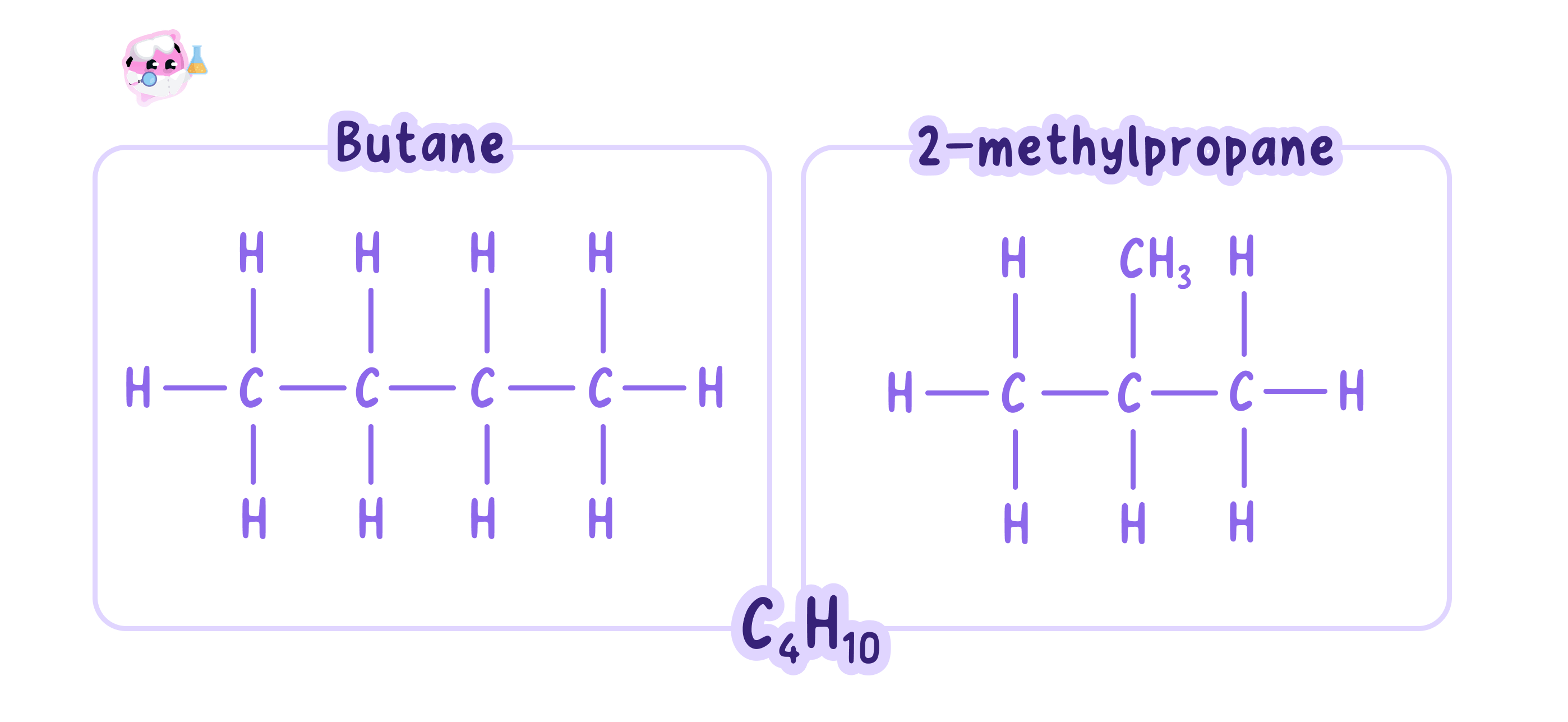
Butane and methylpropane both have the formula C4H10\text{C}_4\text{H}_{10}C4H10, but one is a straight chain and the other is branched, so they are different compounds.
Carbon forms families of compounds with similar reactions
- Members of a family of carbon compounds share the same general structure and differ mainly in the length of the carbon chain.
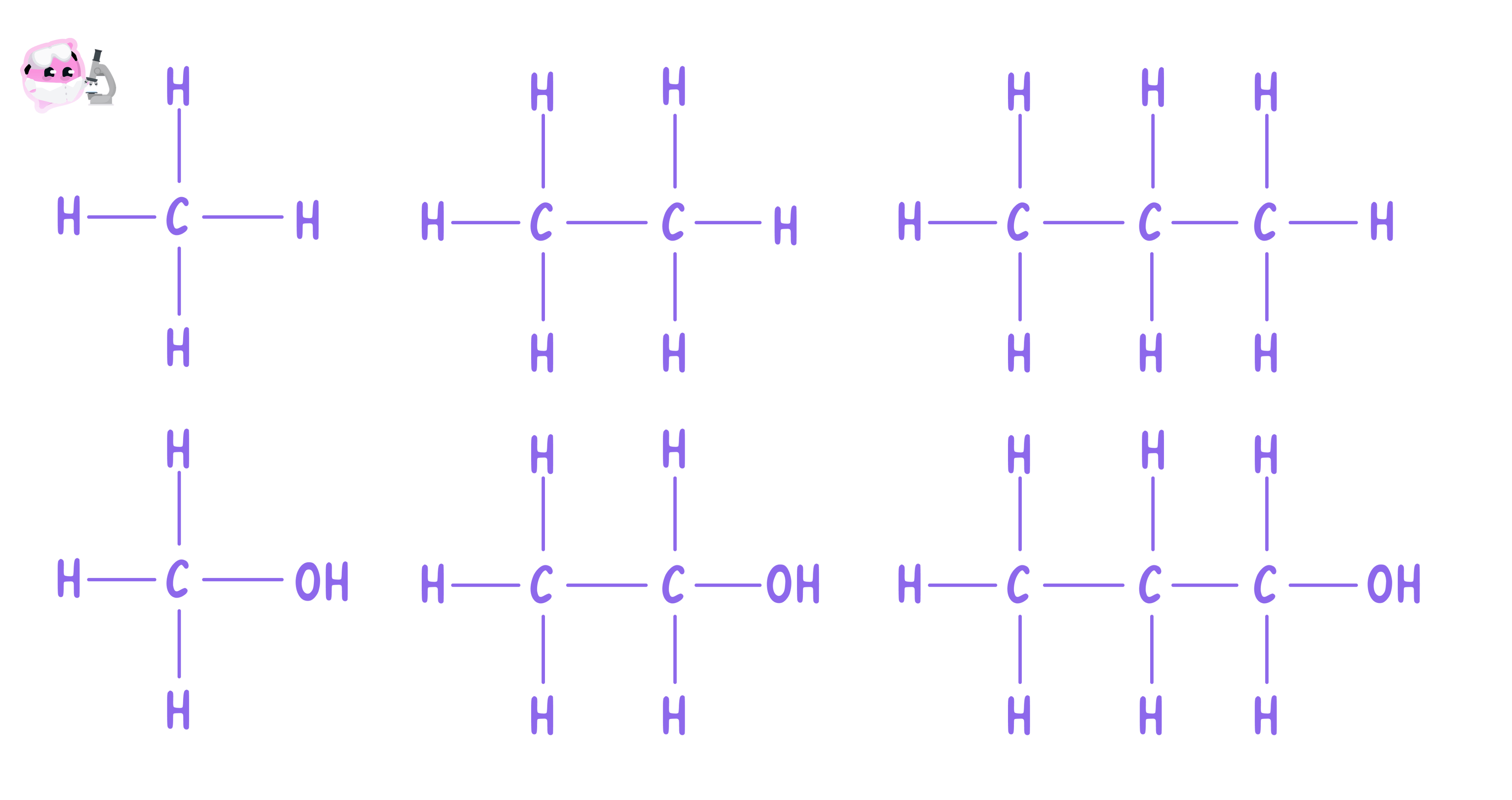
- Methane, ethane and propane belong to the alkanes, where each member has one more CH2\text{CH}_2CH2 than the one before.
- Members of a family react in similar ways, because they contain the same group of atoms that takes part in reactions.
- Ethanol and propanol are alcohols, and each contains an OH\text{OH}OH group.
- Knowing how one member reacts lets chemists predict how the others will react.
Four bonds per atom, strong bonds between carbon atoms and the ability to form chains and rings together explain the huge range of carbon compounds.
Carbon bonding underlies natural and synthetic organic compounds
Synthetic organic compound
An organic compound made by chemical processes rather than produced by a living organism.
- Living things are built from natural organic compounds, such as sugars, fats, proteins and DNA.
- Starch and cellulose in plants are long chains of sugar units joined together.
- Chemists make synthetic organic compounds, including plastics, medicines, dyes and fuel additives.
- Many synthetic compounds are made from crude oil, which is a mixture of hydrocarbons.
- Natural and synthetic compounds rely on the same features of carbon, namely four bonds, chains and rings.
Aspirin is a synthetic organic compound built around a ring of six carbon atoms, first made from a compound found in willow bark.
- How many covalent bonds does a carbon atom form, and why?
- What shapes can chains of carbon atoms form?
- Why are there millions of different carbon compounds?
- What do members of the same family of carbon compounds have in common?
- Give one natural and one synthetic organic compound.
2.3.2 Diamond, graphite, fullerenes and graphene
Diamond, graphite, graphene and fullerenes are all carbon
Allotrope
One of two or more different forms of the same element in the same physical state.
Giant covalent structure
A structure in which atoms are joined by strong covalent bonds in a large continuous network.
- All four are made only of carbon atoms joined by covalent bonds.
- They have very different properties because the atoms are bonded differently and arranged in different shapes.
- Diamond, graphite and graphene are giant covalent structures.
- Fullerenes are molecules, such as buckminsterfullerene, C60\text{C}_{60}C60, which is shaped like a hollow football.
Every property of these substances can be explained from how many bonds each carbon atom forms and how the atoms are arranged.
Four covalent bonds per atom make diamond hard
- In diamond, each carbon atom is covalently bonded to four others in a rigid three-dimensional network.
- Melting diamond means breaking many strong covalent bonds, which needs a huge amount of energy, so its melting point is very high.
- The rigid network makes diamond extremely hard, which is why it is used on the tips of cutting tools and drills.
- Diamond does not conduct electricity, because all four outer electrons of each atom are in bonds, leaving no delocalised electrons.
Do not mention intermolecular forces for diamond or graphite, because these are giant covalent structures with no separate molecules.
Layers and delocalised electrons explain graphite's properties
Delocalised electron
An electron that is not attached to one particular atom or ion and can move through a structure.
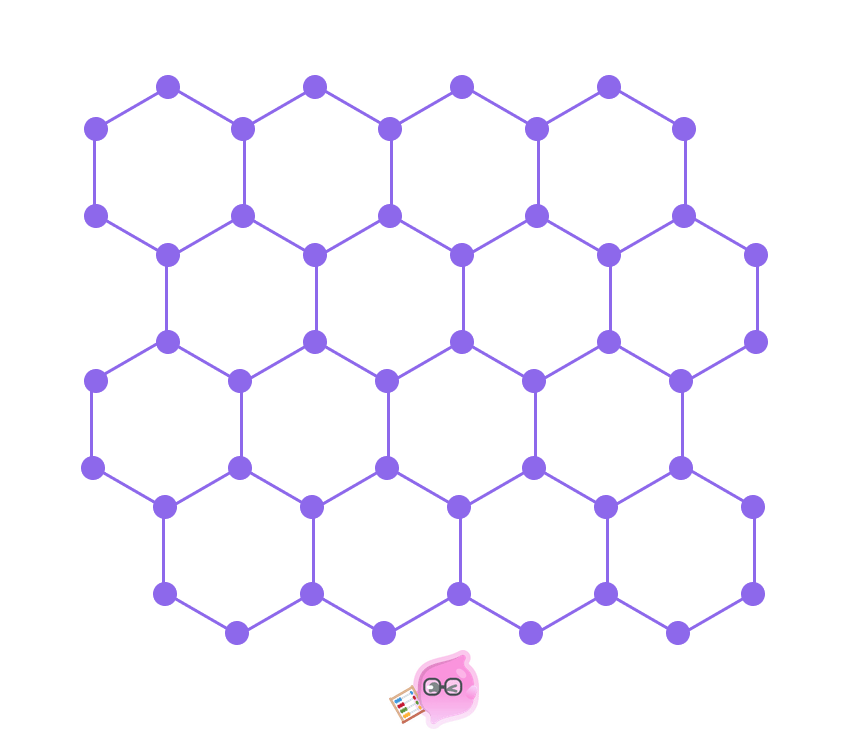
- In graphite, each carbon atom forms three covalent bonds, making flat layers of hexagonal rings.
- The fourth outer electron from each atom is delocalised, so graphite conducts electricity along the layers.
- The layers are held together only by weak forces, so they slide over each other easily.
- This makes graphite soft and slippery, which is why it is used in pencils and as a lubricant.
- Graphite still has a very high melting point, because melting breaks the strong covalent bonds within the layers.
Graphite is used for the electrodes in electrolysis because it conducts electricity and has a very high melting point.
Graphene sheets and hollow fullerene molecules
Graphene
A single layer of carbon atoms, with each carbon atom covalently bonded to three others in a hexagonal arrangement.
Fullerene
A molecular form of carbon in which carbon atoms form a hollow cage, such as a sphere or tube.
- Graphene is one atom thick, so it is very light and almost transparent.
- Its strong covalent bonds make it extremely strong for its mass.
- Each carbon atom in graphene has a delocalised electron, so graphene conducts electricity very well and could be used in flexible electronics.
- Fullerenes such as C60\text{C}_{60}C60 are separate molecules, so the weak intermolecular forces between them give much lower melting points than diamond.
- Carbon nanotubes are fullerenes shaped as cylinders, which are very strong and conduct electricity, so they can reinforce materials.
- The hollow shape of fullerenes lets them carry drug molecules into the body.
When comparing diamond and graphite, compare the number of bonds each carbon atom forms and whether any electrons are delocalised, because those two facts explain most of the differences.
- Why does diamond have a very high melting point?
- Why does graphite conduct electricity but diamond does not?
- Why is graphite soft and slippery?
- What is graphene, and why does it conduct electricity?
- Why does C60\text{C}_{60}C60 have a much lower melting point than diamond?
2.3.3 Bond strength, changes of state and predicting states
Changing state means overcoming forces between particles
Intermolecular force
An attraction between separate molecules.
Boiling point
The temperature at which a liquid changes to a gas at a stated pressure.
- Melting and boiling need energy to be transferred to the substance to overcome the attractions holding its particles together.
- The stronger the attractions, the more energy is needed and the higher the melting and boiling points.
- Freezing and condensing release energy as the attractions form again.
- What has to be overcome depends on the type of structure, which is why melting points range from −210 ∘C-210\ ^{\circ}\text{C}−210 ∘C for nitrogen to over 3500 ∘C3500\ ^{\circ}\text{C}3500 ∘C for diamond.
To explain a melting or boiling point, name what is overcome and say how strong it is.
Simple molecular substances have low melting and boiling points
Simple molecular substance
A substance made of separate small molecules, such as water, oxygen or methane.
- Inside each molecule, the atoms are held by strong covalent bonds.
- Between the molecules there are only weak intermolecular forces.
- Melting or boiling separates the molecules, so only the intermolecular forces are overcome and the covalent bonds stay intact.
- Little energy is needed, so these substances are often gases or liquids at room temperature.
- Larger molecules have stronger intermolecular forces, so they have higher boiling points.
- This is why pentane boils at 36 ∘C36\ ^{\circ}\text{C}36 ∘C, while methane boils at −162 ∘C-162\ ^{\circ}\text{C}−162 ∘C.
Do not say that covalent bonds break when a simple molecular substance boils, because boiling water still gives H2O\text{H}_2\text{O}H2O molecules.
Giant structures have high melting points
- In an ionic lattice, melting means overcoming strong electrostatic attractions between huge numbers of oppositely charged ions.
- Magnesium oxide, with 2+2+2+ and 2−2-2− ions, has stronger attractions than sodium chloride and melts at about 2850 ∘C2850\ ^{\circ}\text{C}2850 ∘C.
- In a giant covalent structure, melting breaks many strong covalent bonds, so diamond and silicon dioxide melt at very high temperatures.
- In a metal, the strong attraction between positive ions and delocalised electrons means most metals need a lot of energy to melt.
- Boiling points of giant structures are even higher, because the particles must be separated completely.
Sodium chloride melts at 801 ∘C801\ ^{\circ}\text{C}801 ∘C but chlorine boils at −34 ∘C-34\ ^{\circ}\text{C}−34 ∘C, because salt's ions are held in a strong lattice while chlorine molecules are held only by weak intermolecular forces.
Predicting state from melting and boiling points
Melting point
The temperature at which a solid changes to a liquid at a stated pressure.
- Below its melting point, a substance is a solid.
- Between its melting and boiling points, it is a liquid.
- Above its boiling point, it is a gas.
- Take care with negative values, since −50 ∘C-50\ ^{\circ}\text{C}−50 ∘C is colder than −20 ∘C-20\ ^{\circ}\text{C}−20 ∘C.
- At its melting point, a substance can be present as both solid and liquid.
- Bromine melts at −7 ∘C-7\ ^{\circ}\text{C}−7 ∘C and boils at 59 ∘C59\ ^{\circ}\text{C}59 ∘C; predict its state at 25 ∘C25\ ^{\circ}\text{C}25 ∘C.
- Compare with the melting point: 25 ∘C25\ ^{\circ}\text{C}25 ∘C is above −7 ∘C-7\ ^{\circ}\text{C}−7 ∘C, so bromine is not a solid.
- Compare with the boiling point: 25 ∘C25\ ^{\circ}\text{C}25 ∘C is below 59 ∘C59\ ^{\circ}\text{C}59 ∘C, so bromine has not boiled.
- Bromine is a liquid at 25 ∘C25\ ^{\circ}\text{C}25 ∘C.
- Why does a substance with stronger forces between its particles have a higher boiling point?
- What is overcome when water boils?
- Why does magnesium oxide have a higher melting point than sodium chloride?
- Why does pentane boil at a higher temperature than methane?
- Ethanol melts at −114 ∘C-114\ ^{\circ}\text{C}−114 ∘C and boils at 78 ∘C78\ ^{\circ}\text{C}78 ∘C; what is its state at 100 ∘C100\ ^{\circ}\text{C}100 ∘C?
2.3.4 Bulk properties and types of bonding
Bulk properties come from bonding and structure
Bulk property
A property of a large amount of a material, such as its melting point, hardness or electrical conductivity.
- A single atom or molecule has no melting point and cannot conduct, because these are properties of the whole material.
- Bulk properties depend on the type of bond, how strong it is compared with any intermolecular forces, and how the bonds are arranged.
- Electrical conductivity needs charged particles that are free to move, either ions or delocalised electrons.
- Hardness and brittleness depend on whether layers of particles can move past each other without the bonding breaking.
For any material, ask which particles are present, what holds them together and whether anything charged can move.
Hard, brittle ionic compounds conduct when molten or dissolved
Ionic lattice
A regular, repeating three-dimensional arrangement of oppositely charged ions.
- Strong attractions between ions give ionic compounds high melting points.
- Solid ionic compounds do not conduct, because their ions are fixed in the lattice.
- When molten or dissolved in water, the ions can move, so the compound conducts electricity.
- Ionic crystals are brittle, because a sharp blow shifts a layer so that ions with the same charge line up and repel.
- Many ionic compounds, such as sodium chloride, dissolve in water.
Do not say molten ionic compounds conduct because electrons move, because the charge is carried by moving ions.
Simple molecular substances melt easily and do not conduct
Simple molecular substance
A substance made of separate small molecules, such as water, oxygen or methane.
- Only weak intermolecular forces act between the molecules, so melting and boiling points are low.
- Simple molecular substances do not conduct electricity, because the molecules have no overall charge and there are no free electrons.
- Their solids are usually soft, because little force is needed to push the molecules apart.
- Many do not dissolve in water, although some, such as sugar, do.
Candle wax melts in a flame and does not conduct, because it is made of molecules held together by weak intermolecular forces.
Giant covalent structures are hard, while polymers are flexible
Polymer
A substance made of very long molecules built from many repeating units joined by covalent bonds.
- Giant covalent substances such as diamond and silicon dioxide have very high melting points, because many strong covalent bonds must break.
- They are hard, because the rigid network of bonds resists being pushed out of shape.
- Most do not conduct electricity, because all their outer electrons are in bonds, with graphite the exception.
- In a polymer, strong covalent bonds run along each chain, while weaker intermolecular forces hold neighbouring chains together.
- The chains can slide past each other, so many polymers are flexible and soften when heated.
- Polymers melt at higher temperatures than small molecules, because their long chains have stronger intermolecular forces.
A poly(ethene) carrier bag stretches and softens when warmed because its chains slide past one another, but it holds together because each chain is joined by covalent bonds.
Delocalised electrons and layers of ions explain metal properties
Delocalised electron
An electron that is not attached to one particular atom or ion and can move through a structure.
- Metals conduct electricity, because their delocalised electrons can move through the structure.
- Metals also conduct heat well, because the delocalised electrons carry energy through the metal.
- Metals are malleable and ductile, because layers of ions can slide over each other without the metallic bonding breaking.
- Most metals have high melting points, because of the strong attraction between the ions and the delocalised electrons.
- In an alloy, atoms of different sizes disrupt the layers, so the layers slide less easily and the alloy is harder.
When explaining conductivity, always say what moves: ions in a molten or dissolved ionic compound, and delocalised electrons in a metal or graphite.
- Why does solid sodium chloride not conduct electricity when molten sodium chloride does?
- Why are ionic crystals brittle?
- Why do simple molecular substances not conduct electricity?
- Why are many polymers flexible?
- Why can metals be hammered into shape without breaking?
2.3.5 Nanoparticles: scale, surface area, uses and risks
Nanoparticles are between 1 and 100 nanometres across
Nanoparticle
A particle between 1 and 100 nanometres across.
- One nanometre (nm) is 1×10⁻⁹ m1 \times 10^{-9}\,\text{m}1×10⁻⁹m.
- A typical atom is about 0.2 nm0.2\,\text{nm}0.2nm across, so a 1 nm1\,\text{nm}1nm nanoparticle is only about five atoms wide.
- A 100 nm100\,\text{nm}100nm nanoparticle is about 500 atoms wide.
- Nanoparticles are therefore much larger than simple molecules but far smaller than grains of dust or sand.
- Compare the width of a 50 nm50\,\text{nm}50nm nanoparticle with an atom 0.2 nm0.2\,\text{nm}0.2nm across.
- Divide the widths: 50 nm0.2 nm=250\dfrac{50\,\text{nm}}{0.2\,\text{nm}} = 2500.2nm50nm=250.
- The nanoparticle is about 250250250 atoms across, more than two orders of magnitude wider than one atom.
Smaller particles have larger surface area to volume ratios
Surface area to volume ratio
The surface area of a particle divided by its volume.
- For a cube of side LLL, the surface area is 6L26L^26L2 and the volume is L3L^3L3, so the ratio is 6L\dfrac{6}{L}L6.
- When the side of a cube decreases by a factor of 10, its surface area to volume ratio increases by a factor of 10.
- A nanoparticle therefore has a large fraction of its atoms at the surface compared with a lump of the same material.
- Surface atoms are the ones that react or act as a catalyst, so nanoparticles often behave differently from the bulk material.
- Calculate the surface area to volume ratio of a cube with sides of 10 nm10\,\text{nm}10nm and of a cube with sides of 1 nm1\,\text{nm}1nm.
- For the 10 nm10\,\text{nm}10nm cube: 6×102103=0.6 nm−1\dfrac{6 \times 10^2}{10^3} = 0.6\,\text{nm}^{-1}1036×102=0.6nm−1.
- For the 1 nm1\,\text{nm}1nm cube: 6×1213=6 nm−1\dfrac{6 \times 1^2}{1^3} = 6\,\text{nm}^{-1}136×12=6nm−1.
- The ratio for the smaller cube is 101010 times larger.
Large surface area gives nanoparticles their useful properties
Catalyst
A substance that increases the rate of a reaction by providing an alternative pathway with a lower activation energy without being used up.
- Less material is needed for the same effect, because so much of each nanoparticle is surface.
- Nanoparticles of platinum and other metals make efficient catalysts, for example in car catalytic converters.
- Silver nanoparticles kill bacteria, so they are added to wound dressings, socks and some food containers.
- Titanium dioxide and zinc oxide nanoparticles in sun creams absorb ultraviolet light but are too small to leave a white layer on the skin.
- Nanoparticles are also being developed to deliver drugs to particular cells and for use in electronics and sensors.
Gold is unreactive as a lump but becomes an active catalyst as nanoparticles, which shows how strongly size can change a substance's behaviour.
The risks of nanoparticles are not fully understood
Toxicity
The ability of a substance to cause harm to living organisms.
- Nanoparticles are small enough to be breathed in deeply and may pass into the bloodstream and cells.
- Their large surface area makes them more reactive, so they could be toxic in ways the bulk material is not.
- Silver nanoparticles washed out of clothing could harm useful bacteria in soil and water.
- Nanoparticle products are fairly new, so their long-term effects on health and the environment are still being studied.
- This uncertainty is why nanoparticle products need thorough testing and clear labelling before sale.
When a question asks you to evaluate a use of nanoparticles, give a benefit linked to surface area and a risk linked to size or reactivity, then weigh them for that product.
- How many nanometres are there in one metre?
- Roughly how many atoms wide is a 20 nm20\,\text{nm}20nm nanoparticle?
- What happens to the surface area to volume ratio as a particle gets smaller?
- Why are silver nanoparticles used in wound dressings?
- Give one possible risk of nanoparticles.
