2.2.1 Metals, non-metals and the Periodic Table
Metals and non-metals have contrasting physical properties
Malleable
Able to be hammered or pressed into shape without breaking.
Ductile
Able to be drawn out into a thin wire.
- Metals are usually shiny, strong and dense, with high melting points.
- Metals are good conductors of electricity and heat.
- Copper is used for electrical wiring because it conducts well and is ductile.
- Aluminium can be rolled into thin foil because it is malleable.
- Non-metals are usually dull, brittle when solid and poor conductors, with low melting and boiling points.
- Graphite is an exception, because it is a non-metal that conducts electricity.
Mercury is a metal that is liquid at room temperature and diamond is a non-metal with a very high melting point, so these properties are general patterns with exceptions.
Metals lose electrons while non-metals gain or share them
Ion
An atom or group of atoms that carries an overall electric charge.
- When they react, metal atoms lose electrons to form positive ions, such as Na+\text{Na}^{+}Na+ and Mg2+\text{Mg}^{2+}Mg2+.
- Non-metal atoms gain electrons to form negative ions, such as Cl−\text{Cl}^{-}Cl− and O2−\text{O}^{2-}O2−, when they react with metals.
- Non-metal atoms can also share electrons with other non-metals to form molecules, such as H2O\text{H}_2\text{O}H2O.
- Metal oxides are basic, and those that dissolve in water form alkaline solutions.
- Non-metal oxides are often acidic, so sulfur dioxide and carbon dioxide form acidic solutions in water.
Do not say that metals gain electrons when they react, because metal atoms lose their outer electrons to become positive ions.
Electron arrangement gives an element's group and period
Electron arrangement
The way an atom's electrons are distributed between the shells around its nucleus, written as numbers such as 2.8.1.
Group
A vertical column of the Periodic Table.
- Elements are placed in order of atomic number, so each element has one more proton and one more electron than the one before.
- Electrons fill the shells in order, with up to 222 in the first shell and up to 888 in each of the next two.
- For Groups 1 to 7, the group number equals the number of electrons in the outer shell.
- The period number equals the number of occupied shells.
- Sodium, atomic number 111111, has the arrangement 2.8.12.8.12.8.1, so it is in Group 1 and Period 3.
- Find the group and period of chlorine, atomic number 171717.
- Fill the shells: 2.8.72.8.72.8.7.
- Seven outer electrons place chlorine in Group 7.
- Three occupied shells place chlorine in Period 3.
Few outer electrons place metals left and centre
- Atoms of metals usually have 1, 2 or 3 outer electrons, which they lose relatively easily.
- This places most metals on the left-hand side and in the centre of the table.
- Aluminium, with the arrangement 2.8.32.8.32.8.3, is a metal in Group 3.
- Atoms of non-metals usually have 4 to 7 outer electrons, or a full outer shell in Group 0.
- This places the non-metals on the right-hand side of the table.
- A staircase line running from boron down to astatine roughly divides the metals from the non-metals.
The atomic number sets the number of outer electrons, which decides both where an element sits and whether it behaves as a metal or a non-metal.
- Give three physical properties that distinguish metals from non-metals.
- What type of ion does a metal atom form, and why?
- What is the electron arrangement of magnesium, atomic number 121212?
- How do the group and period of an element relate to its electron arrangement?
- Why are most non-metals found on the right of the Periodic Table?
2.2.2 Types of chemical bonding and dot and cross diagrams
Chemical bonds form by transferring or sharing electrons
Chemical bond
A strong attraction that holds atoms or ions together in a substance.
- Atoms bond in ways that give them a full outer shell, like the outer shell of a noble gas.
- A metal bonding with a non-metal transfers electrons, forming ionic bonds.
- Non-metals bonding with each other share electrons, forming covalent bonds.
- Metal atoms bonding together release their outer electrons into a shared pool, forming metallic bonds.
- In every case the bond is an electrostatic attraction between opposite charges.
Whether the elements are metals or non-metals tells you which type of bonding to expect.
Ionic bonds hold oppositely charged ions together
Ionic bond
The electrostatic attraction between oppositely charged ions.
Ionic lattice
A regular, repeating three-dimensional arrangement of oppositely charged ions.
- When sodium reacts with chlorine, each sodium atom transfers its one outer electron to a chlorine atom.
- Sodium becomes Na+\text{Na}^{+}Na+, with the arrangement [2.8]+[2.8]^{+}[2.8]+, and chlorine becomes Cl−\text{Cl}^{-}Cl−, with the arrangement [2.8.8]−[2.8.8]^{-}[2.8.8]−.
- The ions attract each other in all directions, so they build a giant structure.
- A grain of salt contains millions of ions, so the formula NaCl gives the ratio of ions rather than a molecule.
- In magnesium oxide, magnesium transfers two electrons to oxygen, forming Mg2+\text{Mg}^{2+}Mg2+ and O2−\text{O}^{2-}O2− ions.
- Do not call the particles in sodium chloride atoms or molecules, because the lattice is made of ions.
- Do not describe ionic bonding as an attraction between a nucleus and electrons, because it is the attraction between oppositely charged ions.
Covalent bonds form molecules, giant structures and polymers
Covalent bond
A shared pair of electrons between two atoms.
Molecule
A particle made from two or more atoms joined by covalent bonds.
- A covalent bond forms when two non-metal atoms each put one electron into a shared pair.
- The shared pair is attracted to both nuclei, which holds the two atoms together.
- In simple molecules such as H2\text{H}_2H2, Cl2\text{Cl}_2Cl2, H2O\text{H}_2\text{O}H2O and CH4\text{CH}_4CH4, a small, fixed number of atoms are joined by covalent bonds.
- Separate molecules are held to one another only by weak intermolecular forces, which are much weaker than the covalent bonds inside them.
- In giant covalent structures such as diamond and silicon dioxide, huge numbers of atoms are joined by covalent bonds in a continuous network.
- Polymers such as poly(ethene) are very long molecules in which thousands of atoms are joined in chains by covalent bonds.
- Neighbouring polymer chains are held together by intermolecular forces, which are stronger than between small molecules because the chains are so long.
Do not describe the forces between simple molecules as weak covalent bonds, because the covalent bonds inside the molecules are strong and the forces between them are separate, weaker attractions.
Metallic bonding involves a sea of delocalised electrons
Delocalised electron
An electron that is not attached to one particular atom or ion and can move through a structure.
- In a metal, the atoms are packed closely in a regular arrangement.
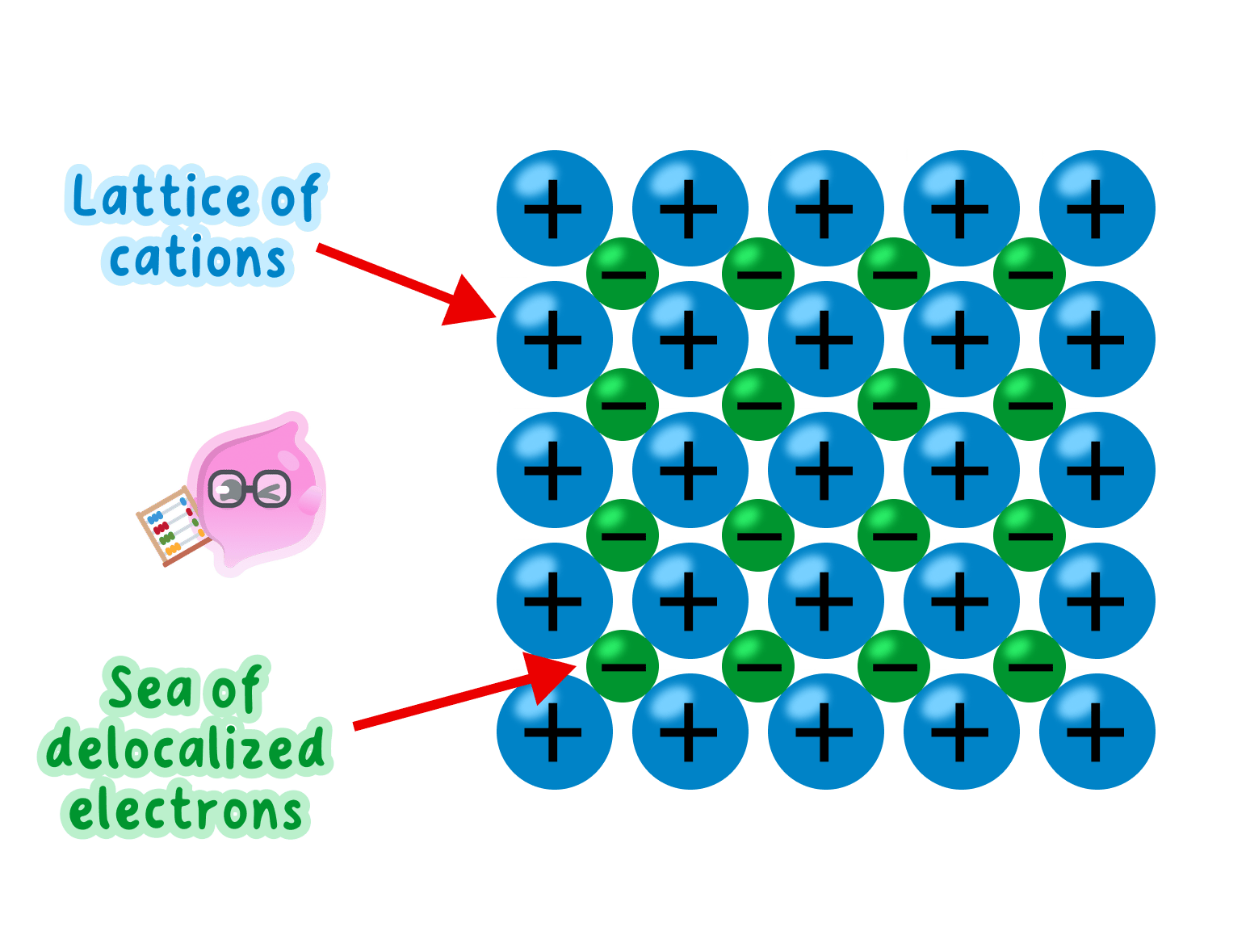
- Each atom gives up its outer electrons, leaving positive metal ions.
- The released electrons spread through the whole metal as a sea of electrons.
- This strong electrostatic attraction between positive ions and delocalised electrons is called metallic bonding.
- Ionic, giant covalent and metallic substances are giant structures, while simple molecules and polymers are made of separate molecules.
- Sodium chloride is made of ions held by ionic bonds in a giant lattice.
- Water is made of small molecules with covalent bonds inside them and weak intermolecular forces between them.
- Copper is made of positive ions in a sea of delocalised electrons.
Dot and cross diagrams show outer electrons
Dot-and-cross diagram
A diagram showing how the outer-shell electrons of atoms are transferred or shared when they bond.
- Electrons from one atom are drawn as dots and electrons from the other atom as crosses, so it is clear where each came from.
- For a binary ionic compound, draw the outer shell of each ion inside square brackets, with the charge written outside at the top right.
- In MgO\text{MgO}MgO, magnesium's two outer electrons appear as crosses in the outer shell of oxygen, giving [Mg]2+[\text{Mg}]^{2+}[Mg]2+ and [O]2−[\text{O}]^{2-}[O]2− with eight outer electrons.
- For a simple covalent molecule, draw the outer shells overlapping, with each shared pair of one dot and one cross inside the overlap.
- In H2O\text{H}_2\text{O}H2O, oxygen shares one pair with each hydrogen atom, leaving oxygen with two pairs of outer electrons that are not shared.
- Finish by counting the outer electrons around each atom to check that every outer shell is full.
- Draw a dot and cross diagram for methane, CH4\text{CH}_4CH4.
- Carbon, 2.42.42.4, has four outer electrons, drawn as dots, and each hydrogen atom has one electron, drawn as a cross.
- Draw the outer shell of carbon overlapping the shell of each of the four hydrogen atoms.
- Place one dot and one cross in each overlap, giving four shared pairs around the carbon atom.
- What is transferred in ionic bonding, and what is shared in covalent bonding?
- What holds the ions together in a sodium chloride lattice?
- How do the bonds within a water molecule compare with the forces between water molecules?
- What is a metallic bond?
- Where is the charge written on the dot and cross diagram of an ion?
2.2.3 Limitations of bonding models
Every representation of a substance is a model
Scientific model
A simplified representation used to show or explain selected features of something real.
- Chemists represent substances with dot and cross diagrams, displayed formulae, ball and stick models and space-filling models.
- Each representation is chosen to show one feature clearly, such as which electrons form a bond or how the atoms are arranged.
- No single model shows everything, because real particles are not balls, sticks or lines on paper.
- Knowing what a model leaves out helps you choose the right one and avoid false conclusions.
A limitation is anything real that a model cannot show, or shows wrongly.
Dot and cross diagrams show electrons, not shape
Dot-and-cross diagram
A diagram showing how the outer-shell electrons of atoms are transferred or shared when they bond.
- A dot and cross diagram shows which electrons are transferred or shared and which atom they came from.
- It is two-dimensional, so it cannot show the three-dimensional shape of a molecule.
- Methane is drawn flat, but its four hydrogen atoms really point away from the carbon atom in three dimensions.
- It does not show the relative sizes of atoms or ions.
- Electrons from different atoms are drawn differently, although all electrons are identical.
- For an ionic compound it shows one pair of ions rather than the giant lattice.
Do not read the dots and crosses as different kinds of electron, because the symbols only record which atom each electron came from.
Displayed formulae and ball and stick models show bonds
Displayed formula
A two-dimensional formula that shows every atom in a molecule and each bond between the atoms.
Ball-and-stick model
A three-dimensional representation in which spheres represent atoms and sticks represent bonds.
- A displayed formula makes it easy to see which atoms are bonded to which.
- It is flat, so the bonds appear at right angles even though real molecules are three-dimensional.
- It does not show the electrons in each bond or the outer electrons that are not shared.
- A ball and stick model shows the 3D shape of a molecule much better.
- Its sticks suggest large gaps between atoms and make bonds look like solid rods, whereas bonded atoms are really very close together.
- The balls are often the wrong relative sizes, and the electrons are not shown at all.
In a ball and stick model of sodium chloride, the sticks wrongly suggest bonds between fixed pairs of ions, when each ion is really attracted to all six ions around it.
Space-filling and lattice diagrams hide the bonding
- A space-filling model shows the atoms touching at roughly their correct relative sizes.
- It shows the overall shape of a molecule well, but the bonds and bond angles are hard to see.
- A lattice diagram of sodium chloride shows how the ions repeat in three directions.
- It shows only a tiny part of the lattice, which really continues in every direction for millions of ions.
- A diagram of a metal shows positive ions in a sea of electrons, but it cannot show the electrons moving.
- When a question asks for a limitation of a model, say what the model shows wrongly or leaves out and then what the real substance is like.
- Choose a limitation that fits the model in the question, such as the flat shape of a displayed formula or the gaps between atoms in a ball and stick model.
- What does a dot and cross diagram show well?
- Give two limitations of a dot and cross diagram of methane.
- Why does a displayed formula give a misleading picture of bond angles?
- What false impression do the sticks in a ball and stick model give?
- Why does a diagram of a sodium chloride lattice show only part of the structure?
2.2.4 Reactivity, atomic number and the modern Periodic Table
Same outer electrons make group elements react similarly
Reactivity
How readily an element takes part in chemical reactions.
- Chemical reactions involve the outer electrons of atoms, which are lost, gained or shared.
- Atoms in the same group have the same number of outer electrons, so they react in similar ways.
- Lithium, sodium and potassium each have one outer electron, and all react with water to give hydrogen and an alkaline solution.
- The atomic number fixes the number of electrons, so it also fixes the electron arrangement and the way an element reacts.
- Group 0 elements have full outer shells, so they have no tendency to lose, gain or share electrons and are very unreactive.
Fluorine, 2.72.72.7, and chlorine, 2.8.72.8.72.8.7, each need one more electron to fill the outer shell, so both react with sodium to form compounds with the same ratio, NaF and NaCl.
Elements near period ends lose or gain electrons
- Atoms with one or two outer electrons, in Groups 1 and 2, react by losing them to form positive ions.
- Atoms with six or seven outer electrons, in Groups 6 and 7, react by gaining electrons to form negative ions.
- This is why elements from opposite sides of the table, such as sodium and chlorine, react vigorously with each other.
- Elements with four outer electrons, such as carbon, tend to share electrons instead.
An element's position gives its number of outer electrons, which predicts whether it will lose, gain or share electrons in a reaction.
Mendeleev ordered by atomic mass but grouped by properties
Relative atomic mass
The average mass of an atom of an element compared with one-twelfth of the mass of a carbon-12 atom.
- In 1869, Dmitri Mendeleev arranged the 60 or so elements then known in order of increasing atomic mass.
- He placed elements with similar properties in the same columns, even when this broke the mass order.
- He put iodine after tellurium so that it sat with the other halogens, although iodine has the lower atomic mass.
- He left gaps for elements that had not yet been discovered.
- He predicted the properties of the missing elements, and when gallium and germanium were found their properties closely matched his predictions.
Mendeleev predicted that an element below silicon would have an atomic mass of about 727272 and a white oxide, and germanium, discovered in 1886, has an atomic mass of 72.672.672.6 and forms a white oxide.
Ordering by atomic number explains Mendeleev's swaps
Periodic Table
A chart of the elements in which elements with similar properties are placed in the same column.
- In 1913, Henry Moseley showed that each element has its own atomic number, which was later explained as the number of protons in its nucleus.
- Ordering by atomic number puts tellurium, 525252, before iodine, 535353, with no swap needed.
- Atomic masses can run out of order because of isotopes, since an element with many heavier isotopes has a higher average mass.
- Atomic number also sets the electron arrangement, which explains why elements in a group behave alike.
- The noble gases, unknown to Mendeleev in 1869, fitted in as a whole new group, Group 0.
When a question asks how Mendeleev's table was refined, link the change to atomic number and give a pair such as tellurium and iodine as evidence.
- Why do elements in the same group react in similar ways?
- Why are Group 0 elements unreactive?
- How did Mendeleev order the elements, and why did he leave gaps?
- Why did Mendeleev place iodine after tellurium even though iodine has the lower atomic mass?
- What property is the modern Periodic Table ordered by?
