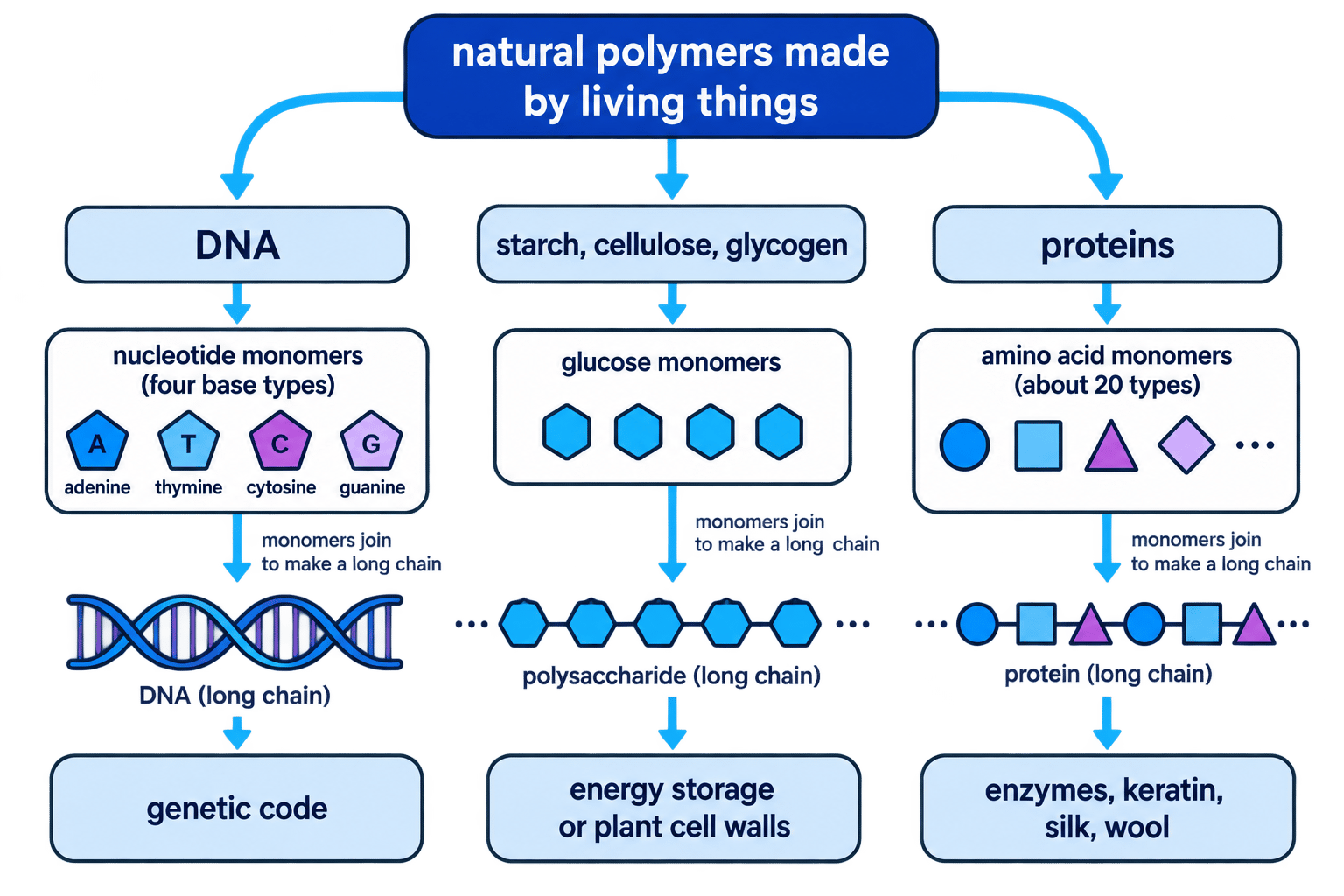
Natural polymers are long chains of small monomers
Polymer
A substance made of very long molecules built from many repeating units joined by covalent bonds.
Monomer
A small molecule that can join with many other molecules to form a polymer.
- A natural polymer is made inside living things from many small monomer molecules joined by covalent bonds.
- The monomers join end to end into long chains, which can contain thousands of units.
- Natural polymers fall into three families according to their monomers.
- DNA is built from nucleotides.
- Starch and cellulose are built from sugars.
- Proteins are built from amino acids.
Like synthetic polymers, natural polymers are long chains of monomers, but living organisms make them.
DNA is a polymer made from four different nucleotides
Nucleotide
One of the four different monomers that join together in long chains to form DNA.
- DNA, or deoxyribonucleic acid, is found in the cells of every living organism and carries its genetic code.
- Its monomers are nucleotides, and there are four different types.
- Each nucleotide contains a sugar, a phosphate group and one of four bases.
- The bases are adenine, thymine, cytosine and guanine, so the four nucleotides are often labelled A, T, C and G after their four bases.
- A DNA molecule contains millions of nucleotides joined in two strands, which twist into a double helix.
- The order of the nucleotides along the chain stores the information for making proteins.
Do not say that DNA contains only four nucleotides, because it contains millions of nucleotides of four different types.
Starch, cellulose and glycogen are polymers of sugars
Glucose
A simple sugar made by plants in photosynthesis, which is the monomer of starch, cellulose and glycogen.
- Plants make the sugar glucose by photosynthesis.
- Plants join glucose molecules into long chains of starch, which stores energy in foods such as potatoes, rice and wheat.
- Glucose also forms cellulose, the tough polymer in plant cell walls.
- Cotton and paper are mostly cellulose, so a cotton T-shirt is made of a natural polymer.
- Animals store glucose as glycogen, a polymer found in the liver and muscles.
- Starch and cellulose are both made from glucose, but the glucose units are linked differently, which gives them very different properties.
Bread tastes sweeter the longer you chew it, because an enzyme in saliva breaks its starch back down into sugar.
Proteins are natural polymers built from amino acids
Amino acid
A small molecule that acts as a monomer, joining with others in chains to form proteins.
- Proteins are long chains of amino acids joined together.
- There are about 20 different amino acids in the proteins of living things.
- The order of the amino acids decides the shape of each protein and so the job it does.
- Enzymes are proteins that act as biological catalysts, such as amylase in saliva.
- Hair and nails are made of the protein keratin, and silk and wool are also proteins.
- The body digests proteins in food back into amino acids, then joins them in new orders to build its own proteins.
- When a question names a natural polymer, match it to its monomer: DNA to nucleotides, starch and cellulose to sugars, and proteins to amino acids.
- When it asks how many different monomers DNA is made from, the answer is four.
- What are the monomers of DNA called?
- How many different nucleotides make up DNA?
- Which sugar is the monomer of starch and cellulose?
- What type of monomer joins to make a protein?
- Name one natural polymer found in plants and one found in hair.