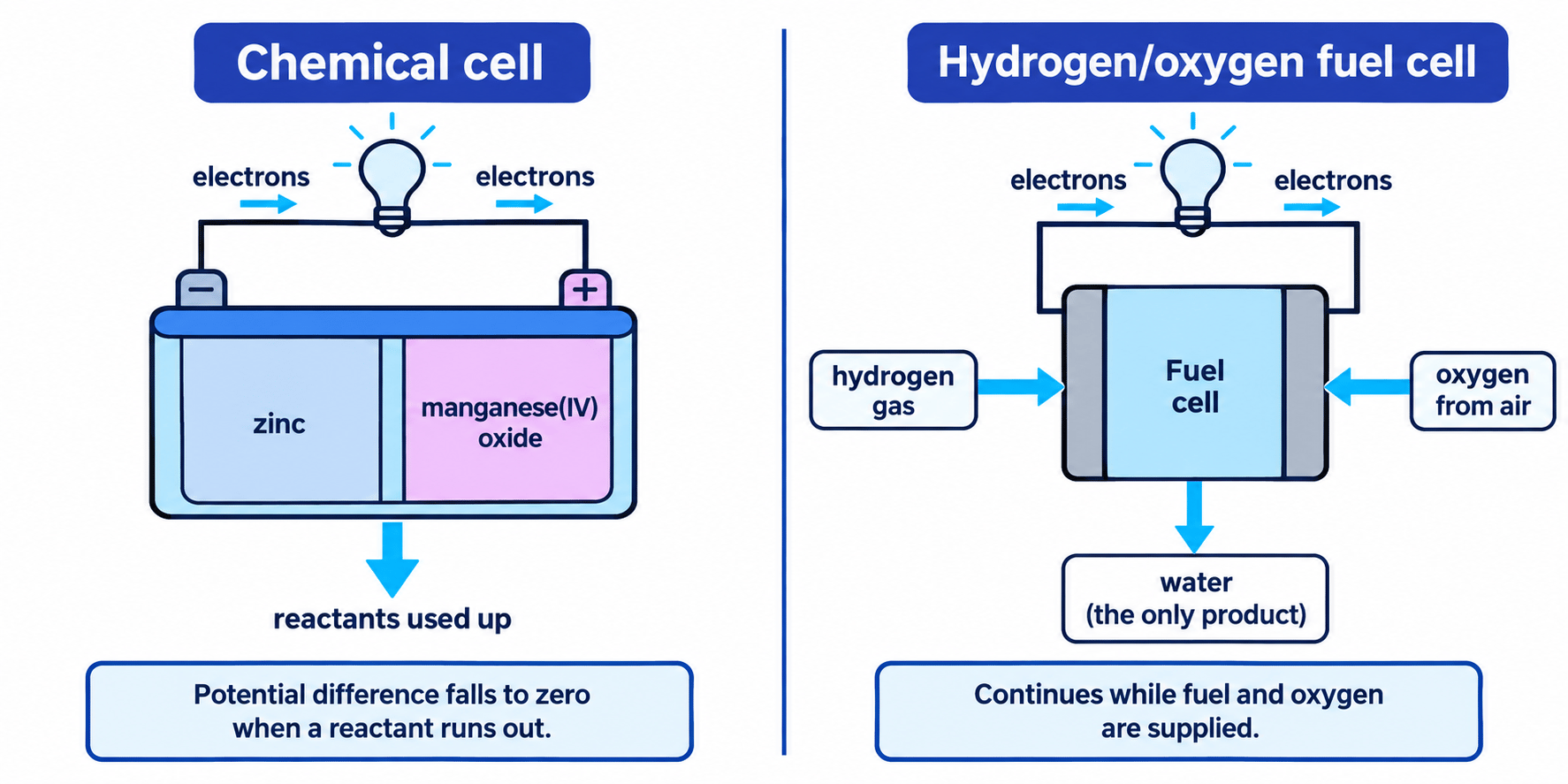
Chemical cells work until their reactants run out
Chemical cell
A device in which a reaction between stored reactants produces a potential difference until those reactants are used up.
- Inside a cell, a chemical reaction pushes electrons around the external circuit, producing a potential difference.
- An everyday cell, such as an AA battery, contains a fixed amount of reactants sealed inside it.
- An alkaline AA cell reacts zinc with manganese(IV) oxide to give about 1.5 V1.5\,\text{V}1.5V.
- As the cell is used, its reactants are used up, and once one runs out the potential difference falls to zero and the cell is flat.
- A rechargeable cell can be recharged by passing a current through it, which reverses the reaction and remakes the reactants.
A TV remote stops working when its cells go flat, because the zinc or the manganese(IV) oxide inside them has been used up.
Fuel cells run while fuel and oxygen are supplied
Fuel cell
A cell that produces a potential difference from the reaction of a fuel with oxygen, both supplied continuously from outside the cell.
- Fuel and oxygen, usually from the air, are fed into a fuel cell continuously from outside.
- The products are removed as they form, so the cell does not run flat while the supply continues.
- In a hydrogen/oxygen fuel cell, hydrogen reacts with oxygen to form water: 2H2+O2→2H2O2\text{H}_2 + \text{O}_2 \rightarrow 2\text{H}_2\text{O}2H2+O2→2H2O
- This is the same overall reaction as burning hydrogen, but the energy is transferred directly as electrical energy rather than as heat in a flame.
- Fuel cells therefore waste less energy as heat, so they are more efficient than engines that burn fuel.
A chemical cell stores its reactants and runs out, while a fuel cell has its reactants supplied and runs for as long as the supply lasts.
Hydrogen fuel cells give off only water
- The only product is water, so no carbon dioxide is released at the point of use.
- They also release no nitrogen oxides or soot particles, which petrol and diesel engines give out.
- Fuel cells convert more of the energy in their fuel into electrical energy than a petrol or diesel engine does.
- They have no moving parts, so they are quiet and need less maintenance.
- A hydrogen car can be refuelled in a few minutes, much faster than most battery cars can be recharged.
- A hydrogen tank and fuel cell are lighter than batteries storing the same energy, which suits long journeys and heavy vehicles.
London has run hydrogen fuel cell buses on some routes, where the only exhaust is water vapour.
Hydrogen is hard to store and often fossil-based
- Hydrogen is a very flammable gas, so leaks can cause explosions.
- Hydrogen gas takes up a large volume, so it is stored in heavy high-pressure tanks.
- There are few refuelling stations, so hydrogen vehicles cannot yet travel everywhere.
- Most hydrogen is made from natural gas or other hydrocarbons, a process that releases carbon dioxide.
- Hydrogen can also be made by the electrolysis of water, but this needs a lot of electricity, which may come from burning fossil fuels.
- Only hydrogen made using renewable electricity, such as wind or solar power, gives a fuel cell very low carbon emissions overall.
- Fuel cells are expensive, partly because they use a platinum catalyst.
Do not call a hydrogen fuel cell pollution free, because making, compressing and transporting the hydrogen can all release carbon dioxide.
Weighing benefits and drawbacks when choosing a fuel cell
- Other fuel cells use fuels such as methanol, a liquid alcohol.
- Methanol is easier to store and carry than hydrogen, because it is a liquid at room temperature.
- Methanol contains carbon, so a methanol fuel cell releases carbon dioxide as well as water: 2CH3OH+3O2→2CO2+4H2O2\text{CH}_3\text{OH} + 3\text{O}_2 \rightarrow 2\text{CO}_2 + 4\text{H}_2\text{O}2CH3OH+3O2→2CO2+4H2O
- Methanol is toxic and flammable, so its cartridges must be sealed and handled safely.
- For a given use, compare the emissions, efficiency, fuel storage, cost and safety of each option.
- A hydrogen fuel cell suits a city bus that returns to one depot each night, where a single hydrogen supply can refuel the whole fleet.
- A methanol fuel cell suits a remote sensor or a camping power pack, where a small liquid cartridge is easier to carry than a gas cylinder.
- When a question asks you to evaluate a fuel cell for a use, give at least one advantage and one disadvantage that relate to that use.
- Finish with a conclusion that says whether the fuel cell is a good choice for that use and why.
- Why does a chemical cell stop producing a potential difference?
- What must be supplied to a fuel cell to keep it working?
- What is the overall equation for the reaction in a hydrogen/oxygen fuel cell?
- Give one advantage and one disadvantage of hydrogen fuel cell cars.
- Why does a methanol fuel cell release carbon dioxide?