Addition polymerisation joins alkene monomers through double bonds
Definition
Addition polymerisation
A reaction in which many monomers containing a carbon to carbon double bond join together to form a polymer as the only product.
Definition
Monomer
A small molecule that can join with many other molecules to form a polymer.
- Addition polymerisation needs monomers with a C=C\text{C}=\text{C}C=C double bond, which is the functional group of the alkenes.
- At high pressure and with a catalyst, one bond in each double bond breaks.
- Each opened monomer then forms new single bonds to the monomers on either side of it.
- Thousands of monomers join in this way to make one very long polymer chain.
- The polymer is the only product, so every atom from the monomers ends up in the polymer.
- The polymer is named by putting the monomer's name in brackets after poly, so ethene forms poly(ethene).
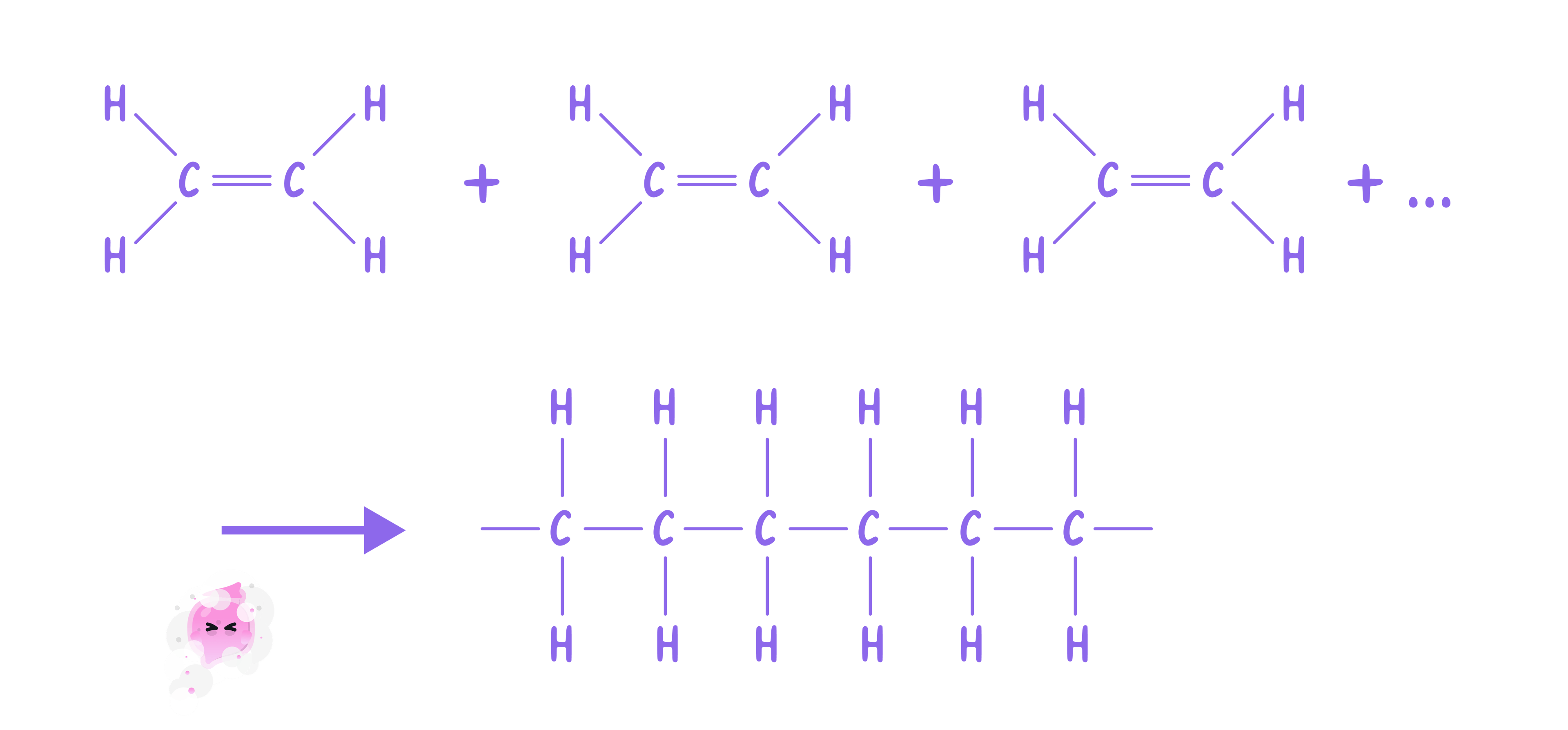
Key Idea
Addition polymerisation keeps every atom of the monomer and changes only the double bond, which becomes a single bond in the chain.
Repeating units have the monomer's atoms but single bonds
Definition
Repeating unit
The section of a polymer chain that is repeated over and over to make up the whole molecule.
- In poly(ethene), the unit that repeats contains two carbon atoms and four hydrogen atoms, like one ethene molecule.
- The double bond of the monomer becomes a single bond in the repeating unit.
- A bond sticks out from each end carbon atom through the brackets, to show that the unit joins to identical units on either side.
- The letter nnn after the brackets stands for a large number of repeating units.
- The equation for making poly(ethene) is:
n CH2=CH2→[CH2−CH2]nn\,\text{CH}_2{=}\text{CH}_2 \rightarrow \left[\text{CH}_2{-}\text{CH}_2\right]_nnCH2=CH2→[CH2−CH2]n
- In displayed formulae: n HH∣∣C=C∣∣HH → [HH∣∣−C−C−∣∣HH]nn\; \begin{array}{ccc}\mathrm{H}&&\mathrm{H}\\\vert&&\vert\\\mathrm{C}&=&\mathrm{C}\\\vert&&\vert\\\mathrm{H}&&\mathrm{H}\end{array} \;\rightarrow\; \left[ \begin{array}{ccccc}&\mathrm{H}&&\mathrm{H}&\\&\vert&&\vert&\\-&\mathrm{C}&-&\mathrm{C}&-\\&\vert&&\vert&\\&\mathrm{H}&&\mathrm{H}&\end{array} \right]_nnH∣C∣H=H∣C∣H→−H∣C∣H−H∣C∣H−n
- The repeating unit and the monomer have the same molecular formula, C2H4\text{C}_2\text{H}_4C2H4 for ethene.
Common Mistake
Do not leave a C=C\text{C}=\text{C}C=C double bond inside the repeating unit, because the double bond is used up in making the chain.
Drawing a polymer from its monomer
- Draw the monomer with its two double-bonded carbon atoms side by side and the other groups above and below them.
- Change the double bond to a single bond.
- Add a bond sticking out from each of the two carbon atoms, then draw brackets across these bonds and write nnn after them.
- Keep every side group, such as CH3\text{CH}_3CH3 or Cl\text{Cl}Cl, on the same carbon atom as in the monomer.
- Chloroethene, CH2=CHCl\text{CH}_2{=}\text{CHCl}CH2=CHCl, forms poly(chloroethene), or PVC, which is used for window frames and pipes.
- Tetrafluoroethene, CF2=CF2\text{CF}_2{=}\text{CF}_2CF2=CF2, forms PTFE, the non-stick coating on frying pans.
- In displayed formulae: n FF∣∣C=C∣∣FF → [FF∣∣−C−C−∣∣FF]nn\; \begin{array}{ccc}\mathrm{F}&&\mathrm{F}\\\vert&&\vert\\\mathrm{C}&=&\mathrm{C}\\\vert&&\vert\\\mathrm{F}&&\mathrm{F}\end{array} \;\rightarrow\; \left[ \begin{array}{ccccc}&\mathrm{F}&&\mathrm{F}&\\&\vert&&\vert&\\-&\mathrm{C}&-&\mathrm{C}&-\\&\vert&&\vert&\\&\mathrm{F}&&\mathrm{F}&\end{array} \right]_nnF∣C∣F=F∣C∣F→−F∣C∣F−F∣C∣F−n
Example
- Draw the repeating unit of the polymer made from propene, CH2=CHCH3\text{CH}_2{=}\text{CHCH}_3CH2=CHCH3.
- Draw propene with the CH3\text{CH}_3CH3 group on one of the double-bonded carbon atoms: HH∣∣C=C∣∣HCH3\begin{array}{ccc}\mathrm{H}&&\mathrm{H}\\\vert&&\vert\\\mathrm{C}&=&\mathrm{C}\\\vert&&\vert\\\mathrm{H}&&\mathrm{CH}_3\end{array}H∣C∣H=H∣C∣CH3
- Change the double bond to a single bond and add a bond out from each of the two carbon atoms.
- Put brackets around the unit and write nnn: [HH∣∣−C−C−∣∣HCH3]n\left[ \begin{array}{ccccc}&\mathrm{H}&&\mathrm{H}&\\&\vert&&\vert&\\-&\mathrm{C}&-&\mathrm{C}&-\\&\vert&&\vert&\\&\mathrm{H}&&\mathrm{CH}_3&\end{array} \right]_n−H∣C∣H−H∣C∣CH3−n
Finding the monomer from a polymer
- Find the repeating unit, which in a simple addition polymer has two carbon atoms in the main chain.
- Remove the two bonds that stick out through the brackets.
- Put a double bond between the two carbon atoms, keeping every other atom and group where it was.
- Name the monomer by removing poly and the brackets from the name of the polymer, so poly(propene) comes from propene.
- Poly(chloroethene) has the repeating unit [HH∣∣−C−C−∣∣HCl]n\left[ \begin{array}{ccccc}&\mathrm{H}&&\mathrm{H}&\\&\vert&&\vert&\\-&\mathrm{C}&-&\mathrm{C}&-\\&\vert&&\vert&\\&\mathrm{H}&&\mathrm{Cl}&\end{array} \right]_n−H∣C∣H−H∣C∣Cl−n, so its monomer is chloroethene: HH∣∣C=C∣∣HCl\begin{array}{ccc}\mathrm{H}&&\mathrm{H}\\\vert&&\vert\\\mathrm{C}&=&\mathrm{C}\\\vert&&\vert\\\mathrm{H}&&\mathrm{Cl}\end{array}H∣C∣H=H∣C∣Cl
- In a long section of chain, the pattern repeats every two carbon atoms, so a chain of six carbon atoms contains three repeating units.
Exam technique
- When a question asks for the repeating unit, show the single bond, every side group and a bond through each bracket, and write nnn.
- When it asks for the monomer, check that your answer has a C=C\text{C}=\text{C}C=C double bond and no bonds left sticking out.
Self review
- Which functional group must a monomer have to form an addition polymer?
- Why is the polymer the only product of addition polymerisation?
- What happens to the double bond during addition polymerisation?
- What is the repeating unit of poly(ethene)?
- Which monomer forms PTFE?
