Question 51
FA student uses a titration to find the volume of dilute sulfuric acid that neutralises 25.0 cm3\mathrm{cm^{3}}cm3 of potassium hydroxide solution.
The student adds the acid from a burette. The student does a rough titration and then four more titrations.
The table shows the results.
| Titration | Final burette reading (cm3\mathrm{cm^{3}}cm3) | Initial burette reading (cm3\mathrm{cm^{3}}cm3) | Titre (cm3\mathrm{cm^{3}}cm3) |
|---|---|---|---|
| rough | 24.60 | 0.50 | 24.10 |
| 1 | 23.85 | 0.20 | 23.65 |
| 2 | ? | ? | ? |
| 3 | 24.25 | 0.30 | 23.95 |
| 4 | 23.70 | 0.10 | 23.60 |
a.[2]
The diagrams show the burette at the start and at the end of titration 2.
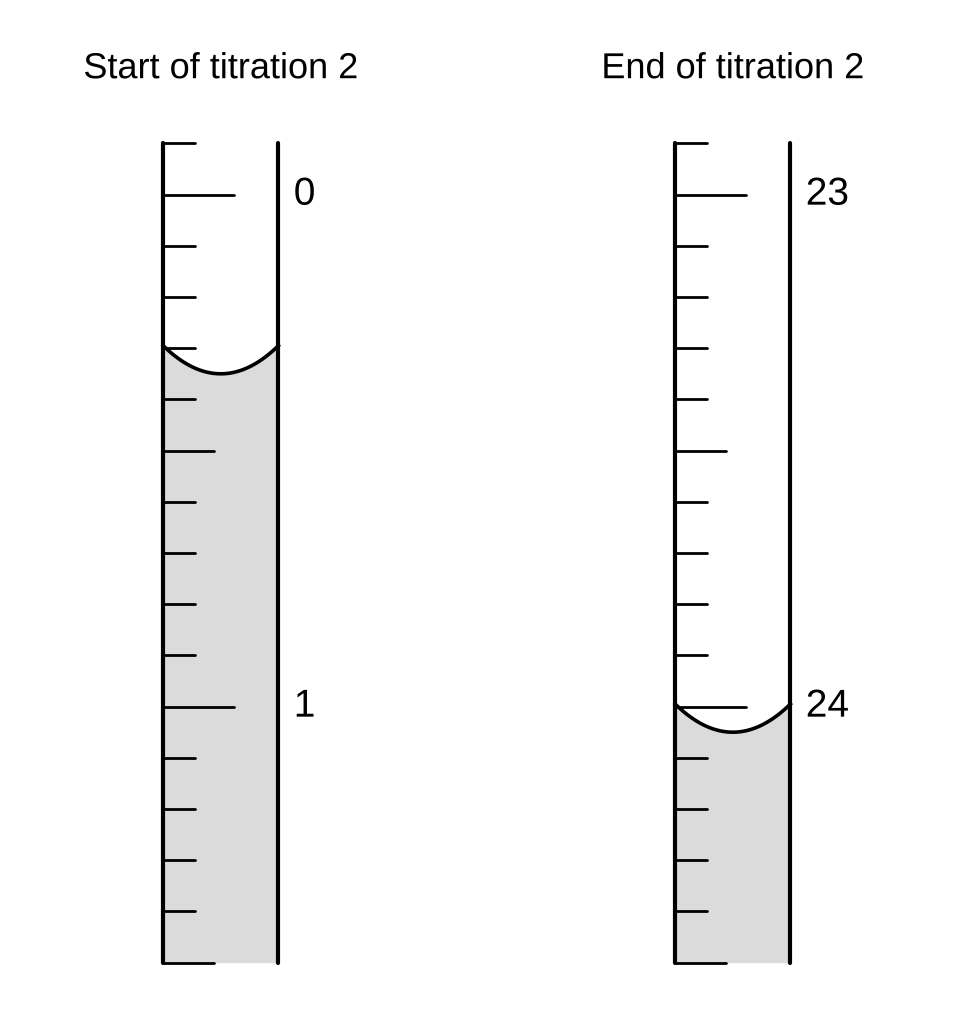
Write down the initial and final burette readings for titration 2. Then calculate the titre.
Initial reading = ...... cm3\mathrm{cm^{3}}cm3
Final reading = ...... cm3\mathrm{cm^{3}}cm3
Titre = ...... cm3\mathrm{cm^{3}}cm3
b.[1]
Explain why the student does a rough titration first.
c.[2]
Which titrations give concordant results?
Give a reason for your answer.
d.[2]
Calculate the mean titre. Use only the concordant results.
Give your answer to 2 decimal places.
Mean titre = ...... cm3\mathrm{cm^{3}}cm3
e.[1]
Suggest one mistake the student could have made in titration 3.
f.[2]
Before filling the burette, the student rinses it with a little of the sulfuric acid, not with water.
Explain why.
5.1 Monitoring chemical reactions Questions
152 exam-style questions on OCR GCSE Chemistry 5.1 Monitoring chemical reactions, covering 5.1.1 The technique of titration, 5.1.2 Theoretical mass, percentage yield and atom economy, 5.1.3 Concentration of a solution in mol/dm3, 5.1.4 Concentration calculations and titration results, 5.1.5 Molar gas volume and volumes of gases in reactions, and 5.1.6 Choosing a reaction pathway. Each one has a worked solution and a mark scheme showing where the marks go.