Question 2
FA student does a titration to find the volume of dilute hydrochloric acid that neutralises 25.0 cm3\mathrm{cm^{3}}cm3 of sodium hydroxide solution.
The diagram shows the apparatus the student uses.
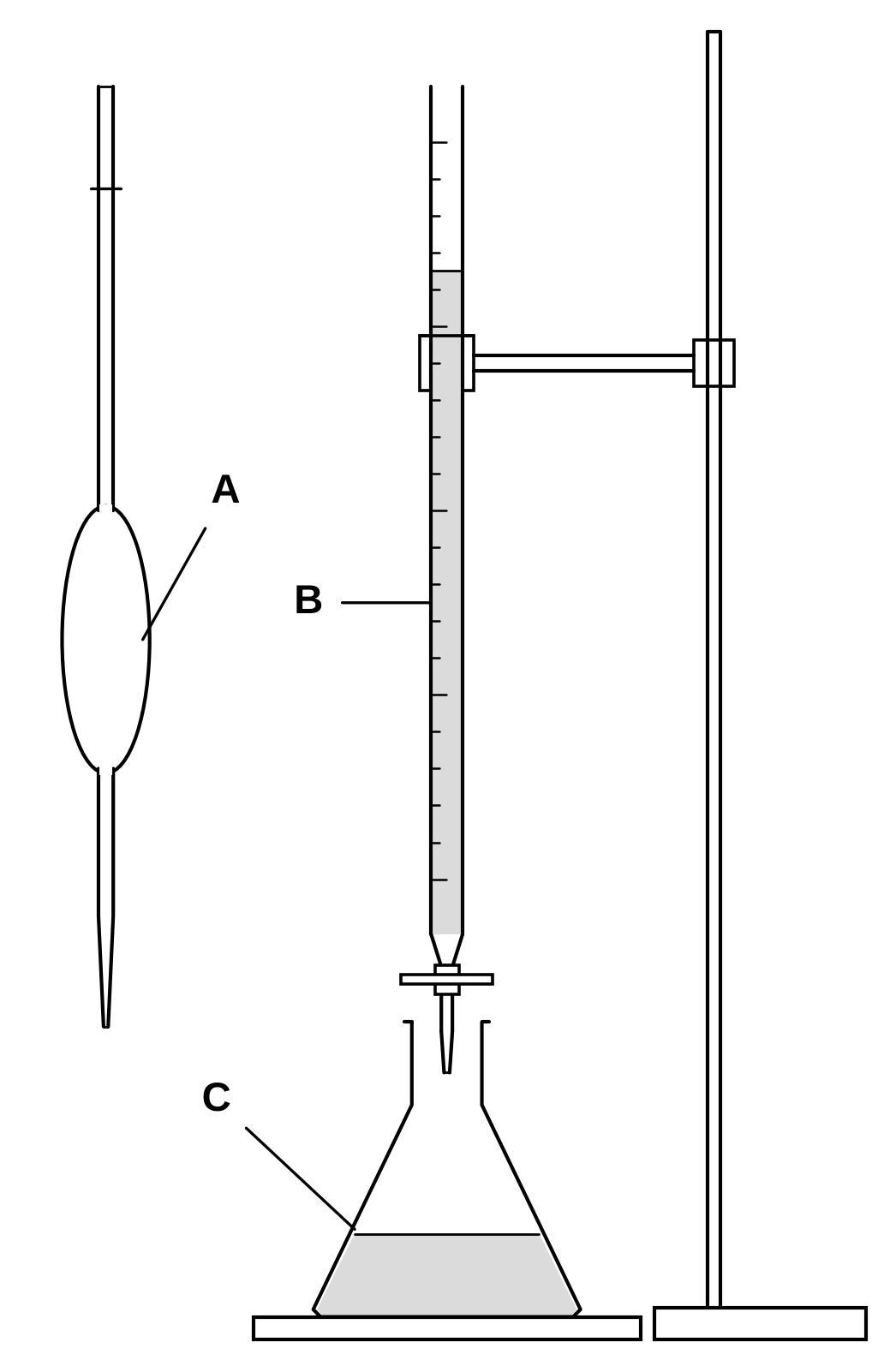
The student measures exactly 25.0 cm3\mathrm{cm^{3}}cm3 of sodium hydroxide solution using apparatus A and puts it into apparatus C. The student adds the hydrochloric acid from apparatus B.
a.[3]
Name the pieces of apparatus labelled A, B and C.
Use words from the list: beaker, burette, conical flask, measuring cylinder, pipette, test tube
A ......
B ......
C ......
b.[2]
The student adds a few drops of methyl orange indicator to the sodium hydroxide solution.
What colour is the methyl orange at the start of the titration and at the end point?
Start: ......
End point: ......
c.[1]
The student stands the flask on a white tile.
Explain why.
d.[2]
Describe two things the student should do while adding the acid so that the end point is found accurately.
e.[1]
The teacher tells the student not to use universal indicator for a titration.
Explain why.
5.1 Monitoring chemical reactions Questions
57 exam-style questions on OCR GCSE Chemistry 5.1 Monitoring chemical reactions, covering 5.1.1 The technique of titration, 5.1.2 Theoretical mass, percentage yield and atom economy, 5.1.3 Concentration of a solution in mol/dm3, 5.1.4 Concentration calculations and titration results, 5.1.5 Molar gas volume and volumes of gases in reactions, and 5.1.6 Choosing a reaction pathway. Each one has a worked solution and a mark scheme showing where the marks go.